

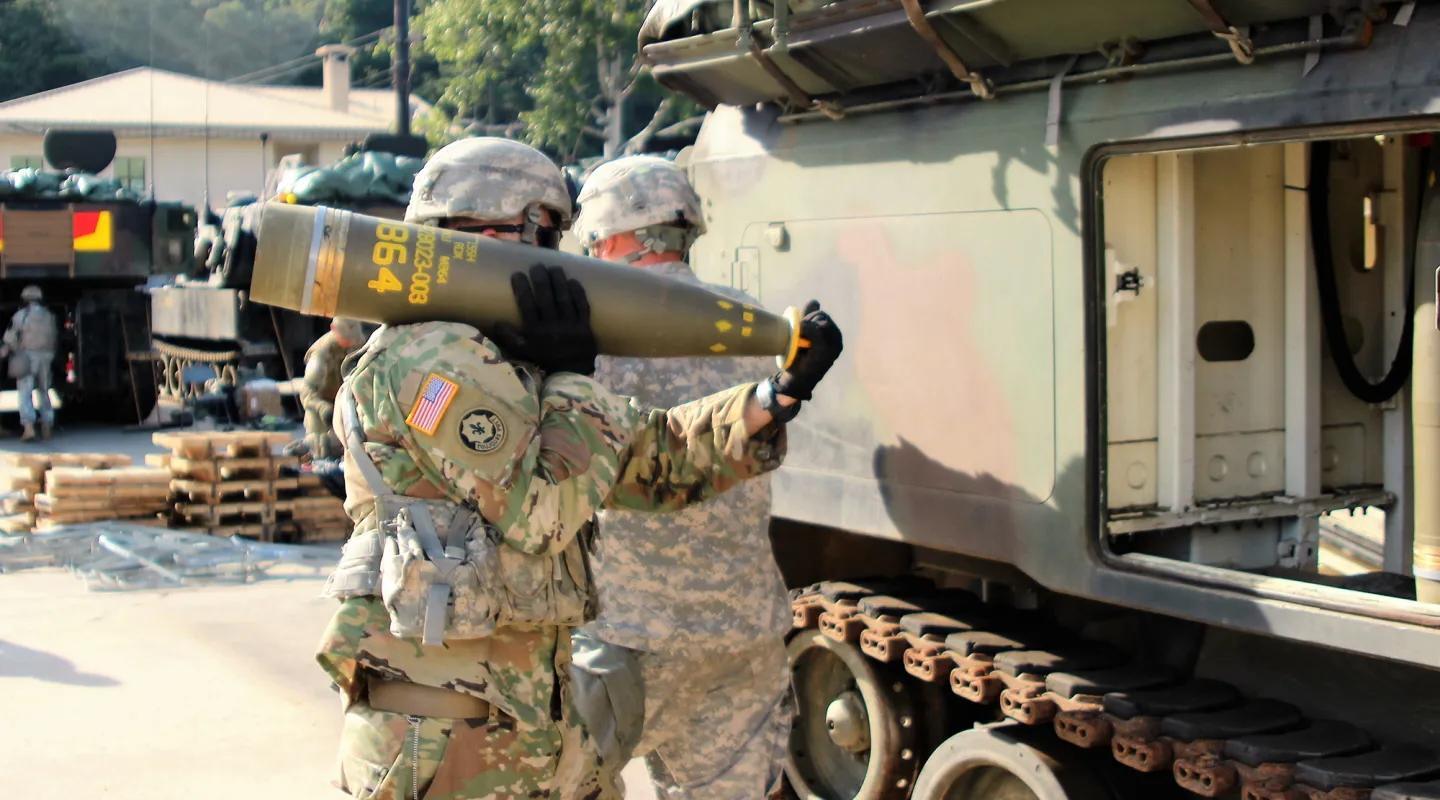
A coalition of human rights organizations, anti-war groups, and Christian churches are urging the U.S. to cancel its $210 million purchase of next-generation cluster munitions from an Israeli state-owned company, citing the “severe, foreseeable dangers” these weapons pose to civilians.
In an open letter shared exclusively with RS, the organizations write that cluster munitions “disperse submunitions across broad areas, making it exceedingly difficult to confine their impact to lawful military targets.” By expanding its cluster munitions stockpiles, the U.S. is putting itself “dramatically out of step with civilian protection practices,” the groups argue.
“These weapons’ humanitarian impacts vastly outweigh any possible tactical benefit that they provide,” said Ursala Knudsen-Latta of the Friends Committee on National Legislation, which signed the letter. “Unfortunately, it is really sowing seeds of terror for generations to come anywhere they are used.”
The purchase, first reported by the Intercept earlier this month, represents the latest step in the unraveling of an international consensus against the use or stockpiling of cluster munitions. Years of advocacy, fueled by research showing the long-term dangers of unexploded bomblets left behind after conflict, culminated in the widespread adoption of an anti-cluster munitions treaty in 2010.
The U.S. military stopped using cluster munitions in its own operations back in 2009, and American companies haven’t produced the weapons in years. But Washington never opted to join the treaty or destroy its existing stockpile. (Notably, Russia and China also refused to sign the convention.)
This choice proved consequential. When Russia invaded Ukraine and used cluster munitions of its own, the Biden administration decided to arm Kyiv with the controversial weapons, arguing that they would be “useful especially against dug-in Russian positions.” The move appeared to violate U.S. law, which prohibits the transfer of bombs with a “dud rate” above 1%. But Congress failed to block the initiative, and Ukraine began fielding the weapons in 2023.
In the intervening years, an increasing number of states have expressed interest in using the weapons, including Lithuania, which withdrew from the anti-cluster munitions treaty in 2025. “We're deeply concerned that the U.S. continuing to participate in the use of these weapons will only encourage more allies to do the same,” Knudsen-Latta told RS.
Signatories to the open letter include Human Rights Watch, Amnesty International USA, the United Methodist Church, the Arms Control Association, the Center for Civilians in Conflict (CIVIC), the Center for International Policy, and the Quincy Institute, which publishes RS.
The Defense Department did not respond to a request for comment about how it intends to use its new cluster munitions.
The purchase appears to be part of a broader expansion in the use or stockpiling of cluster munitions by the U.S. military. Late last year, Army Contracting Command solicited bids for new contracts to make the next-generation XM1208 cluster munition, with the stated goal of establishing capacity for producing the weapons within the United States. The new cluster munitions will give U.S. soldiers a capability to “effectively engage imprecisely located enemies within an area,” the notice said, adding that contractors must be able to manufacture at least 30,000 XM1208 rounds per year.
The 155mm artillery shells, produced for now by the Israeli state-owned company Tomer, are made up of nine “bomblets,” each of which contains 1,200 shards of tungsten. Military contractors say the weapons are less dangerous than their predecessors because they include failsafes that keep the dud rate below 1% in testing conditions.
But weapons analysts are skeptical of these safety claims. “What you often see is that in different practice scenarios, the dud rate can vary pretty wildly depending on how and where cluster munitions are used,” John Ramming Chappell of CIVIC said, adding that contractors often test the munitions in computer simulations or under ideal conditions.
In practice, the failure rate is often much higher. The U.S. historically sought to keep dud rates to a maximum of 2%, but when Israel used a previous generation of American cluster munitions in Lebanon in 2006, roughly 40% of bomblets failed to explode on impact, leaving behind thousands of hidden explosives, according to the United Nations. (There is some evidence that Israel has used the XM1208 in its latest war with Hezbollah, but the practical dud rate of the munition has not been revealed.)
Ramming Chappell hopes that Congress will seek to step in and stop the Defense Department’s increasing embrace of cluster munitions. A bipartisan group of 178 House members voted against transferring cluster munitions to Ukraine in 2023, and there’s reason to believe these lawmakers would also scrutinize American use of the weapons.
“I would expect that we'd see potential questions from Congress about why the United States is moving forward with this transfer and what it intends to do with the cluster munitions it's purchasing,” Ramming Chappell said.