

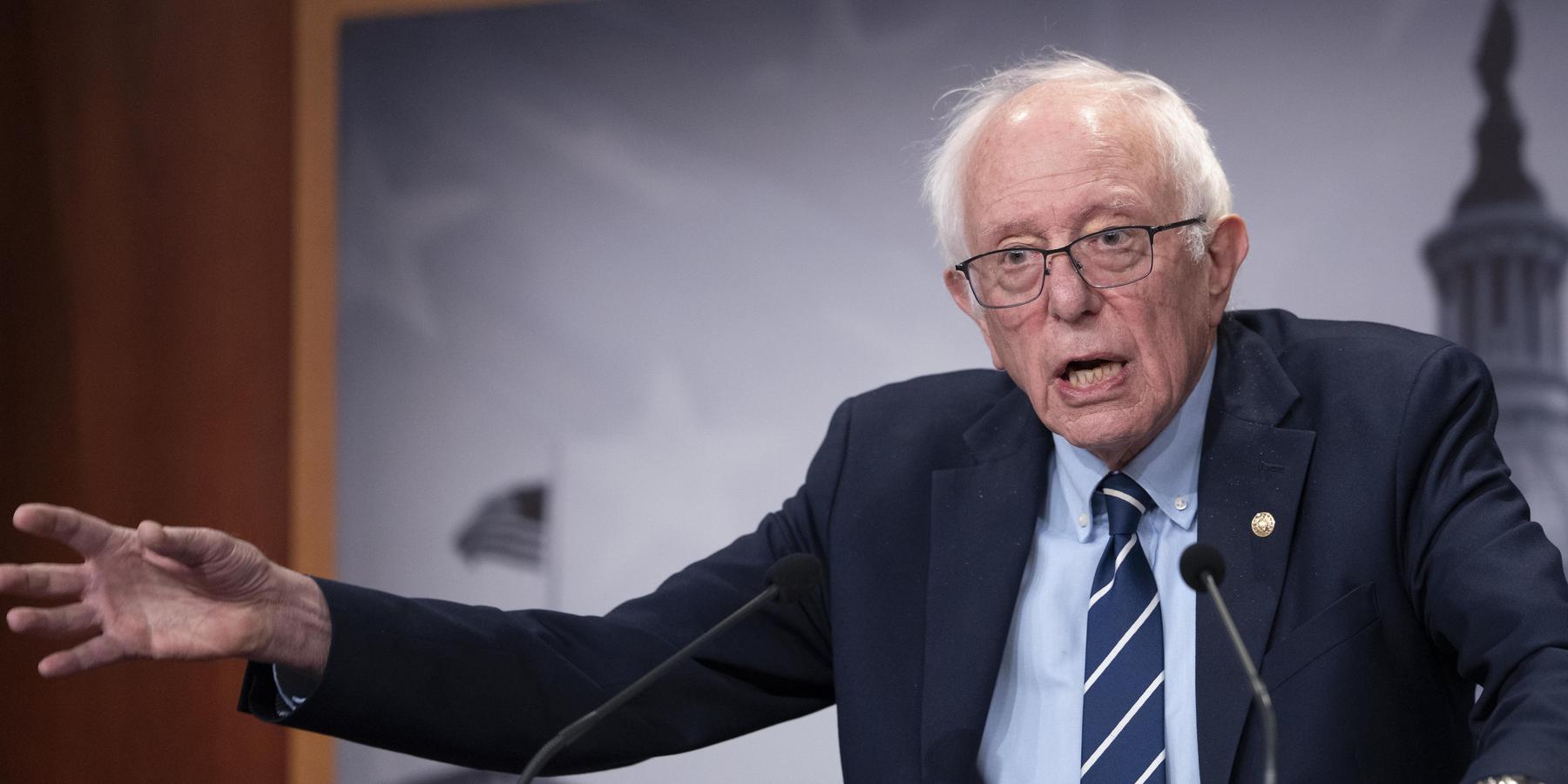
During a Wednesday night event at the Capitol, Sen. Bernie Sanders (I-Vt.) urged the U.S. and China to cooperate on AI regulation, warning that continued competition could lead humanity to “lose control” of the rapidly developing technology.
“We need international cooperation between the nations of the world to prevent the possibility of a cataclysmic development,” Sanders said, flanked on either side by leading AI scientists from the U.S. and China. “We need to cooperate. We need dialogue.”
The event, largely attended by Hill staffers and progressive activists, contrasted sharply with the prevailing mood in D.C., where China has in recent years become a dirty word. Treasury Secretary Scott Bessent channeled this sentiment in a post ahead of the event, slamming Sanders for “inviting foreign nationals to tell the United States how to regulate AI.”
“The real threat to AI safety is letting any nation other than the United States set the global standard,” Bessent argued.
But the possible existential risk of AI is increasingly becoming a concern both on the left and within the MAGA right. Former Trump whisperer Steve Bannon has been particularly influential on this point, calling AI one of the “most dangerous technologies in the history of mankind.” Sens. Josh Hawley (R-Mo.) and Marsha Blackburn (R-Tenn.), for their part, have introduced legislation that would restrict the use of AI in fields like medicine and banking.
Still, Sanders is at the moment the only prominent politician calling for serious international cooperation to deal with the risk, which the assembled AI scientists framed in apocalyptic terms. By their lights, racing with China to create superintelligence — meaning an AI that outperforms humans on all tasks — is suicidal.
“We're talking about basically summoning an alien species, and one that is much smarter than us and can do things that we have not been able to even conceive of,” said David Krueger, an AI researcher and professor at the University of Montreal. “At that point, it would be very difficult for humans to maintain any relevance in society.” Krueger estimates that AI labs, at their current pace, could develop superintelligence within the next five years.
Xue Lan, an AI professor at Tsinghua University, lamented that the international community has been “not very effective” in dealing with the threats of AI, including both existential risks and the possibility of rapid job loss.
Despite the doom and gloom of the event, the panelists expressed hope that the upcoming summit between President Donald Trump and Chinese President Xi Jinping could yield some progress on this issue. “I was surprised and delighted to see, apparently, that as part of their agenda, there is going to be some discussion of AI safety,” Sanders said. “I think that’s a good start.”
- Why China is playing it cool amid Trump's chaos ›
- Forget regs, AI CEOs got a need for speed to 'beat China' ›
- Is all this AI doomsaying distracting us from the real threat? | Responsible Statecraft ›