

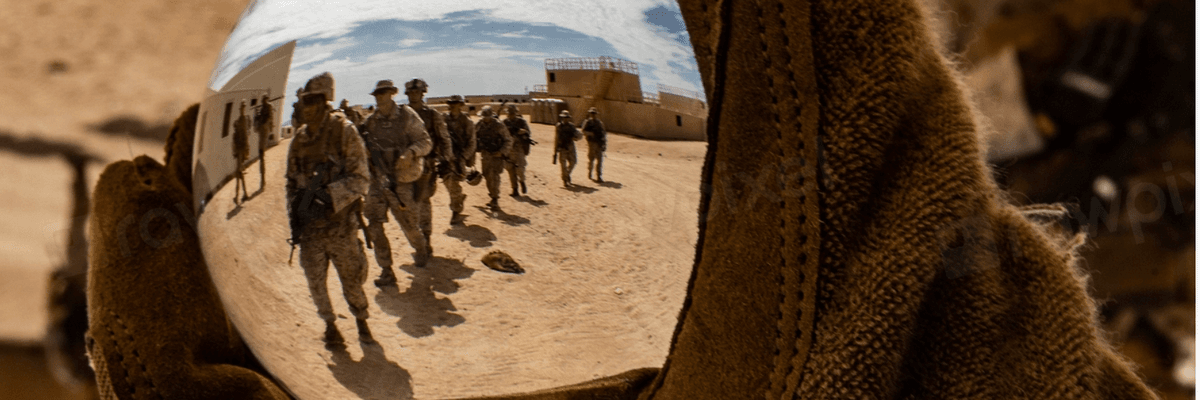
In RS this morning, Jennifer Kavanagh provided an excellent contribution assessing the limitations of the operational concepts applied by the U.S. military against Iran to a future great power war with China. Kavanagh concludes that the vulnerability of U.S. forward bases highlighted during the Iran war may render them obsolete.
This argument, while useful, goes too far. Kavanagh’s conclusion overstates the severity of U.S. bases’ vulnerability, neglects the effective countermeasures the U.S. can take to increase their survivability, and downplays the fundamental importance of proximity in conducting effective military operations.
Were U.S. forward bases in the Middle East vulnerable? Yes, absolutely. They took significant incoming fire and sustained serious damage. Did Iran’s targeting prevent the U.S. from conducting offensive military operations at those bases? No. While some troops were relocated from forward U.S. bases during the war, these were primarily support and command staff rather than units directly involved in attacking Iran.
Vulnerability is, historically, inherent to conducting operations at forward military bases. The sanctuary-like nature of most of our forward bases during the post–Cold War period is a historical anomaly reflective of U.S. unipolarity. In World War II and Vietnam, for example, sustained incoming fire directed at U.S. forward operating bases was a perpetual challenge. Henderson Field on Guadalcanal was the recipient of constant Japanese artillery and even naval gunfire throughout the six-month-long American campaign to retake the Pacific island. At Khe Sanh, North Vietnamese artillery literally trailed U.S. supply planes while they landed and took off at the air base. Still, U.S. operations continued to operate effectively at both locations.
For years, the Pentagon has neglected to spend money on hardening many of the U.S. bases in the Middle East despite the clear need — and calls — to do so. As a result, these bases were more vulnerable than should be the case. Moreover, many of the assets Iran successfully hit, including THAAD radars, for example, are not structurally fortified and possess no form of active defense. Still, the successful interception rates of Iranian drones and missiles were consistently high, and the damage sustained was far less significant than what many feared (and what the Iranians claimed they were capable of).
U.S. forward bases in the Western Pacific are similarly vulnerable to incoming fire from a far more lethal and effective Chinese missile force. However, the services are well aware of this issue, and there is significant pressure to harden critical assets on those bases to ensure that they remain operational while taking incoming fire. Still, progress remains slow on this front, and the Iran war should serve as a reminder of the need to invest in these efforts.
Kavanagh is right that we can no longer rely on one or two large bases to freely conduct operations. Again, however, this is why the Marine Corps, Navy, Army, and Air Force have all adopted operating concepts in which they emphasize dispersion. This is also why the U.S. is working to increase operational access at a large number of small and geographically distributed sites across the Western Pacific, from Peleliu in the Palaus to Itbayat in the northern Philippines and Tinian in the Northern Marianas.
Kavanagh is also right that there are significant drawbacks to conducting a war entirely at standoff distance, meaning that weapons are launched from outside the range of enemy fire. The U.S. failed to fully destroy Iran’s inventory of ballistic missiles, drones, anti-ship cruise missiles, and launchers precisely because it relied on employing a strategic air campaign at distance — an approach that historically, has faced stark limitations.
But that is why, despite their vulnerability, forward operating bases are so essential in order to conduct a strategy of denial, as would be needed to win a war over Taiwan. There is no alternative to proximity — for our sensors, targeting, employment of accurate and lethal fires, and the logistics necessary to sustain frontline forces. As INDOPACOM Commander Admiral Samuel Paparo has stated, the emphasis is therefore on ensuring the survivability and operational effectiveness of that forward force “under fire.”
As Kavanagh rightly pointed out, that forward presence will look remarkably different from the legacy expeditionary force that developed during the post–Cold War period, which could rely on uncontested access and power projection in Eurasia’s littorals. While there has been some progress in adapting, particularly with the Marine Corps, other services, despite their awareness of this problem, are moving far too slowly in modifying their force design.
- Iran killed any delusions of US military domination over China ›
- How massive US footprint in the Gulf became a bullseye overnight ›