

For decades, U.S. policy toward the Middle East has revolved around a simple premise: the forward deployment of U.S. military power would deter adversaries — chiefly Iran — and, if necessary, defend host states from attack. Today, that premise is increasingly difficult to sustain.
A series of Iranian strikes and threats against critical infrastructure has underscored a widening gap between the promise of protection and the reality of exposure. Far from insulating Persian Gulf states, the U.S. military presence has contributed to their vulnerability.
The persistence of this security model reflects institutional inertia rather than strategic effectiveness. To understand why, it is necessary to examine both the structure of U.S. basing in the Gulf and the empirical record of its performance. More importantly, we must ask whether, and how, this model can be replaced.
The limits of forward deployments
The United States maintains a dense network of military facilities across the Gulf, each with distinct operational roles but a shared strategic purpose that dates back to the Cold War: deterring Russia (and now China), projecting power, and maintaining influence over natural resources like oil and natural gas.
The U.S. Navy’s Fifth Fleet is headquartered at the Naval Support Activity in Bahrain, a critical hub for maritime operations in the Persian Gulf and its surrounding waters. Al Udeid Air Base in Qatar is the largest U.S. military facility in the region, serving as the forward headquarters for U.S. Central Command and a key node for air operations.
The United Arab Emirates hosts Al Dhafra Air Base, an aviation hub that supports intelligence, surveillance, and reconnaissance missions, as well as advanced fighter deployments. Kuwait hosts the largest number of U.S. bases in the region, including Camp Arifjan, Camp Buehring, Ali Al Salem Air Base, and Ahmad al-Jaber Air Base, with roughly 13,500 personnel, including contractors, stationed there.
Facilities such as Camp Arifjan also function as logistical hubs and staging grounds for ground forces. Meanwhile, in Saudi Arabia, installations like Prince Sultan Air Base have been reactivated to support air and missile defense operations.
Taken together, this network represents one of the most extensive forward deployments of U.S. military power anywhere in the world. In theory, it provides layered deterrence: naval forces secure sea lanes; air assets enable rapid response; and ground forces offer reinforcement capacity. This architecture reflects a model of deterrence built around conventional superiority, in which forward presence, rapid-strike capability, and the threat of escalation would dissuade adversaries from initiating attacks.
In practice, however, this architecture has struggled to keep pace with the evolving threat landscape. The issue is not the absence of power, but a growing mismatch between how U.S. forces are structured and how Iran chooses to challenge them. Indeed, Iran’s strategy has adapted to the asymmetries of the regional balance by relying on drones, cruise missiles, and proxy forces to conduct precise strikes and circumvent U.S. strengths.
Naval dominance, for example, has ensured continued U.S. control over critical waterways; yet it has done little to prevent attacks on the energy infrastructure that underpins Gulf economies. Saudi Arabia and the U.S. both blamed Iran for the attacks on Saudi oil facilities in 2019, which led to a series of global oil disruptions. More importantly, the attacks demonstrated that even heavily defended, strategically vital sites could be penetrated with relative ease. Despite the proximity of U.S. naval and air assets and extensive U.S. support and advanced air defense systems, the strikes hit their targets, temporarily disrupting a significant portion of global oil supply.
The U.S. response — limited and largely defensive — highlighted both operational and political constraints.
Airpower, long considered the backbone of Washington’s regional dominance, has similarly struggled to provide reliable protection. Facilities within range of Iranian drones and cruise missiles — including those near major U.S. bases, such as Al Udeid and Al Dhafra — remain exposed to low-altitude, hard-to-detect strikes. In recent escalatory cycles, Iranian threats and attacks on U.S. bases (as well as LNG facilities, airports, and desalination plants) have occurred despite the continued presence of advanced U.S. air defense systems. Facilities located within range of Iranian missiles remain exposed, and the existence of nearby U.S. bases has not altered that vulnerability in any meaningful way.
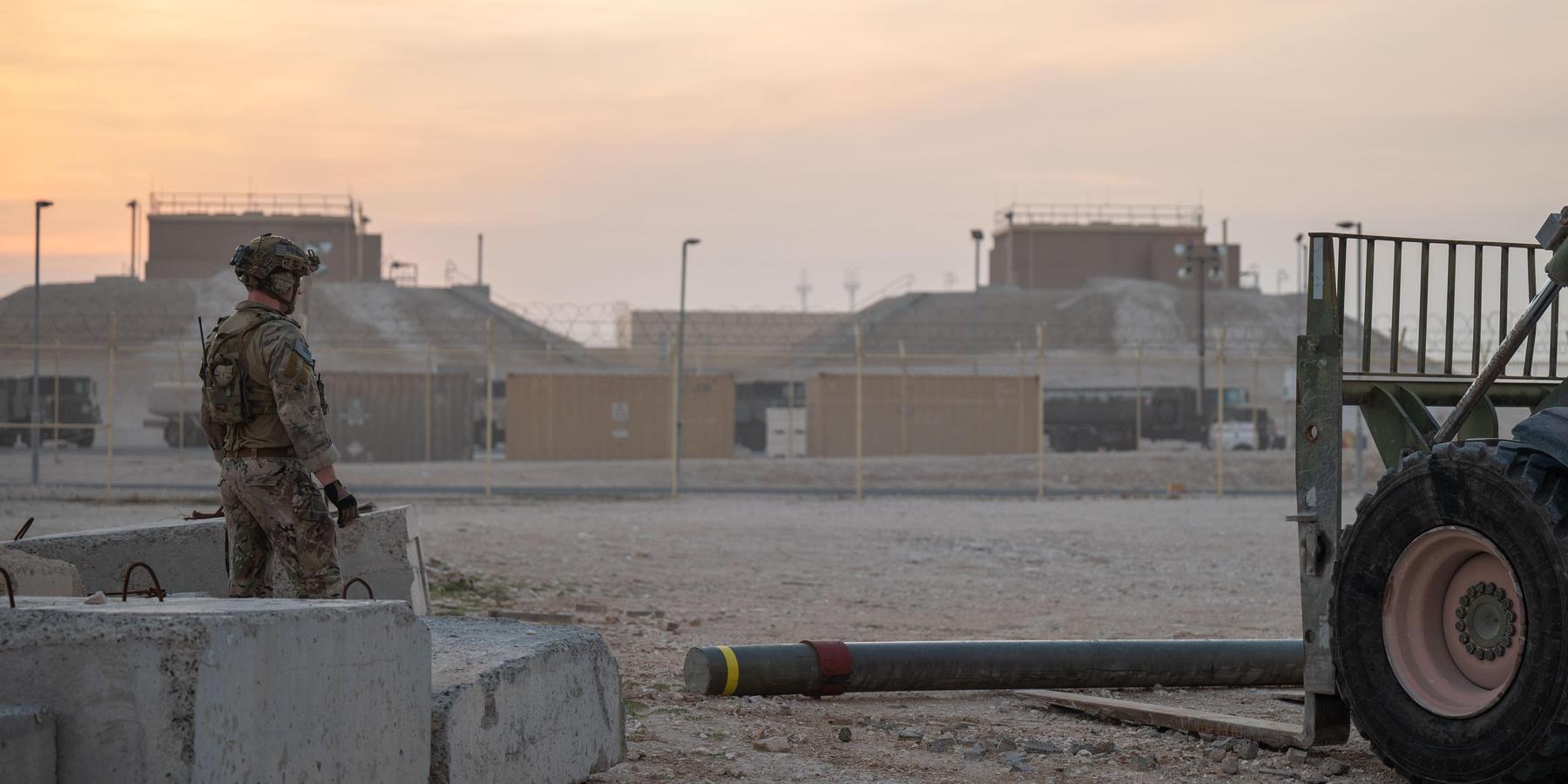
Ground-based installations, meanwhile, have not functioned as protective anchors so much as fixed points of risk. Bases, such as Camp Arifjan and Ali Al Salem in Kuwait, or Prince Sultan Air Base in Saudi Arabia, have become key targets. Satellite imagery that is finally available to the public shows that all 13 U.S. bases have become uninhabitable. Their proximity to critical infrastructure further amplifies the risk, as attacks on military facilities can spill over into civilian and economic domains.
These examples point to a broader conceptual failure. Traditional deterrence assumes that an adversary can be dissuaded by the threat of retaliation.
Iran’s approach, however, is calibrated to operate below the threshold that would trigger a large-scale U.S. response. By targeting economic infrastructure rather than military assets, Tehran has found ways to impose costs without provoking decisive retaliation. The presence of U.S. forces has not prevented these attacks; nor has it meaningfully altered Iran’s calculus.
Why Gulf states cannot easily say ‘no’
Given these dynamics, why have Gulf states not moved more decisively to curtail the U.S. military presence? The answer lies in a combination of structural dependence and political constraint.
Unlike European allies, Gulf monarchies operate in a security environment in which external guarantees have long been central to regime survival. Their defense institutions are deeply integrated with U.S. systems, from training and logistics to intelligence sharing and arms procurement. This creates a form of path dependence that is difficult to unwind.
The contrast with Spain is instructive. Madrid has, at various points, placed limits on U.S. use of its bases, reflecting both domestic political pressures and a more diversified security environment anchored in NATO and the European Union. Gulf states lack comparable institutional buffers. Their security relationships are more bilateral, more asymmetric, and more closely tied to regime-level concerns.
There is also a political dimension. Hosting U.S. forces provides not only military support but also implicit backing for the regime. For smaller states in a volatile region, this carries significant weight. The cost of challenging U.S. preferences — particularly in a period of heightened tension — can therefore appear prohibitive.
Toward strategic reassessment
But the status quo is becoming increasingly untenable. The combination of persistent vulnerability and escalating risk suggests the need for a fundamental reassessment.
Closing U.S. bases would not eliminate the challenges facing Gulf states, nor would it preclude continued cooperation with Washington. But it would reduce a key source of exposure and create space for a more balanced approach to regional security — one that emphasizes de-escalation, diversification, and greater self-reliance.
A useful contrast is Pakistan, which has managed to balance security cooperation with regional partners and the U.S. while avoiding the liabilities associated with hosting a permanent U.S. military presence.
This has afforded Islamabad greater diplomatic flexibility in moments of crisis. In the current escalation, Pakistan has been able to signal neutrality and explore a mediating role between Iran and Gulf states without being viewed as a direct party to the conflict. Its posture underscores a broader lesson: security partnerships need not require permanent basing, and maintaining a degree of strategic distance from U.S. military infrastructure can reduce exposure to retaliation while preserving political and diplomatic maneuverability.
The alternative is to remain locked into a model that no longer delivers on its core promise of security. The evidence is increasingly clear: U.S. bases have not protected Gulf states from Iranian aggression, and in some cases may have made them more vulnerable. Recognizing this reality is the first step toward building an alternative, and potentially more sustainable, security architecture.
- Can Gulf states really stay out of war with Iran? ›
- Iran war shows perils of America's Mideast bases ›