


The Trump administration expects U.S. taxpayers to fund not only its own military adventurism but Israel’s as well.
Ending American subsidies for Israel’s wars is one reason why Senators Bernie Sanders (I-Vt.), Chris Van Hollen (D-Md.), Jeff Merkley (D-Ore.), and Peter Welch (D-Vt.) recently filed Joint Resolutions of Disapproval opposing $659 million in President Donald Trump-approved bomb sales to Israel, with many of the bombs coming directly from U.S. stocks.
“Given the horrific destruction that Israel’s extremist government has wrought on Gaza, Iran and Lebanon, the last thing in the world that American taxpayers need to do right now is to provide 22,000 new bombs to the [Benjamin] Netanyahu government,” Sanders said in a statement.
Van Hollen added that “Congress must use all the tools at our disposal to end Trump’s war, including stopping the transfer…of taxpayer-funded bombs to the Netanyahu government.”
The senators are right to highlight U.S. taxpayers’ role in these arms deals. That they’re reported as sales belies who’s actually paying for them. Americans, not Israelis, pay for the vast majority of U.S. arms sales to Israel.
Who really pays for U.S. arms sales to Israel
U.S. arms sales to Israel aren’t really sales, at least not in the typical sense. Israel’s position as purchaser in these weapons deals isn’t synonymous with funder. This is made clear in the arms sales notifications themselves.
Consider the four most recent notified arms sales to Israel published in the Federal Register: $740 million for armored personnel carriers, $1.98 billion for tactical vehicles and accessories, $3.8 billion for attack helicopters and related weaponry, and $150 million for utility helicopters and parts. After “Prospective Purchaser,” all these notifications list Government of Israel. After “Funding Source,” all list Foreign Military Financing — or FMF, the U.S. military aid program through which Israel receives at least $3.3 billion a year.
In practice, FMF functions as a gift card for Israel to spend on weapons. U.S. taxpayers are stuck paying for the gift card. The only trace of Israeli funding in those $6.7 billion in arms sales is in the tactical vehicle deal, where National Funds follows FMF on the funding source line.
What about the pair of sales including 22,000 bombs, objected to by Sanders, et al.? Both deals are funded by FMF, or in other words, U.S. taxpayers.
This is, of course, a small sample size. But four years of arms sales data tell the same story: Israel doesn’t pay for most of the weapons the U.S. sells it — U.S. taxpayers do.
This fact undermines the economic justification for these arms sales. By foreclosing any claims that they bring significant foreign investment into the U.S., the case for these sales collapses into the same flawed job creations argument that many hawks use to defend lavish government spending on the military.
The jobs argument is itself a tacit admission of a weak national security justification. A policy that truly concerned the nation’s very existence wouldn’t have to be sold in terms as banal as job creation. The security justification alone would be convincing enough.
Military spending is the least efficient way a government can create jobs. Using military aid to boost employment is like buying a plane ticket to watch a film: yes, there’s an in-flight movie; no, that doesn’t justify the expense.
Even that analogy is generous. The relationship between military spending and jobs is not self-evident. In 1985, the U.S. military budget was $295 billion — $746 billion in today’s dollars — and there were 3 million workers in the U.S. arms industry. By 2021, the U.S. military budget had increased by $132 billion in real terms — to $879 billion — while the number of arms industry workers had dropped to 1.1 million. Despite military spending increasing 18% above inflation, there was a 63% drop in arms industry employment.
Under Biden, U.S. taxpayers funded $18 billion in arms “sales” to Israel
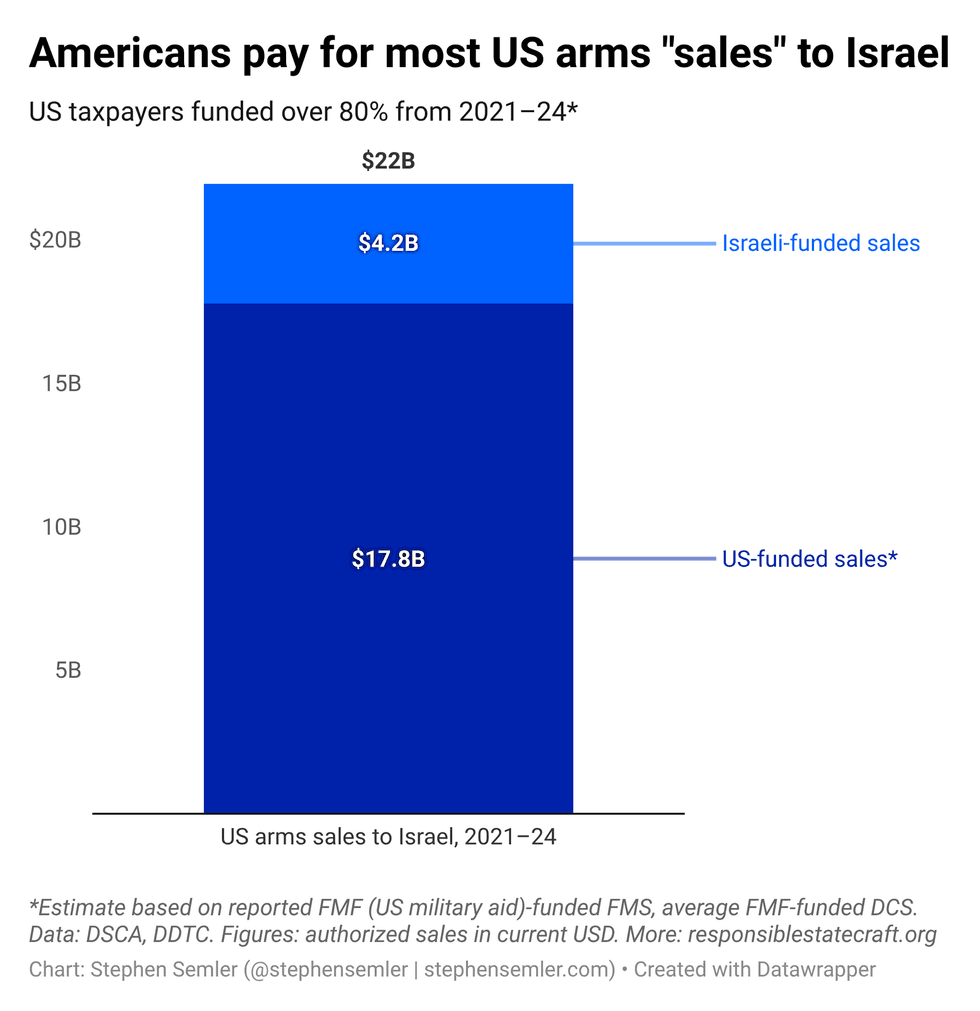
American arms sales are either U.S. government-brokered (“Foreign Military Sales”) or commercial (“Direct Commercial Sales”). I collected data on both via the Defense Security Cooperation Agency’s (DSCA) Historical Sales Books and the Directorate of Defense Trade Controls’ (DDTC) Section 655 Reports, respectively. Both yearly publications tally the value of authorized arms sales.
The Biden administration authorized $22 billion in arms sales to Israel, including more than $13.2 billion in U.S. government-brokered sales and over $8.7 billion in commercial sales. According to the DSCA report, 90% of the government-brokered deals were funded with U.S. military aid. The DDTC report doesn’t specify the funding source, but 68% is a reasonable estimate based on the average annual share of FMF funding that Israel reportedly spends on commercial sales.1
All told, U.S. taxpayers funded $17.8 billion in arms sales to Israel under Biden — $11.9 billion government-brokered and $5.9 billion commercial — 81% of the $22 billion in sales from 2021–2024. That’s nearly $18 billion in subsidies disguised as sales.
U.S. taxpayers deserve a refund, not more of the same from Trump.
- Israel to receive $1 billion in bombs and bulldozers from Trump ›
- Bombs, guns, treasure: What Israel wants, the US gives ›