

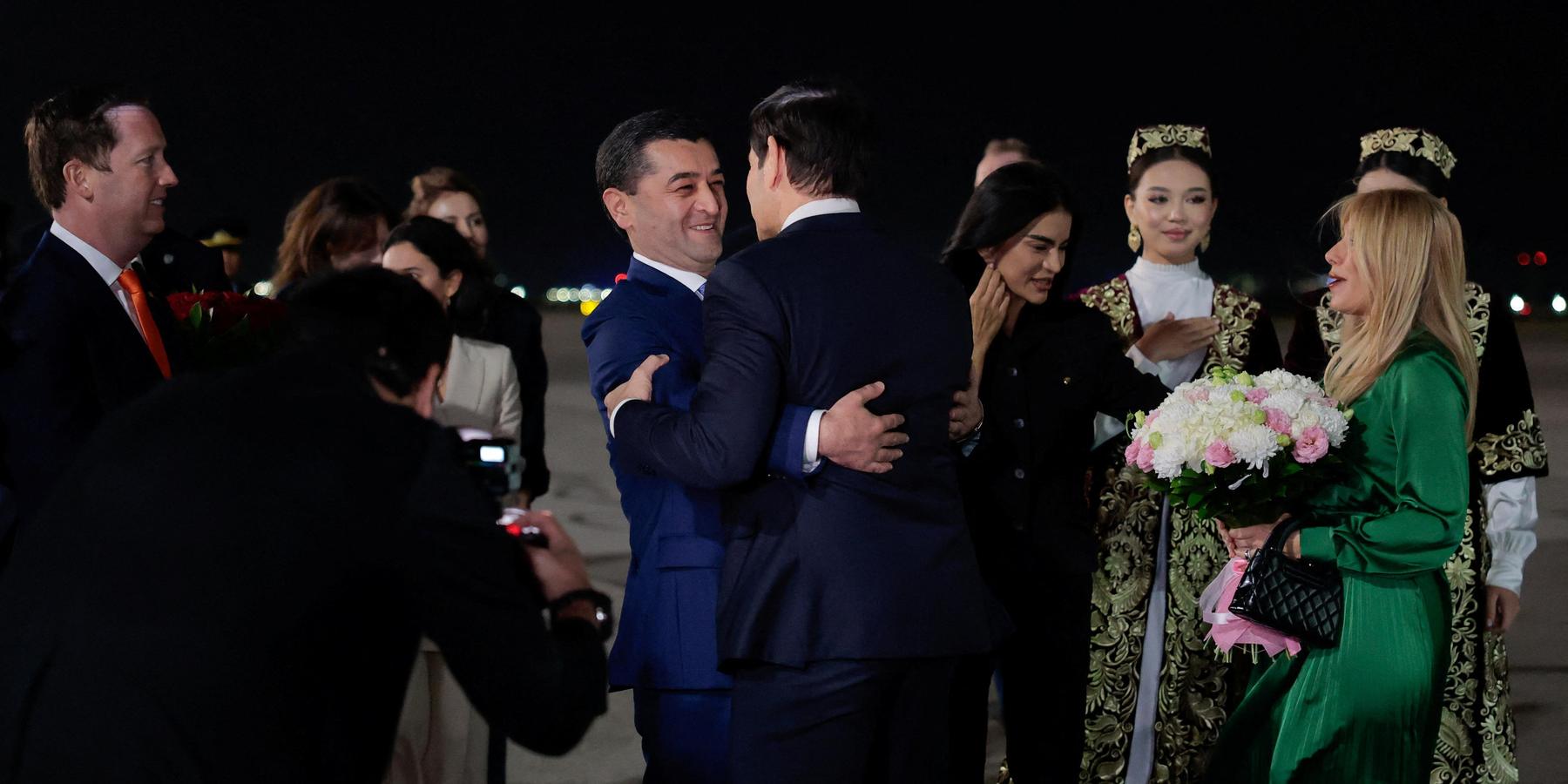
When Secretary of State Marco Rubio met with the leaders of five Central Asian states in Samarkand, Uzbekistan, on October 19, in a format known as 5+1, a sense of contradiction loomed.
Just a few days earlier in Athens, Greece, Rubio had spoken against ancient Persia as an invader and destroyer in a speech purportedly extolling Western civilization. Yet here he was, courting partners in Samarkand, a city that epitomizes the historic Persianate realm, whose inhabitants still predominantly speak Tajik, a variant of Persian. The irony was not lost on Iranian diplomats, who took to social media to troll Rubio over the incongruity.
Rubio was accompanied by over 200 American businessmen at the summit, where he discussed new trade and investment initiatives. The American-Uzbek Business & Investment Council announced 54 deals worth $12 billion as a result of the visit.
As a key hub of the ancient Silk Road, Samarkand is a fitting place to strike trade deals. Rubio spoke of a “fair chance to compete” for American businesses.
There is, however, an influential strand of think tank opinion in Washington that sees Central Asia primarily through the lens of great power competition. In this reading, the U.S. has to assert its influence in the region to counter Russia, Iran and China and empower a “Turkic front” in the region. The neoconservative Hudson Institute is at the vanguard of this effort.
Hudson fellow Ken Moryasu argues that the region is central to the U.S. strategy of containing China, pointing to the region’s overland energy routes, which give Beijing an opportunity to bypass sea lanes where the U.S. has an advantage. His Hudson colleague Michael Doran, a former member of the George W. Bush administration’s National Security Council, is known for his long-standing advocacy for closer ties with Azerbaijan as a gateway to Central Asia and a counterweight to both Russia and Iran.
The advocacy is not limited to Hudson. The American Foreign Policy Council (AFPC), another DC-based think tank, runs a research program focused on the region called Central Asia – Caucasus Initiative (CACI). S. Frederick Starr, Svante Cornell and their co-authors published a strategy paper in 2025 that calls for bringing Azerbaijan into 5+1, appointing a presidential envoy to the region, and securing access to critical minerals for the U.S.
In a separate paper co-authored with Brenda Schaffer, who has a record of undisclosed advocacy for Azerbaijan, Cornell welcomes the “recent rise of Turkish influence in the region” and “the weakening of Iran” as opportunities for Washington. Schaffer also published work for the hawkish Foundation for Defense of Democracies in which she laid the ground for Iran’s fragmentation along ethnic lines, with a particular emphasis on leveraging the Azerbaijani minority against Tehran.
Another Hudson fellow – Luke Coffey – takes the ambition a step further. He calls for cultivating the Organization of Turkic States (OTS). Its membership is not the same as 5+1, but it overlaps with it to a significant extent: its members are four Turkic Central Asian states (Uzbekistan, Kazakhstan, Kyrgyzstan with Turkmenistan as an observer) plus Turkey and Azerbaijan, minus the Persian-speaking Tajikistan.
In late October 2026, just after Rubio’s visit, Coffey wrote about the nascent “Turkic century,” calling on Washington to leverage it against Moscow, Tehran and Beijing.
What the Washington hawks tend to overlook, however, is that the Turkic and Central Asian states are far from being a homogenous bloc. These are sovereign states, each with their own domestic and foreign policy priorities that do not align on all occasions, and may, in fact, be in conflict with each other.
The recent spat between Turkey and Azerbaijan is a case in point. The conflict started when Baku imposed fresh restrictions on Islamic headscarves in schools, prompting unusually blunt reactions from members of Turkey’s ruling AKP party, which built its identity, to a large extent, on resisting such restrictions on religious freedom in Turkey.
Joseph Epstein, the director of the Turan Research Center, hosted at the Yorktown University in Washington, DC, defended Baku’s move as an assertion of Azerbaijani sovereignty. The alleged religious influence from Turkey is presented as a threat to that sovereignty – much in the same way the hawks have long treated Iranian influence.
Epstein also happens to be a research fellow at Israel’s Begin-Sadat Center for Strategic Studies, and director of research for Endowment for Middle East Truth (Emet), an explicitly pro-Israeli outfit in Washington. Since pro-Israeli officials and think-tankers increasingly frame Turkey as a “new Iran,” Azerbaijan’s appeal grows not only as Israel’s foothold on Iran’s borders, but also as a check on Turkey’s influence.
One can see in this a new iteration of Israel’s “periphery doctrine”: the original strategy consisted of balancing the hostile Arab core of the Middle East with “moderate” Muslim regimes on its rim, such as the Shah’s Iran and Kemalist Turkey. The fall of the shah and Turkey’s drift from strict Kemalism under the AKP put an end to that arrangement.
Now Iran and Turkey are the ones to be contained and confronted. The Turkic arc consisting of post-Soviet, secular Muslim republics offer Israel, in that reading, a useful counterweight to Turkey and new strategic depth in the Muslim world. Azerbaijan maintains close strategic relations with Israel, and Kazakhstan joined the Abraham Accords last year.
While Turkey, Azerbaijan and Kazakhstan all have strong reasons to cooperate, their differences over Israel and religious freedom will be difficult to overlook. These tensions show how little the common Turkic heritage tells us about their foreign policies.
To complicate the matters further, at the last OTS summit in Ankara, Kazakh President Kassym-Jomart Tokayev floated a role for Russia in the club, potentially as an observer. Astana sees no contradiction in keeping close relations with Turkey, maintaining economic ties with China, and making room for Russia in a Turkic forum. Each relationship serves a purpose in Astana’s multi-vector foreign policy. A one-sided American alignment would upset the balance Tokayev has carefully crafted.
Turkey has options of its own. It can use the OTS to expand links across Eurasia while working with Saudi Arabia and Pakistan through the Mecca Pact to strengthen its position in the Middle East. That framework could eventually provide a way to bring Iran into a wider regional security dialogue. An American strategy to organize the Turkic states against Tehran would narrow Ankara’s room for maneuver and exacerbate its rivalry with Tehran – something the Turkish leaders have so far sought to avoid.
These examples show the absurdity of the idea that the Turkic world and Central Asia act as a geopolitical actor with a common foreign policy and shared strategic outlook. Trying to mold the region into a united front against Russia, China and Iran would ignore the contradictions within that diverse group of countries and risk destroying the balanced policies they have been building.
Washington should resist the reflex to measure the success of its strategy in Central Asia in terms of the regional countries’ alignment with U.S. geopolitical goals. By that measure, every new deal of these states with Moscow, Beijing, or Tehran would become a setback for the U.S. to counter, thus perpetually fueling confrontation. Instead, the U.S. can pursue trade, investment, and transport projects in Central Asia as one of several partners, not necessarily the dominant one.