

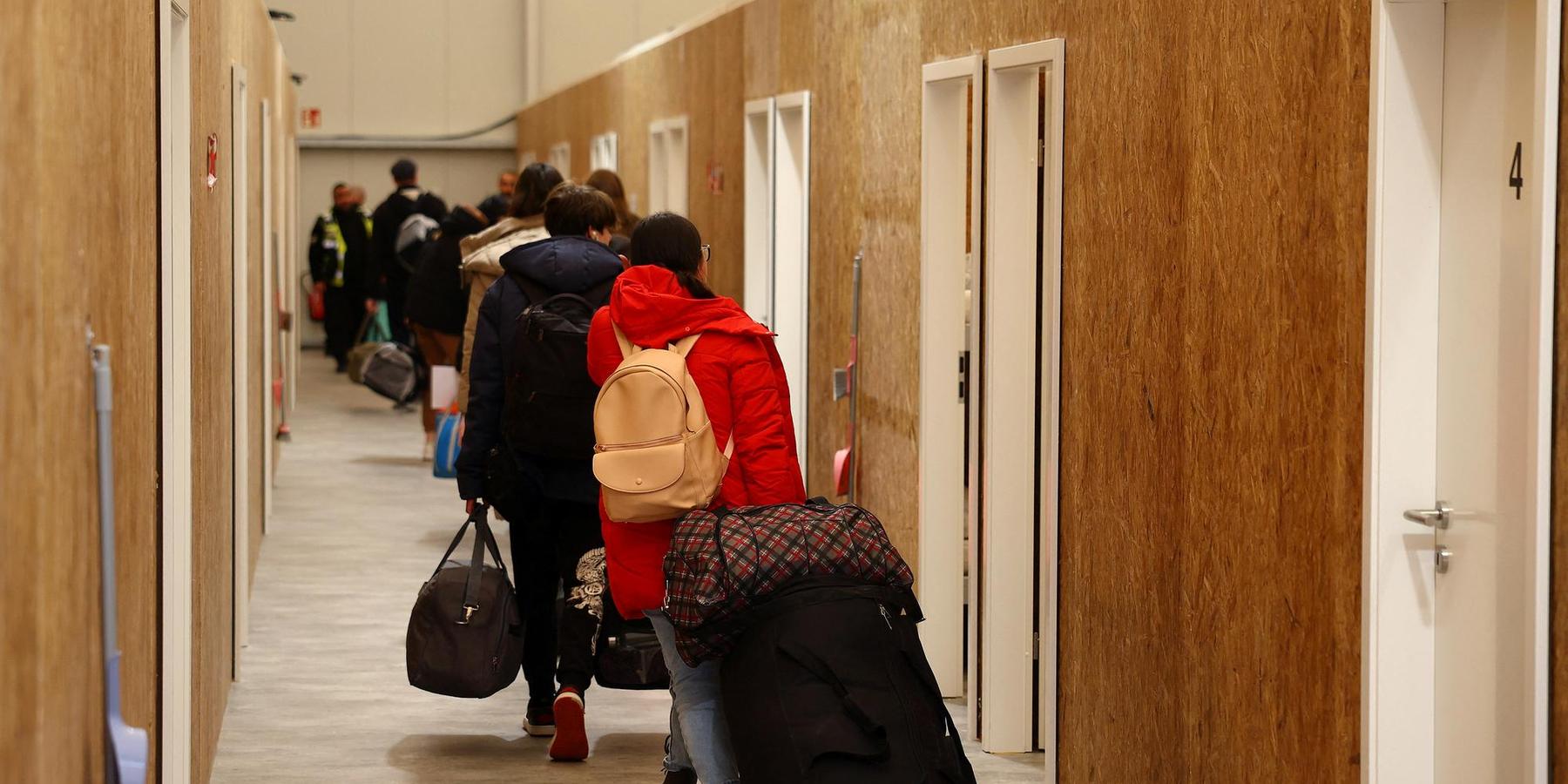
At a European Union summit earlier this month, Sweden’s migration minister revealed that there is “strong support” among European governments for excluding military-aged Ukrainian men from the bloc’s temporary protection scheme for Ukrainian refugees.
The policy, which allows Ukrainian citizens to live and work in the European Union, currently covers more than 4.3 million people. The majority of the beneficiaries are women, children, and the elderly since Ukrainian men between the ages of 23 and 60 are legally barred from leaving the country without prior authorization. Nevertheless, 26.6% of those in the EU are adult men, many of whom either were already in the bloc prior to the current conflict or left Ukraine in order to avoid mobilization and deployment to the front.
Despite a warm reception in early 2022, European publics and governments have started to sour on Ukrainian refugees. In a 2022 survey, 94% of Polish respondents supported accepting Ukrainians fleeing the conflict across the border, but that figure has since plummeted to 48%, with 46% opposing. In Germany, two-thirds support cancelling unemployment benefits to Ukrainians, and 62% support sending military-aged Ukrainian men back to their country. And, though the Czech Republic has generally been supportive of Ukraine, 47% of Czechs now believe that their country has accepted more Ukrainian refugees than they can handle, with only 23% in favor of allowing them to settle permanently.
Amid this growing weariness, some European leaders are pushing to repatriate Ukrainian men. In 2024, the Polish and Lithuanian defense ministers pledged to assist with repatriation of Ukrainian men. Last year, in response to the increased number of Ukrainian arrivals after Ukraine raised the exit ban age from 18 to 23, German Chancellor Friedrich Merz urged Ukrainian President Volodymyr Zelenskyy to ensure that young men did not leave the beleaguered and conflict-riddled country. Earlier this year, the Norwegian Directorate of Immigration announced that Ukrainian men between ages 18 and 60 who arrived after May 5 will no longer be covered by temporary collective protection and would instead have to apply individually.
Though drone warfare has altered the relative significance of conventional infantry units, Ukraine’s manpower shortage has continued to grow more acute. This trend could weaken Ukraine’s negotiating leverage and push the Ukrainian leadership to make concessions to reach a final peace agreement with Russia. This would run counter to the apparent preference of many Western policymaking elites, some of whom view the conflict as a valuable way of weakening Russia. As the long-time German diplomat and head of the Munich Security Conference Wolfgang Ischinger stated, “As long as this war is being fought, you know, vigilantly and courageously, by our Ukrainian friends, Europe is safe.”
By seeking to replenish Ukraine’s manpower through an infusion of men living in the EU, European governments risk simply extending the conflict while increasing the number of combatant deaths on both sides. Though European Commissioner for Migration Magnus Brunner argues that this is “what the Ukrainians want us to do,” a prolongation of the conflict will likely exacerbate Ukraine’s already catastrophic demographic crisis and trajectory. A brief swelling of the Ukrainian ranks is unlikely to meaningfully alter the course of the conflict, especially when one takes into account the time it would take to repatriate, train, and deploy a cohort of unenthusiastic conscripts.
The collapse in the number of volunteers in the Ukrainian military is an overlooked aspect of the conflict, one that reflects a wider, structural challenge that officials in Kyiv have so far been unable to resolve. While there was an uptick in volunteer enlistments in the spring of 2022, by June 2024 three-quarters of the Ukrainian military consisted of those who were there not by choice but by force. Meanwhile, domestically many are avoiding military service. By January of this year, according to Defense Minister Mykhailo Fedorov, approximately 200,000 soldiers were absent without official leave, and an additional two million men have been avoiding the draft.
As the journalist Peter Korotaev and sociologist Volodymyr Ishchenko have noted, the failure to mobilize more troops is rooted in decades of poor governance. “This failure to deliver meaningful opportunities and protections for the majority of Ukrainians has left the state unable to demand much from them in return,” Korotaev and Ischchenko wrote. “As a result, today, Ukraine is unable to fully mobilise its people who are divided by a profound sociopolitical disconnect.”
It remains unclear what a cancellation of temporary protection for Ukrainian men will actually entail. Under the current scheme, most Ukrainians in the EU have not applied for asylum, which is determined by national governments, so a policy reversal here might lead to a surge in asylum applications that may take months if not years to assess.
Differences between EU member states may also result in Ukrainian men moving around the bloc. Many may simply find themselves as undocumented migrants who are unable to access public services and are therefore forced to live underground. This is already the case for many within Ukraine, where men live in hiding out of fear of being apprehended by mobilization officers. Some European governments may even wish to carry out formal deportations.
Rather than trying to address domestic political pressure by fueling conflict in Eastern Europe while further destroying Ukraine’s prospects for postwar reconstruction, EU leaders need to focus their efforts on addressing the root causes of the fighting.
While European leaders have become increasingly supportive of direct talks with Russia, this has largely been reactive, emanating from a fear of being excluded by US-Russia talks. A proactive approach can save lives instead of resorting to sex-based discrimination against refugees.
- Touting battlefield successes, Ukraine leans into peace talks ›
- Ukraine's conscription crisis is getting increasingly bloody ›
- Why are Westerns hawks pushing Ukraine to draft women? ›