

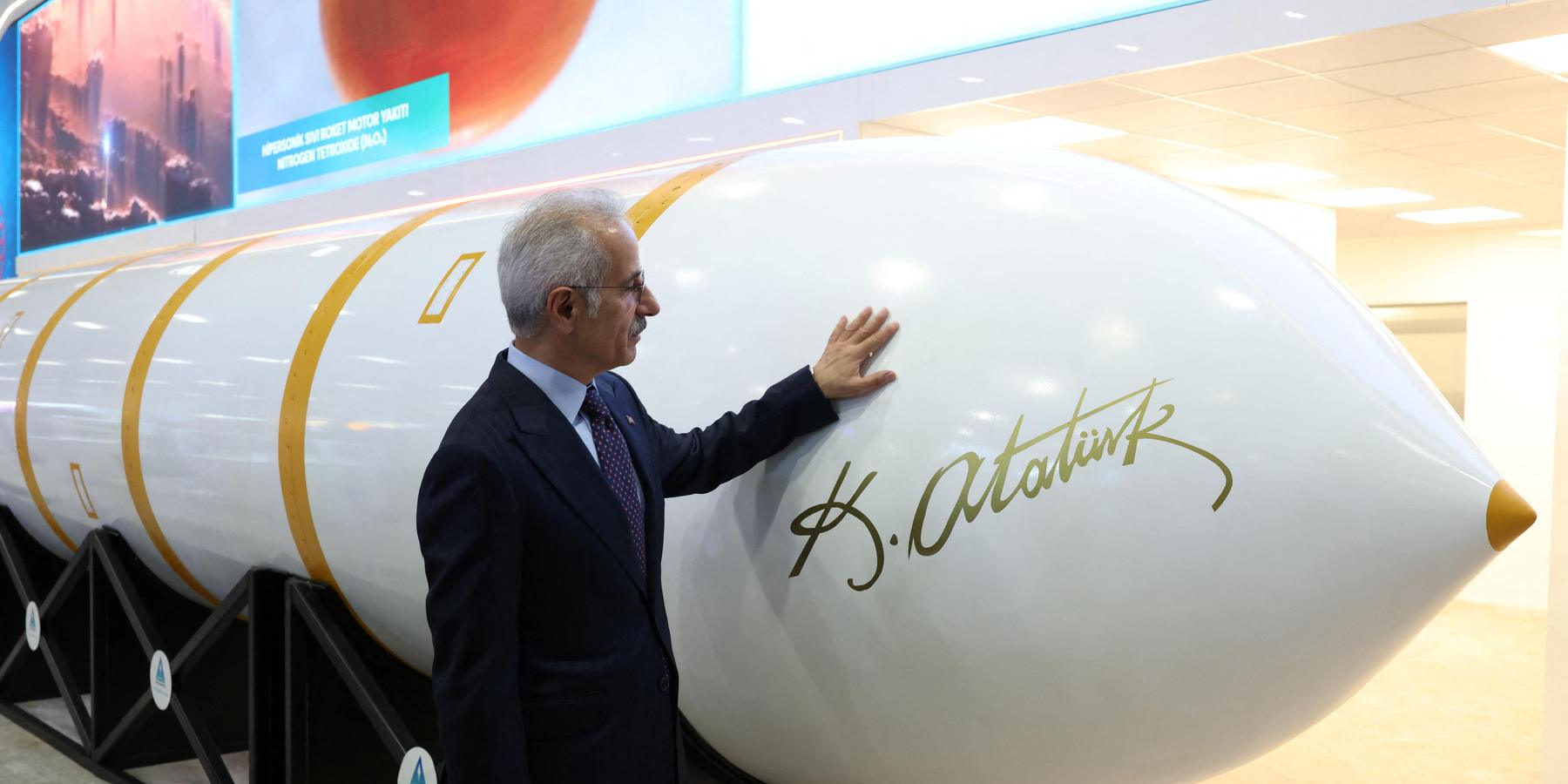
In May, Turkey unveiled Yıldırımhan, its first intercontinental ballistic missile project, in a move that came as a surprise even to many in the Turkish defense community.
Until then, public attention in Turkey had focused mostly on short- and medium-range systems such as Tayfun and Cenk. There had been no public indication that Ankara was ready to introduce a missile with a purported range of 3,700 miles.
Some in Turkey saw this as a proud milestone for the country's defense industry. Others found it premature to present Yıldırımhan as a major victory while its operational capabilities remain unproven.
The reaction abroad moved in a different direction. Some Western commentators, including voices from the Washington-based neoconservative Foundation for Defense of Democracies, framed Ankara's new missile as evidence that Turkey is seeking to upend the balance of power in the Middle East and act as a “new Iran.” Michael Rubin of the neoconservative American Enterprise Institute speculated that Turkey was developing the missile to use against India in a future conflict over Kashmir, warning ominously that “the storm is now brewing” for such a fight.
In that framing, analysts cast an unfinished project as an immediate strategic threat to Europe, Israel, India and even the United States.
This split response reveals the larger issue at play. Yıldırımhan is not only about range or payload. It is about how Turkey wants to position itself in a region increasingly shaped by missiles, drones, air defense systems, and doubts about the durability of Western security guarantees.
A misread message to the U.S.
Some western coverage of Yıldırımhan focused less on the missile itself than on its promotional video, which seemed at one point to target American territory and gave critics an opening to portray Turkey as an Iran-like missile power rather than a NATO ally seeking to increase its deterrent capabilities.
But it would be misleading to read the footage as an official Turkish targeting message. The video was published not by any official state channel but by an independent motion designer. It appears more like a poorly judged promotional choice made around the Expo 2026 event, where the missile was revealed, with little thought given to the diplomatic consequences. In any case, even if the announced range of 3,700 miles is taken at face value, it is still not enough to reach the U.S. mainland from Turkey.
The political context also makes that reading unrealistic. With President Donald Trump and Turkish President Recep Tayyip Erdoğan again emphasizing their personal rapport, it is hard to believe that Turkey intended to send a threatening message to the United States.
Why Turkey's missile symbolism differs from Iran's
While Turkey's new offensive capabilities are often viewed through the lens of its growing tensions with Israel, Ankara has also taken note of Iran's missile attacks on Gulf states and U.S. bases, as well as repeated incidents involving Iranian-fired missiles heading toward Turkish airspace. In that sense, the missile can also be understood as an indirect message to Iran.
In Iran, however, missiles have become part not only of defense planning, but also of the regime's identity. Tehran displays this capability through military parades and Islamic Revolutionary Guard Corps videos, and underground bases. Some Iranian missiles have carried references to Quranic verses, while others have featured direct political slogans such as "Death to Israel" or "Israel must be wiped out."
Turkey's presentation of Yıldırımhan fits into a different frame. The missile was displayed at a defense industry fair, in a less bombastic tone and as one of several newly unveiled products. The most striking element was the symbolism on the missile itself. The warhead section carried the signature of Mustafa Kemal Atatürk, the founding leader of the Republic of Turkey. On its body was a depiction of Yıldırım Bayezid, the Ottoman sultan whose nickname means "thunderbolt" in Turkish, a reference to his speed and reputation as a warrior on the battlefield.
In Turkey, where Ottoman legacy and republican identity have long existed in tension, Atatürk's signature beside Yıldırım Bayezid's image conveys continuity, not the regime-centered symbolism seen in Iran.
Yıldırımhan in a broader strategy
Writing for Anadolu Agency, defense analyst Can Kasapoğlu described Turkey's ballistic missile program as "not only national capacity-building" but also as a capability that fills a strategic gap at the alliance level. Ankara appears to be drawing the same lesson; namely, that air and missile shields alone are not enough and that offensive deterrence has to be built at the same time.
This choice is not only a military reflex, but also part of a foreign policy strategy. Ankara has recently put more emphasis on proactive diplomacy, from the war in Ukraine and the Iran crisis to mediation efforts in Africa and defense cooperation with Europe.
But Ankara also recognizes the limits of diplomacy without military power behind it. That is why it is trying to back up its diplomatic weight with its defense industry and military capacity. Regionally, Ankara's growing political investments in Pakistan, Qatar, Saudi Arabia, and Syria offer some of the clearest examples of how its diplomacy increasingly moves alongside defense and security partnerships.
A similar pattern is emerging in Europe. After years in which political disputes limited Turkey's engagement with the European Union and major European capitals, the Trump 2.0 era is helping push unresolved disagreements into the background. The fruits of this shift include the U.K.'s support for selling Eurofighters to Turkey, industrial partnerships with Italy and Spain, and major defense deals with Poland, Romania, and Hungary.
Self-reliance, not a break with the West
Erdoğan's emphasis on reducing dependence on foreign-made military equipment became an important political theme, especially during the 2023 election campaign. For a ruling party facing serious economic challenges, the defense industry remains one of its strongest sources of pride.
Yıldırımhan's unveiling, like other major Turkish defense announcements, also carried significant domestic political value. A 2024 survey found that 62.2% of respondents believed advances in the defense industry had increased their sense of security, helping explain their broad appeal.
Even Erdoğan's main opposition rival, Özgür Özel, posed with Yıldırımhan and welcomed its development, showing how major defense projects can create rare moments of agreement between Turkey's government and opposition.
This is clearly useful as domestic political messaging but it has not translated into a break with the West in practice. Turkey is part of the same broader trend seen from Ukraine and Taiwan to Japan, South Korea, and Europe, where countries are building greater self-reliance as confidence in U.S. military guarantees weakens.
The NATO summit in Ankara in July will likely emphasize these shifts and underline Turkey's desire for a more prominent role within the alliance.
Too early to draw conclusions
Erdoğan has long presented Turkey's defense industry advances, including the country’s rapidly developing cost-effective drone technology, as achievements of his own leadership, a message that will likely be remain central to his campaign for reelection if he decides to run again. This has closely tied the industry's rise to his political image in the public’s mind.
But framing Yıldırımhan, as some critics have, as Erdoğan’s pet project and concluding that Turkey is becoming an Iran-like missile power go well beyond what the project is currently capable of.
At this stage, Yıldırımhan is better understood as a statement of strategic intent than an operational capability. Its real significance will depend on testing, accuracy, deployment, survivability, command and control, and warhead integration.
The project is likely to extend beyond Erdogan’s presidency. Given his age and constitutional constraints, Erdogan may well be serving his final term as president and would likely leave office before the missile reaches mass production and achieves a credible deterrent status.
The new missile program also comes as Turkey is modernizing its air force through the Eurofighter process and the domestically developed KAAN fighter jet, while maintaining NATO's second-largest F-16 fleet. This shows that Ankara is also investing heavily in air power as another pillar of its broader defense strategy.
In the medium term, Ankara is likely to integrate more deeply into NATO and Europe's security architecture while firmly pursuing defense localization and developing new missile and weapons systems beyond Yıldırımhan.
- The expanding gravy train for the new land-based Sentinel nuke ›
- US, Russia test ICBMs as nuclear talks end in deadlock ›