

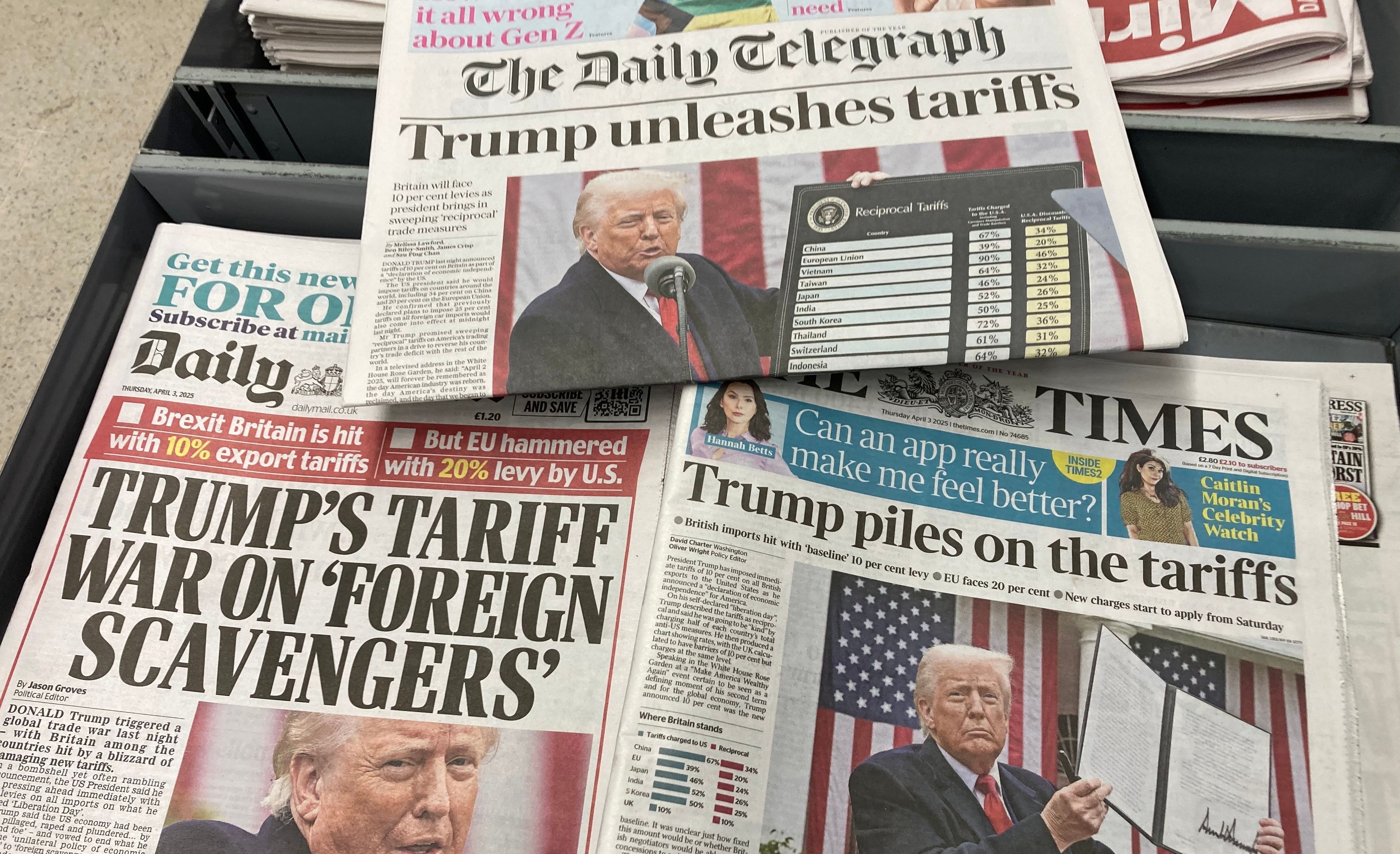
In its July 31 Executive Order modifying the reciprocal tariffs originally laid out in early April, the White House repeatedly invokes the close linkages between trade and national security.
The tariff treatment of different countries is linked to broader adhesion to U.S. foreign policy priorities. For example, (relatively) favorable treatment is justified for those countries that have “agreed to, or are on the verge of agreeing to, meaningful trade and security commitments with the United States, thus signaling their sincere intentions to permanently remedy … trade barriers ….and to align with the United States on economic and national security matters.”
The president is well-known for his long-standing dislike of all American trade deficits. But the more specific linkages between trade and security were also foreshadowed by Treasury Secretary Scott Bessent before he took office when he spoke of a traffic-light system of tariffs, with “green, yellow, and red” tariff levels determined by the extent of a country’s alignment with U.S. national security concerns.
A similar framework can be found in the work of Stephen Miran, the head of the Council of Economic Advisers, who has suggested that U.S. allies with large bilateral trade surpluses could do any one of the following in order to narrow trade imbalances: accept higher tariffs without complaint, buy more American goods — particularly energy or defense equipment, or promise to invest large sums of money in the U.S.
And it is precisely such expedients that some countries or regions have followed (at least in the administration’s telling) to arrive at the deals that have delivered lower tariffs. For example, the White House readout on the deal with the European Union that led to a uniform 15% tariff points to EU commitments to buy $750 billion of American energy in the next three years, invest $600 billion in the U.S. over the same period, and to purchase “significant amounts of U.S. military equipment.” The agreement with Japan over a 15% tariff was reported to feature $550 billion of inbound investment, 90% of the profits from which would be “retained” in the U.S.
Thus, the administration seems to be getting closer to its stated goal of making market access for countries conditional on acquiescence with other U.S. priorities. So can the White House succeed in using the sheer size of the American market to force other countries to align with its economic and national security priorities?
Despite the announcements, things might prove more difficult than they seem. For one thing, both sides don’t agree on the numbers and there are no actual formally drafted and signed trade agreements yet, just rather vague “deals.” America’s counterparts have tried to dampen expectations, with the EU noting that most investment and purchasing decisions will ultimately be made by corporations.
Similarly, officials in Tokyo say the White House numbers on inbound investment from Japan reflect a maximum that might be mobilized with support from Japanese government affiliated financial institutions (the figures do not appear to include Japanese institutional purchases of Treasury Bonds, the scale of which would make the number meaningless). And with significant uncertainty about the investment promises embedded in the deals, it could be too soon to conclude that tariff rates have finally settled.
A broader point is that the world has changed a lot since the international economy was based on the tightly-linked security and trade linkages of the immediate postwar era. Back then, the U.S. was the world’s predominant economic and technological force while the Soviet Union chose near-autarky and forced its clients to do the same. Large parts of the Global South, including India, also had deep reservations about integrating with global markets. So interlocking trade and security networks united the major economies of North America, Europe and Japan.
But beginning in the 1980s, China began to integrate more deeply with the global economy, and was joined by the former Soviet bloc and India in the 1990s. Now, the U.S. remains the world’s largest economy but China has risen to second place and is deeply embedded in global industrial and trading networks as the world’s largest exporter of manufactured goods and its largest importer of commodities.
More than a decade ago, the U.S. launched its first attempt to change these patterns of interconnection. This was the Trans Pacific Partnership (TPP), a free-trade area specifically designed to exclude China, while granting improved market access to other countries of the Pacific Rim. However, this attempt foundered on a bipartisan concern that the domestic political costs in the U.S. of using trade incentives to deepen security alignments would prove too high. So in October 2015, Hillary Clinton disavowed a project she had championed as secretary of state.
Conversely, TPP was of interest to countries in Asia precisely because participation in global industrial supply chains making goods for advanced economies had been a very successful development strategy that they wished to continue (or emulate). At the time, easier access to the American market was seen as a strategy to pull alliance and trading structures into closer alignment but it failed the test of domestic politics.
Current American policies try to deal with the domestic considerations that caused that failure by relying on a high tariff rate floor with some flexibility for security allies. However, the fast-changing and opaque considerations that determine tariff levels now could also cause them to change in the future and make it harder to convince other countries to embrace the White House’s preferred security/tariff/investment linkages for the long term.
For example, India is a member alongside the U.S., Japan, and Australia of the Quad — a maritime group designed to counter China in the Indo-Pacific. The country has benefited from accelerated efforts by Apple and other U.S. companies to diversify their production locations away from China. And yet it has been hit with a 25% tariff justified in part by its continuing purchases of Russian oil. But these tariffs come from an administration whose own attitudes on Russia have been somewhat variable over the last six months.
Similarly, the tariff structures revealed last week are at odds with another national security principle that has come to the fore since the pandemic — “nearshoring” or the deepening of geographically resilient supply chains closer to home. But Canada and Mexico, the U.S.’s fellow-members in the U.S.-Mexico-Canada Agreement (USMCA) have been hit with 30% and 35% tariffs. Even with certain exemptions, this means that partner countries where U.S. automakers have located substantial productive capacity over the past 30 years will be hit with higher tariffs than those levied on European or Japanese automakers.
These issues might be resolved in a USMCA review that is scheduled to begin soon, a subject I have explored in greater detail here. But even so, this would be another instance of a constant policy flux that adds to business uncertainty and chills investment decisions.
The above examples hint at some of the persistent contradictions in current administration attempts to tie national security and economics together through tariff policy. One consequence might be further attempts by countries to offer headline-making “deals” with the U.S. even as they work in parallel to deepen trade links with each other through other, more institutional mechanisms. This would be a rational strategy, but could provoke the administration into fresh tariff escalations that deepen global instability.
- The hidden costs of Trump's 'madman' approach to tariffs ›
- An unexpected pawn: Vietnam's key role in Trump's trade war ›
- Trump's tariffs against Brazil over Bolsonaro will backfire, on us ›