

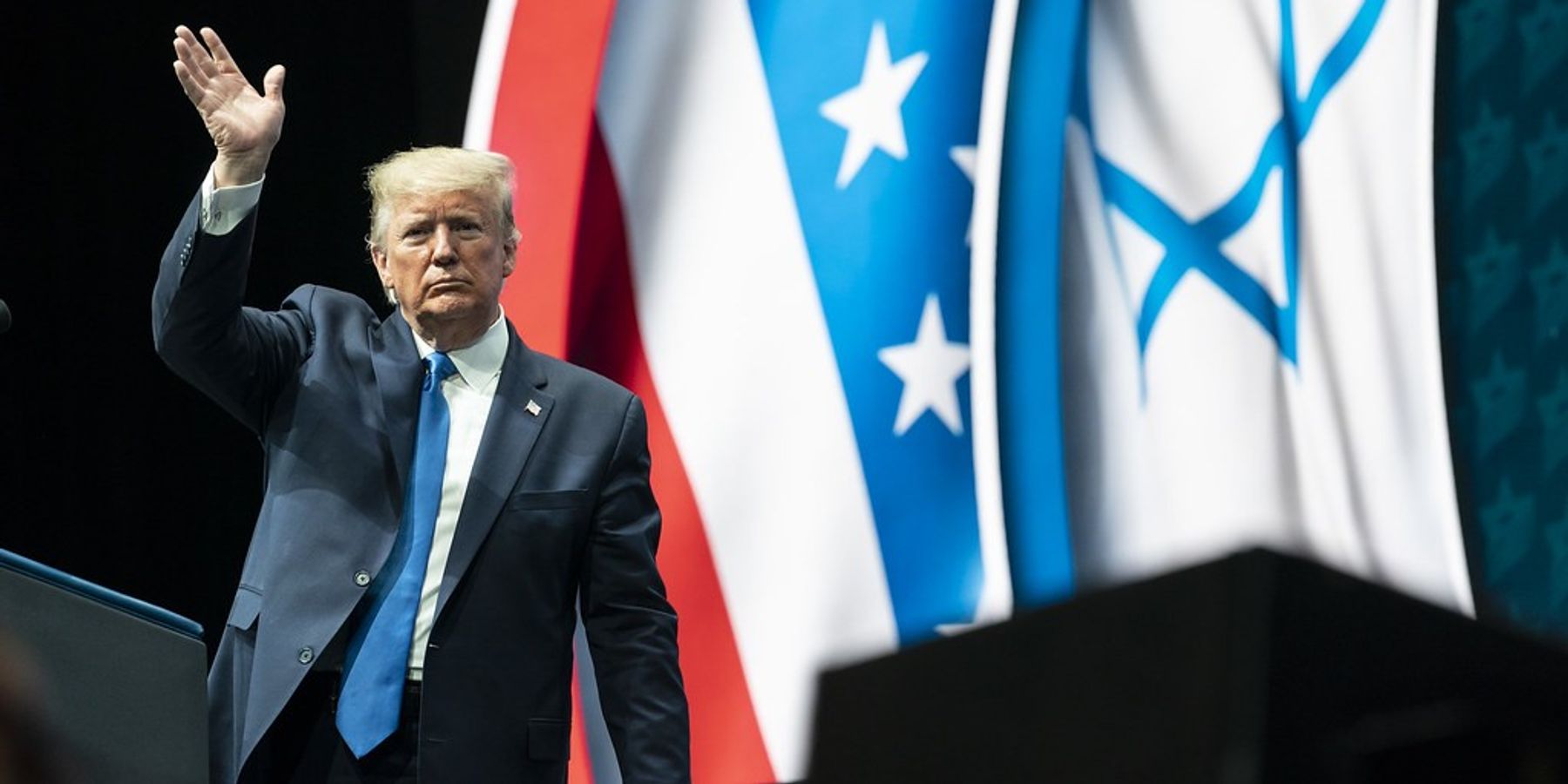
Concerning the Israeli war in Gaza, former President Donald J. Trump is making headlines again, telling Fox News that “you have to finish it up and do it quickly and get back to the world of peace. We need peace in the world…we need peace in the Middle East.”
Trump also continues to expose his long-standing grievances with Israeli Prime Minister Benjamin Netanyahu, saying, “He has been hurt very badly because of what’s happened here. He was not prepared. He was not prepared, and Israel was not prepared.”
This is not the first time Trump has expressed open criticism of Netanyahu. In the aftermath of his loss to Joe Biden in 2020, Trump recounted Netanhayu’s congratulatory call to Biden, grumbling that he “hadn’t spoken to” the Israeli prime minister since leaving office, so “f**k him."
This week, in an interview with the Israeli newspaper Israel Hayom, however, Trump seemed to go further on why he thought the war should end.
“We gotta get to peace, we can’t have this going on. And I will say, Israel has to be very careful, because you’re losing a lot of the world, you’re losing a lot of support,” he said.
When asked about fears that anti-Semitism is on the rise across the globe, he referred back to the optics of civilian death and destruction.
“Well, that’s because you fought back,” he said. “And I think Israel made a very big mistake. I wanted to call [Israel] and say don’t do it. These photos and shots. I mean, moving shots of bombs being dropped into buildings in Gaza. And I said, Oh, that’s a terrible portrait. It’s a very bad picture for the world. The world is seeing this … every night, I would watch buildings pour down on people.”
Even when asked about Hamas presence in the civilian buildings, Trump said, “Go and do what you have to do. But you don’t do that.”
Does he mean Israel should stop bombing civilians, or allowing pictures that show the world they are doing it? The ambiguity is leading observers to read into it what they will. Maybe that’s the point.
Indeed, Trump has revealed little about his views on the Gaza war, from the possibility of a ceasefire to what might happen when the fighting eventually stops. It is difficult to suss out more, as he has offered little elaboration on the campaign trail.
He does call progressive Democrats demanding a ceasefire “lunatics” who “hate Israel.” He said recently that Jews who vote Democratic hate Israel and “hate their religion.”
On the Biden administration itself: “frankly, they got soft,” he told Fox News in early March, adding that the Oct. 7 Hamas attacks would have never happened if he were still president — and nor would the Russian invasion of Ukraine. He doesn’t explain why but insists that his maximum pressure campaign kept Iran “broke” so that it wouldn’t have had the resources to give Hamas.
So given these scattershot comments over the last several weeks, can we actually discern what a U.S. policy toward Israel and the Palestinians might look like if Trump won the November election and was installed as the 47th president in January 2025? Maybe it’s best to go beyond his exhortations and take a look at the record instead.
Clues, past and present
First, regarding Trump’s recent comments, we would caution that any impatience with Netanyahu is bipartisan, widely shared, and growing, with Senate Majority Leader Chuck Schumer’s recent remarks serving as a good gauge of the center-left establishment’s feeling about the Israeli leader.
So far Trump’s comments, however, bear more resemblance to the rightwing establishment’s feelings about Netanyahu: frustration that his government fell down in failing to anticipate the Oct. 7 attacks. But Trump and the pro-Israel right save most of their fire for Biden, who they accuse of not giving Netanyahu enough now that the fight against Hamas is on.
Further, the idea that Trump might be cautioning restraint in the Israel-Gaza war when he makes comments about “peace” would seem to be belied by the people with which he has surrounded himself over the years.
His son-in-law, Jared Kushner, for example, who served as a close foreign policy adviser on the Middle East during Trump’s presidency, has long, personal ties with the Netanyahu family. Just recently, he gave an interview to Harvard University in which he suggested Palestinian refugees might be sheltered in the Israel desert outside of Gaza and may never come back. He also said that the Palestinians should not get their own state because that would be “rewarding” them for the terrorism of Hamas.
And Trump’s current coterie of foreign policy advisers, including former Secretary of State Mike Pompeo, retired General Keith Kellogg, campaign adviser Jason Miller, former U.N. ambassador Richard Grenell, and Fred Fleitz are not known to be doves on any foreign policy issues, least of all Israel-Palestine. Those currently being floated as potential 2024 running mates — among them Tulsi Gabbard, Tim Scott, Sarah Huckabee, Elise Stefanik, and Ron DeSantis — are all equally pro-Israel.
And then there is the 45th president’s record while in office. His actions with regard to Israel-Palestine could in no sense be construed as balanced, much less restrained.
Trump’s appointment of Israel Lobby figure David Friedman as U.S. ambassador to Israel, the decision to move (in violation of international law) the U.S. Embassy to Jerusalem, and his formal acknowledgment of Israel’s territorial claims on the Golan Heights signaled a close alignment with the policy objectives of the Israeli hardline right and, in many ways, his top donors.
Friedman, by the way, just posted on X. In response to Vice President Kamala Harris’s comments that Gazans would have nowhere to go in the event of a Rafah invasion, he declared that “Egypt and other Arab countries” are an option.
Friedman also opposes a two-state solution and is instead pushing a Future of Judea & Samaria plan, which claims that it is Israel’s right to annex the territory of the West Bank. Trump told the aforementioned Israel Hayom newspaper that he planned to meet with Friedman to hear out his plan.
Trump’s biggest donors past and present support a hardline pro-Israel, anti-Iran posture, including Tim Dunn, Bernie Marcus, and of course the Adelson family, which gave over $424 million to Trump and Republican Party causes from 2016-2020 with a primary intent of shaping the U.S-Israel relationship in favor of the hardline political right. The Adelsons — Sheldon, who died in 2021, and his wife Miriam — were especially fired up against the Joint Comprehensive Plan of Action (JCPOA), also known as the Iran nuclear deal, which was signed by President Obama in 2015.
Netanyahu by the way hated that deal so much he engaged in a one-man PR campaign against it, including telling a joint session of Congress in 2015 that it was an “historic mistake” and would “guarantee” that Iran gets nuclear weapons. When Trump took office he tore the JCPOA up and launched a years-long maximum pressure campaign against the Islamic republic. The Iranian nuclear program has only expanded since.
Meanwhile, Miriam Adelson recently met with Trump at his Mar-a-Lago resort in Florida this month, and in Las Vegas last month.
Still more, Trump’s base of support in the election may very well hang on the enthusiastic buy-in of Christian evangelicals, over half of whom cite support of Israel as a critical issue.
What kind of a seat at the policy table will donors and these other interested parties get in a second Trump administration is a fair question.
Conservatives not minding 'the third rail'
None of this proves that Trump is necessarily in full capture of the right’s hardliners today. Major conservative voices that Trump ostensibly listens to have come out publicly for a more restrained policy in Gaza. Tucker Carlson has said the U.S. lost its “moral authority” because it has refused to call for a ceasefire between Israel and Hamas.
Meanwhile tech billionaire David Sacks has said it is not in Israel’s best interest to support it unconditionally. “Historically it has been the American role to encourage the Israelis, basically, not to go to the limit, but to kind of pull them back before they do something that is frankly not in their own interest, nevermind ours,” he told Breaking Points host Saagar Enjeti. “And Biden kind of missed the opportunity to do that, to set some boundaries on what America is willing to support…It’s pretty obvious that indiscriminately bombing a population is gonna backfire.”
And conservative bomb-thrower Candace Owens, who was fired from the Daily Wire last week, has been batting away charges of anti-Semitism, in part, she says, because she’s questioned Israel’s policy in Gaza and because she doesn’t believe “that American taxpayers should have to pay for Israel’s wars or the wars of any other country.”
Without mentioning Israel by name, Owens posted on X, "No government anywhere has a right to commit a genocide, ever. There is no justification for a genocide. I can't believe this even needs to be said or is even considered the least bit controversial to state."
So, while the Israel issue remains a “third rail” in mainstream conservative circles, it may not be an entirely foregone conclusion, yet, in Trump world.
In the end, Trump may just wait to see how the war in Gaza will affect his opponent, who, by most measures, is suffering every day it goes on, particularly with his own base. Trying to divine if the situation would be “better” or “worse” under Biden or Trump is a popular Washington parlor game right now, though reality is very much a hellscape for the people of Israel and in Gaza, no matter what our politicians are saying.
- Trump tell-all cites Adelson's bankrolled Israel embassy move ›
- Forget 'peace,' did Abraham Accords set stage for Israel-Gaza conflict? ›