

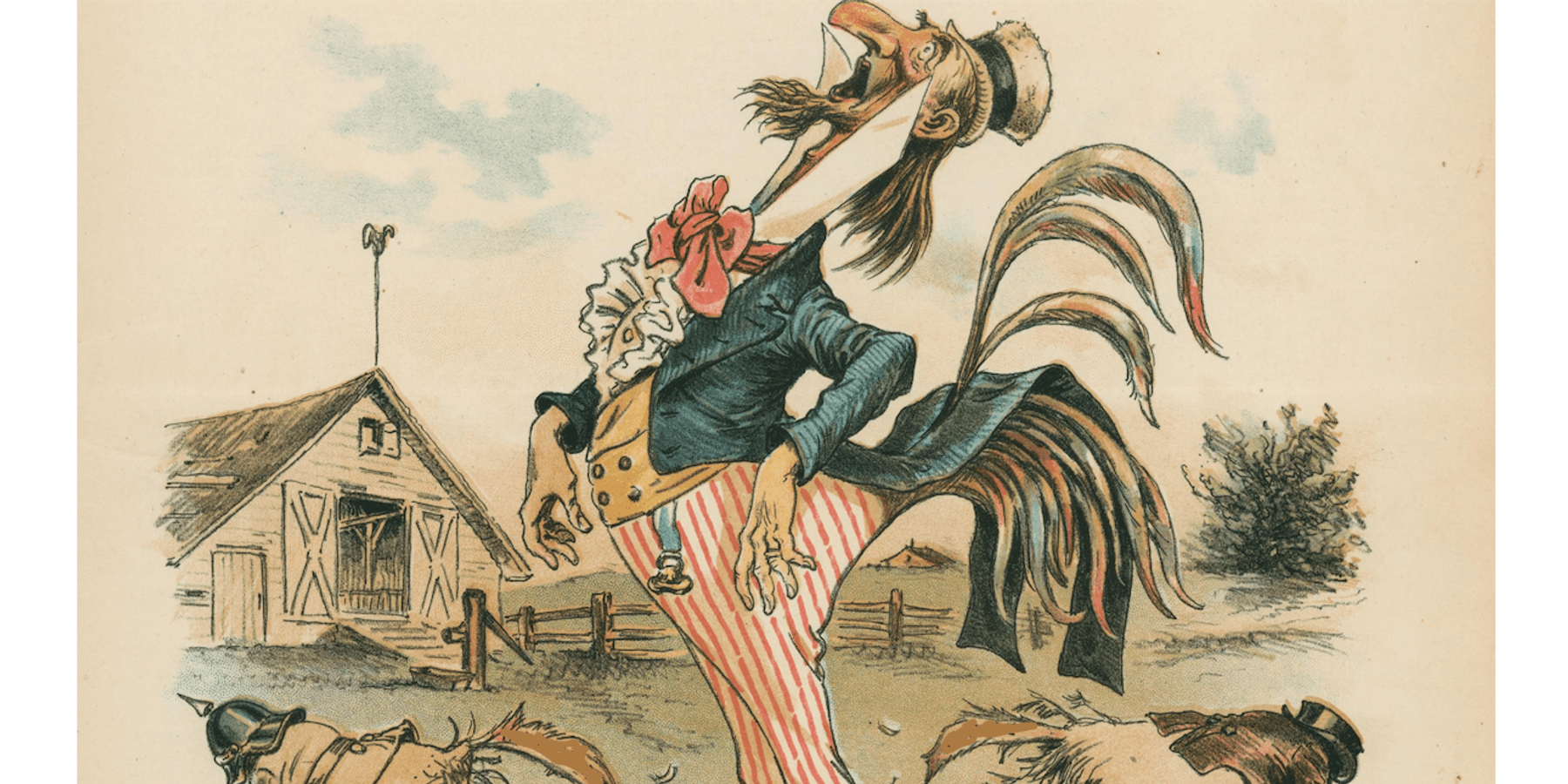
NATO continues to prepare for life without the United States, at least as the dominant alliance member. “Europeans are already backfilling what the U.S. cannot any longer promise,” explained Secretary-General Mark Rutte.
America's foreign policy establishmentarians have long worried about losing influence as a result. Indeed, by driving Europe away from America, Donald Trump may be inadvertently spurring creation of a serious counterweight to Washington. As CNN Fareed Zakaria warned: “As Europe’s spending increases, the continent will become less dependent on the U.S., and less deferential to it.”
American policymakers, he added, might therefore regret the disappearance of the continent as a military backwater governed by obsequious nonentities, which served as a convenient base for U.S. troops to operate around the globe.
The rise of Europe as an independent power will almost certainly transform international politics. And the process could be painful. One issue will be the difficulty of coordinating the militaries of more than a score of often dissonant perspectives within the European Union. Another is the return of Germany as a significant military power. Moreover, as European states increasingly talk about the possibility and, worse, likelihood, of war with Russia, Moscow may perceive a growing threat from the West and increase its military preparations accordingly.
However, the benefits for America will still far outweigh the problems.
Europeans’ reliance on Washington has long reduced their mutual cooperation. For instance, in 2020, years after Moscow wrested Crimea from Ukraine and backed separatists in the Donbas, the Pew Research Center asked Europeans if they favored defending their neighbors. Overall, sentiment was 50% to 38% against. Only in three of 13 countries polled did more people favor fighting for their supposed allies rather than standing by in case of war. In two, pluralities opposed doing so. A majority said no in eight, reaching 66% in Greece. Yet most Europeans still believed that America would intervene on their behalf.
This fecklessness encourages irresponsibility elsewhere. Last year the European Union surrendered economically, agreeing to President Donald Trump’s trade shakedown. EU policymakers and commentators claimed they had no choice, lest they be left to their own defense devices. For instance, European Trade Commissioner Maroš Šefčovič observed: “It’s not only about … trade: It’s about security, it is about Ukraine, it is about current geopolitical volatility.”
And it’s about saving money; as Financial Times columnist Janan Ganesh asked: “How, if not through a smaller welfare state, is a better-armed continent to be funded?” Concern for such tradeoffs, until recently at least, trumped quaint concepts like sovereignty and self-respect. In this way, European subservience not only encouraged the administration’s irresponsible foreign policy, but also its modern, and destructive, mercantilist economic policy.
If the Europeans, and especially the EU, can no longer rely on Washington’s military umbrella, they will have to do more for their own security. This will place greater pressure on them to limit sclerotic rulemaking and liberalize existing controls. They will also have good reason to reject dubious and costly U.S. demands. And they will be more likely to confront American administrations directly when the next George W. Bush or Donald Trump decides to create another international disaster.
An equally important benefit would be to reduce America’s ability to meddle around the world, especially if a full U.S. military withdrawal from the continent ultimately results. Russia would no longer be viewed as a likely existential threat, at least in Washington, allowing the U.S. to follow by eliminating both its commitment to war and the force structure necessary to fulfill that obligation. Americans could then put these unlocked resources to better use elsewhere.
Thus, what some see as a likely problem would actually be an enormous advantage. True, Washington risks losing a subservient Europe willing to back its political interferences and serve as a launching pad for Washington’s military interventions. However, these policies have, more often than not, turned out disastrously. Even the globe’s nominally benign hegemon requires restraint.
The problem, as recognized by the historian John Dalberg-Acton, commonly known as Lord Acton, is that “power tends to corrupt, and absolute power corrupts absolutely.” That maxim applies even to the well-intentioned who wield overwhelming and largely unrestrained power. This includes the United States — especially when that nation is governed by a narcissist with spectacularly poor policy judgment.
Washington’s Cold War misjudgments were legendary. Vietnam was the worst but not alone. Seventy-three years on, supporting the coup that delivered absolute power to Mohammad Reza Pahlavi in Iran looks disastrous. Decisions like backing Pakistan’s Islamist government, headed by General Muhammad Zia-ul-Haq, and funneling aid to Afghanistan’s Mujahedeen through later Pakistani regimes, which empowered the most radical insurgents, look terrible in light of 9/11 and succeeding developments.
However, such errors must be understood, if not excused, by the Cold War and competition with the Soviet Union. The latter was an Evil Empire like Ronald Reagan said, even if perhaps not as militarily aggressive as feared at the time. The same cannot be said for Washington’s missteps after the USSR’s collapse. “What we say goes,” announced President George H.W. Bush, when American policymakers really believed that the U.S. was the unipower and essential nation that could do no wrong.
Alas, hubris overwhelmed judgment, yielding the Somalia, Iraq, and Afghanistan debacles. After a quarter century of the “Global War on Terrorism,” nearly 5 million people have perished, most as an indirect result of the many conflicts. Few in Washington appeared to understand that wandering the globe bombing, invading, and occupying other nations, as well as backing other nations that did the same, would create enemies prepared to strike back with often terrible consequences.
Contra George W. Bush’s comfortable triumphalism, Americans were not attacked on 9/11 because they were so free and generous. Rather, a succession of administrations operating in their name spent years making other nations’ conflicts their own. Unfortunately, if you swat the hornet’s nest, you are likely to get stung.
The usual suspects in Washington tend to share Zakaria’s error in conflating their power to intervene internationally and Americans’ national interest. The former is often negative. Blob members typically enjoy running the world, or at least attempting to do so. Unfortunately, the rest of us pay the price.
If the president inadvertently strengthens Europe, so much the better for Americans as well as Europeans. U.S. policymakers have proved that their power, like that of adversary governments, require limits. A more powerful and dynamic Europe could help provide some.
- Trouble in Paris? There's a Gaullist cure for that American hubris ›
- Flattery is for fools: Can Euros stand up to Trump — and win? ›