

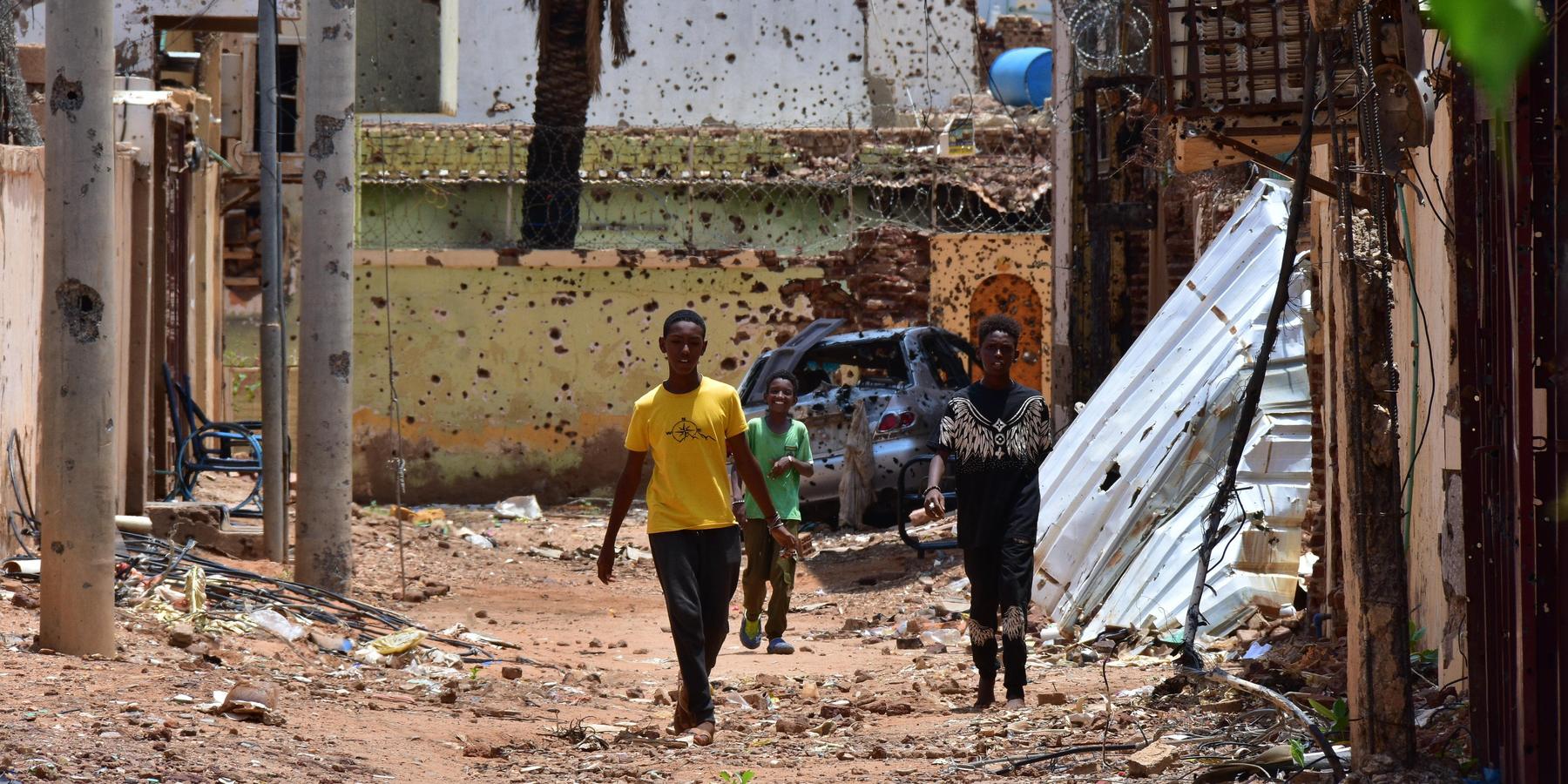
This month marks the third anniversary of the war in Sudan. Estimates of the death toll range from 150,000 to 400,000 or more; 2025 was, according to the United Nations’ internal estimates, a particularly deadly year for civilians.
The humanitarian impacts are even broader: the U.N.’s Office for the Coordination of Humanitarian Affairs calculates that, as of April 2026, nearly two-thirds of Sudan’s 46.8 million people need humanitarian assistance. Doctors Without Borders, in a recent message, stated that the war has “dismantled the essential services people rely on – including health care, protection, food security, and basic safety.”
A ministerial conference on April 15 in Berlin brought a renewed effort to halt the war. The event sparked some expressions of hope from prominent Sudanese civilians — but key factions rejected the initiative, underlining how distant a real peace appears.
The war can be understood through two main lenses. For most international analysts and journalists, it is a “civil war” or a conflict between “warring generals.” That frame focuses on the two main armed factions: the Sudanese Armed Forces (SAF) led by General Abdel Fattah al-Burhan, and the paramilitary Rapid Support Forces (RSF) led by Mohamed Hamdan “Hemedti” Dagalo.
In 2023, the SAF and the RSF clashed over an SAF proposal for the RSF to integrate into the Army; at stake was power, political and economic, especially given the vast business interests that the SAF and the RSF have in sectors ranging from gold to private security to telecommunications.
For many Sudanese activists, however, the conflict is a “counterrevolutionary war.” The SAF and the RSF — even as they fight each other — have both trampled on the revolutionary and democratic aspirations of many Sudanese people. From 1989 to 2019, Sudan was ruled by General Omar al-Bashir, who oversaw the SAF but also built up the RSF as a counterweight and a form of “coup-proofing” his regime.
When popular protests in 2018-2019 made al-Bashir’s continued rule untenable, his top lieutenants, including the SAF and RSF leadership, overthrew him. Demonstrators continued to call for structural change, but were met with serious repression, including an RSF-led but SAF-backed massacre of civilians at a sit-in protest in June 2019.
The SAF and the RSF then shared power with each other, and with civilians, uneasily; the SAF and the RSF staged a coup against the country’s transitional civilian prime minister in 2021, and, by early 2022, meaningful civilian input in government had mostly ended. Amid the war, both the SAF and the RSF have inflicted substantial brutality on civilians – the RSF to a significantly greater degree.
That brutality has rendered civilian activism even more difficult, and sometimes deadly. Meanwhile, the war itself has divided many would-be civilian leaders, who find themselves making difficult choices that sometimes cost them credibility with their own constituents.
The past twelve months of the war have been marked by three broad, interlinked developments: First, the SAF has largely consolidated control over the capital Khartoum after two years of fighting there. Second, the RSF increasingly dominates the western region of Darfur, as demonstrated by its bloody conquest of the key town of El Fasher in October – a capture whose massacres and other crimes are still being investigated, with credible allegations surfacing that the RSF is committing genocide against the region’s non-Arab groups. Third, the war continues to encompass various fronts: in the Kordofan and Nuba Mountains regions, among others, and from the air, as both the SAF and the RSF make extensive use of drones.
Arab states continue to meddle in the crisis, foremost among them the United Arab Emirates, which is widely accused of backing the RSF and thereby prolonging and intensifying the conflict. Alleged Emirati support, many analysts assess, reflects Emirati antipathy to the SAF’s ties to Islamists, Emirati economic interests in Sudan, and the wider matrix of alleged Emirati relationships with various strongmen and secessionist groups across northeast Africa and Yemen.
Amid continuity in alleged Emirati support, supply lines are reportedly shifting. Chad, reportedly a key conduit for arms to the RSF, has started to distance itself from the group. Emirati-Somali relations, meanwhile, have become even frostier, as Ethiopia and other hubs emerge as alleged alternative supply corridors.
Another element of change is the relationship between the UAE and Saudi Arabia. While Emirati President Mohamed bin Zayed (MBZ) was initially a key mentor to Saudi Arabia’s Crown Prince Mohammed bin Salman (MBS) during the latter’s swift political ascent beginning in 2015, Emirati-Saudi relations grew tense in late 2025. Territorial conquests in Yemen by the Southern Transitional Council (STC), a separatist group that aims to revive South Yemen (which was an independent country until Yemeni unification in 1990), alarmed Riyadh and provoked Saudi efforts to curtail the STC’s power.
The STC is one of various groups allegedly backed by the UAE, and Saudi moves to counter Emirati power are now generating a rebalancing in numerous zones, including Sudan, in ways that are yet to fully unfold – but that appear to be contributing to even stronger Saudi and Egyptian backing for the SAF.
To complicate matters further, Saudi Arabia, Egypt, the UAE, and the United States make up the “Quartet,” a diplomatic structure aiming to achieve a ceasefire and a political settlement in Sudan. In 2025, as President Donald Trump pursued peace deals in countries such as the Democratic Republic of the Congo, there was also significant but ultimately fleeting energy spent on an American-brokered deal for Sudan.
Amid the Iran War, Sudan has receded from the Trump administration’s list of priorities. Meanwhile, various factors have limited the Quartet’s ability to make peace: conflicting interests among the Quartet’s members, a lack of trust between the Sudanese factions as well as between each faction and various mediators (including Trump’s Senior Advisor Massad Boulos, whom the SAF has accused of a pro-Emirati bias), and the zero-sum demands and attitudes of the SAF and the RSF.
Theoretically, the United States has the capacity to play a constructive diplomatic role in Sudan. There is a long history, in fact, of American efforts to steer and shape Sudan, a history with many failures and few clear successes. Neither disengagement, nor transactional diplomacy, nor high-level deals, have worked. Productive engagement would require a level of patience, commitment, and nuance that have not been evident recently; productive engagement would also require a willingness to grapple more forthrightly with the roles of external actors in Sudan’s war, a willingness displayed neither by the Trump administration nor by that of President Joe Biden.
For Washington to help make peace in Sudan, it would need to adopt a new perspective — one less interested in foreign adventurism, and more interested in the hard work of building a better world.
- Saudi Arabia chooses sides in Sudan's civil war ›
- Unlikely foes: Egypt and the UAE's hidden battle for Sudan ›
- US knows UAE fueling war in Sudan but $1.4 trillion is getting in the way | Responsible Statecraft ›