
Follow us on social

google cta
SOTU: Trump threatens Iran but doesn't go all the way

SOTU: Trump threatens Iran but doesn't go all the way

Will he or won't he? The president offered little insight, but built a case for potential Mideast escalation if he chose to do it.

Reporting | Washington Politics
google cta
google cta

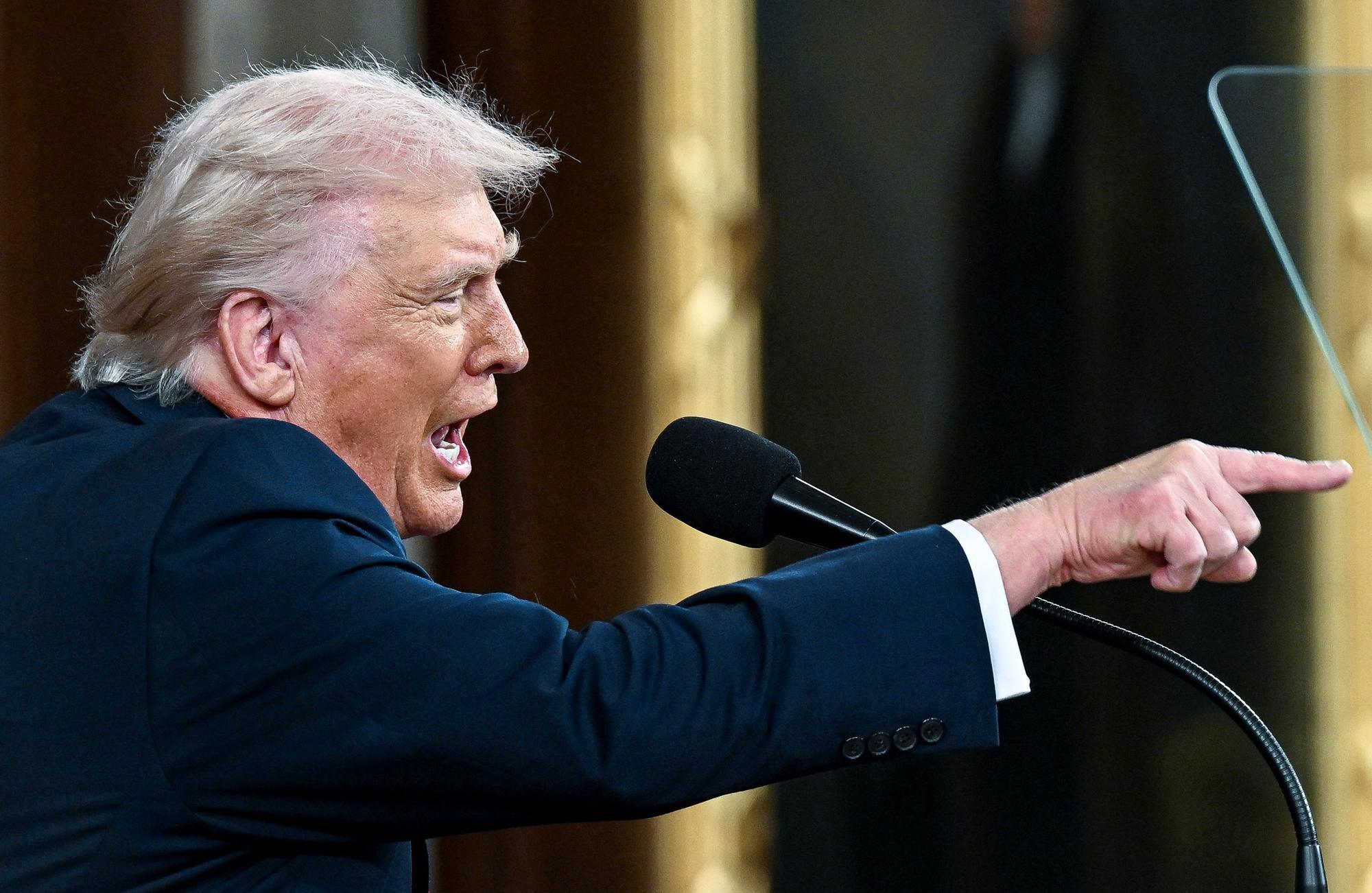
In Tuesday’s State of the Union address, President Donald Trump threatened to bomb Iran but left open a path to return from the brink, suggesting that he would back down if Tehran pledged to never build a nuclear weapon.

“They were warned to make no future attempts to rebuild their weapons program, including their nuclear weapons,” Trump said. While his preference is to “solve this problem through diplomacy,” the president pledged to “never allow the world’s number 1 sponsor of terror… to have a nuclear weapon.”

The speech gave little insight into Trump’s thinking about the possibility of war with Iran as the U.S. continues to surge American forces to the Middle East at rates not seen since the 2003 invasion of Iraq. In making the case for war, he reiterated claims that the Iranian regime killed more than 30,000 protestors in a brutal crackdown last month and alleged that Tehran is “working to build missiles that will soon reach the United States of America.”

“Trump tried to sound very tough — repeating accusations against Iran that will serve as a basis for his case for war, if he chooses war,” said Trita Parsi, executive director of the Quincy Institute, which publishes RS. “Yet he also kept the door open for a deal.”

While the speech focused primarily on domestic issues, Trump addressed several other foreign policy initiatives, lauding his administration’s peacekeeping efforts. “In my first 10 months, I ended eight wars,” he claimed, referring to conflicts including last year’s brief conflict between India and Pakistan as well as a threat of war between Egypt and Ethiopia.

But the president had little to say about the Ukraine war, which he once hoped to end in the early days of his second term. Urging an end to the conflict, he said that 25,000 soldiers are dying per month in the war.

Trump struck a relatively mild tone in his criticism of the Supreme Court, saying last week’s decision to overturn many of his tariffs was “unfortunate.” The president connected the issue of tariffs to his peacemaking efforts, arguing that “many of the wars I settled was because of the threat of tariffs.”

Trump also lauded his administration’s efforts to restore “American dominance in the Western hemisphere.” He described the January capture of Venezuelan President Nicolas Maduro as “one of the most complex, spectacular feats of military competence and power in world history.” To honor the raid, Trump awarded a helicopter pilot who was wounded in the attack with a Congressional Medal of Honor.

The president also celebrated the impact of his campaign of airstrikes against alleged drug smuggling boats in the Caribbean, saying “nobody wants to go fishing anymore.” And he claimed responsibility for the Sunday killing of cartel leader El Mencho, who he described as “one of the most sinister” drug kingpins in the world.


google cta
Reporting | Washington Politics
‘Water War’ rages as India-Pakistan tensions reach boiling point
Top image credit: A view of Ranjit Sagar Dam (Thein Dam), which is near the proposed site of the Shahpur Kandi Dam. (Shutterstock/mrinalpal)

A view of Ranjit Sagar Dam (Thein Dam), which is near the proposed site of the Shahpur Kandi Dam. (Shutterstock/mrinalpal)

‘Water War’ rages as India-Pakistan tensions reach boiling point

Global Crises

Last week, water became a focal point in the Iran war, as airstrikes hit desalination plants in Iran and Bahrain. Further east, a slower motion water war was playing out — one that is heightening tensions between two nuclear armed powers.

The Shahpur Kandi Dam project was first conceptualized in the late 1970s. In 1982, former Indian Prime Minister Indira Gandhi laid its foundation stone and set a 1988 deadline for the project. But inter-state conflicts between Punjab, Jammu, and Kashmir stalled construction for decades.

keep readingShow less
Not so diplomatic: Witkoff, Kushner, and Trump’s march to war in Iran
Top image credit: U.S. President Donald Trump, Vice President JD Vance, Secretary of State Marco Rubio, Donald Trump's son-in-law Jared Kushner and U.S. Special Envoy Steve Witkoff attend the inaugural Board of Peace meeting at the U.S. Institute of Peace in Washington, D.C., U.S., February 19, 2026. REUTERS/Kevin Lamarque

Not so diplomatic: Witkoff, Kushner, and Trump’s march to war in Iran

Middle East

Steve Witkoff, the special envoy to the Middle East who President Donald Trump tasked with negotiating a deal with Iran, does not sound very much like a diplomat lately.

“There’s almost no stopping them, they have an endless supply of [enriched uranium],” Witkoff told Sean Hannity the day the war began. “They thought they could strong-arm us. ... It was very, very clear that it was — it was going to be impossible, probably by the second meeting.”

keep readingShow less
Pete Hegseth
Top Image Credit: Defense Sec. Pete Hegseth and General Dan Caine hold briefing on the U.S. - Iran war 3/13/2026 CNBC Television [YouTube/Screenshot]

=

Hegseth lauds Iran campaign but ignores shrinking US stockpiles

QiOSK

At a Pentagon press conference Friday morning, Defense Secretary Pete Hegseth cheered about how U.S. operations against Iran have blunted Tehran’s munitions capacities and ability to fight.

“Iran has no air defenses. Iran has no air force. Iran has no navy. Their missiles, their missile launchers and drones are being destroyed or shot out of the sky,” Hegseth said, telling reporters the United States and Israel have struck over 15,000 targets in Iran. “Their missile volume is down 90%. Their one-way attack drones yesterday [were] down 95%.”

keep readingShow less
google cta
Want more of our stories on Google?
Click here to make us a Preferred Source.

LATEST

QIOSK

Newsletter

Subscribe now to our weekly round-up and don't miss a beat with your favorite RS contributors and reporters, as well as staff analysis, opinion, and news promoting a positive, non-partisan vision of U.S. foreign policy.