

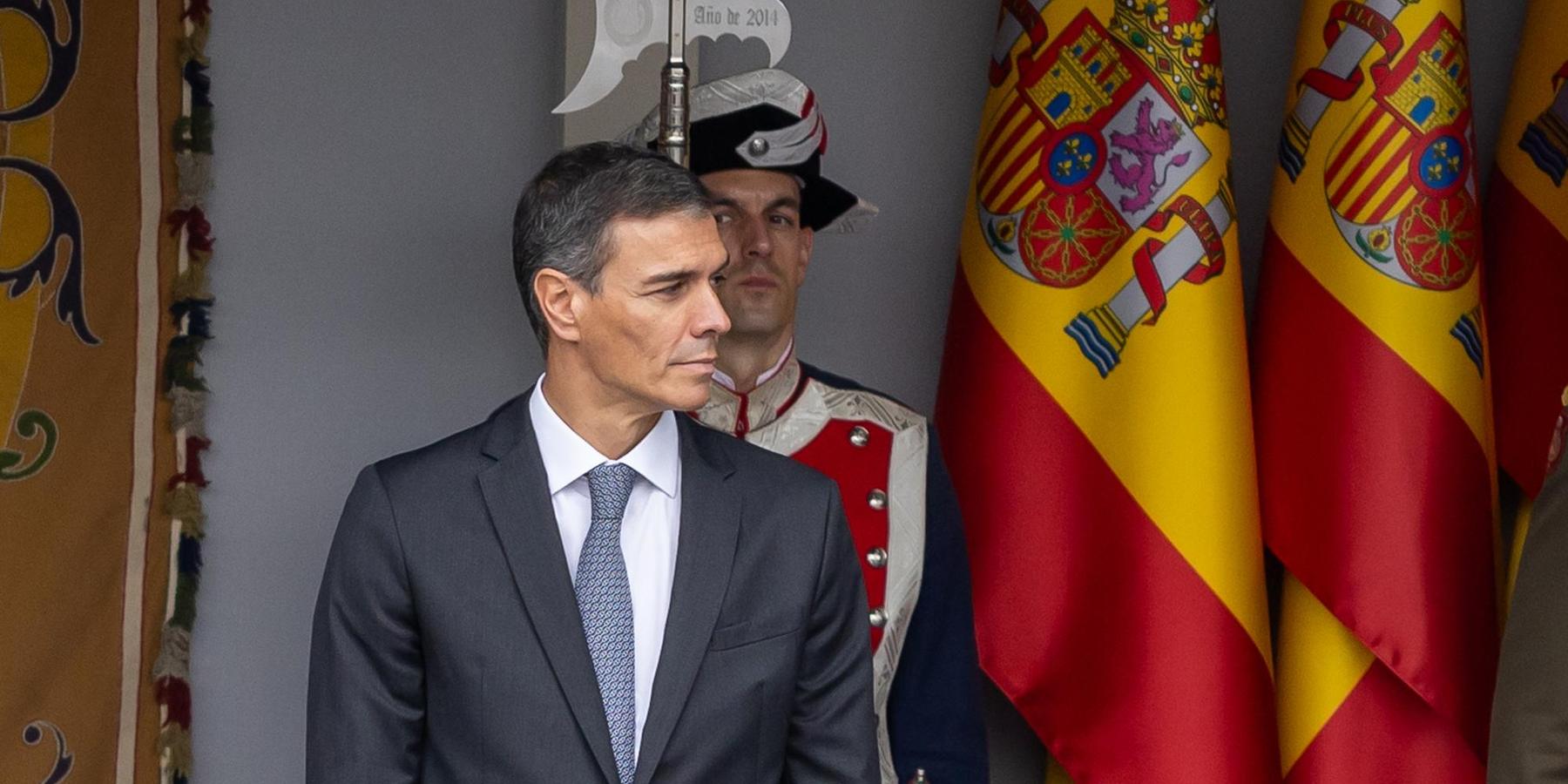
While most European leaders have responded to the U.S.-Israeli strikes on Iran with condemnations of the Iranian regime and tepid calls for "de-escalation" designed not to offend Washington, Spanish Prime Minister Pedro Sanchez has unequivocally condemned the war on Iran as a breach of international law.
Contrast that with German Chancellor Friedrich Merz who chose to insist at the war’s outset that "this is not the time to lecture our partners and allies" about potential violations of international law.
Meanwhile the the British Prime Minister Keir Starmer went to considerable lengths trying to have it both ways: on the one hand, appealing to the international law, on the other he allowed Washington the use of the British military bases for “defensive operations” – which, in effect, are no such a thing as they include targeting Iranian missile launchers on the Iranian territory. He still incurred President Donald Trump’s insult that Starmer is “no Winston Churchill."
The leaders of other major European countries have performed only slightly better – French President Emmanuel Macron waited for fully four days to declare that the U.S./Israel war is “outside international law.” And even then, he pledged to send air defense assets and a warship to defend the island of Cyprus from the strikes from Iran on the British military base there, in retaliation for the UK’s support for attacks on Iran.
Macron also said he wanted to build an international coalition to secure commercial shipping routes “essential to the global economy.” He said France would contribute its aircraft carrier, the Charles de Gaulle.
Sanchez’ position deserves attention because not only did he talk the talk but he also walked the walk. In foreign policy, coherence is a matter of credibility.
Concretely, Sánchez has refused to allow U.S. aircraft to use the jointly operated naval and air bases at Rota and Morón in Spain for strikes against Tehran. That decision predictably elicited Trump’s ire. He called Spain “terrible” and threatened to cut off all trade with Madrid. He also said if he wanted to use Spanish bases he would “fly in there” if he wanted to.
“We could just fly in and use it, nobody is going to tell us not to use it. But we don’t have to,” he said.
Far from folding, Sanchez doubled down by rejecting the violations of international law in a historic televised address to the nation. He dismissed the “illusion that we can solve the world’s problems with bombs” and vowed not “to repeat the mistakes of the past.” The position of the Spanish government can be summarized in four words he uttered: “No to the war.”
On Wednesday, the White House spokesperson said the Spanish had reconsidered and agreed to help after all. The Spanish Foreign Minister José Manuel Albares immediately went to the media and said it was not true. "I can refute (the White House spokesperson)," Albares told Spanish radio station Cadena Ser. "The position of the Spanish government regarding the war in the Middle East, the bombing of Iran and the use of our bases has not changed one iota."
This is is not the posture of naive idealists. It is the stance of a tough, realist leader (Sanchez) who remembers history, reads his audience, and acts to shield his country from a senseless, illegal war and its possible consequences, such as terrorist blowback, economic hardship and mass migration.
Of note, the Spanish leader invoked a memory of the 2003 invasion of Iraq. "A few irresponsible leaders dragged us into an illegal war in the Middle East that brought nothing but insecurity and pain," he warned.
The comparison is apt and resonates strongly in Spain. In March 2003, then-Prime Minister Jose Maria Aznar offered full-blown support to George W. Bush’s invasion of Iraq — a moment immortalized in the “Azores trio,” a photo featuring Aznar, Bush and British Prime Minister Tony Blair following their summit on those Portuguese islands where the decision was taken to launch the war.
The blowback haunted Spain when Al Qaeda terrorists bombed the Madrid train station almost exactly one year later, killing 193 and injuring more than 2,000 people – the biggest terrorist attack in the nation’s history. The attack preceded general elections a few days later, and, while Aznar’s government initially tried to blame Basque separatists for the atrocity so as not to harm the chances of his conservative successor, the evidence soon emerged pointing to the Islamist terrorists acting in retaliation for Spain’s role in Iraq. The Socialist opposition went on to win the election.
Like the Iraq war, the current strikes on Iran lack UN Security Council authorization. Also like the Iraq War, they are being justified by appealing to noble sentiments — in this case, solidarity with Iranian women suffering under the regime, including some Iranian exile activists who have lobbied for war to vindicate “women’s rights.”
Sánchez has been particularly sharp on this point. "Women's rights must never be used as a pretext to launch wars that serve other interests," he argued. "If we truly believe in the freedom of Iranian women, the answer cannot be more violence. It must be more diplomacy, more support, and more international law."
This is not to defend the Iranian regime. Sánchez has been explicit: "Let's remember that one can be against a hateful regime, as is the case with the Iranian regime... and at the same time be against an unjustified, dangerous military intervention.” The distinction is critical — and lost on those who equate, in bad faith, opposition to war with sympathy for Tehran.
Why does Sánchez's stance matter? Because it offers a different path, other than utter submission to Trump, for Europe. Political leaders like Merz and like-minded politicians and pundits seem to be intoxicated with the notion of Europe becoming a “hard power” and seemingly equate its exercise with becoming junior partners in a war against Iran.
Yet, as the European Union expert Alberto Alemanno recently wrote, "Europe backs a war it didn't start, won't fight, and can't afford. Washington gets the geopolitical prize. Europe gets the bill.” That bill will come due in higher energy prices, potential migration flows, terrorist threats and political instability on Europe's southern flank.
Sanchez is refusing to play a part in facilitating any of this. This is not “hard power” but self-defeating subservience to Washington as it wages an illegal war with aims that appear to change from day to day, if not from hour to hour depending on which Trump administration official is speaking at any one time. Europe’s leverage, to the contrary, lies in using its diplomatic and economic power to act in its own collective self-interest.
That means, in this context, denying the U.S. the use of any military bases in Europe for any purposes that violate international law and self-defense. As to Trump’s threats to stop trade with Madrid as retaliation, they ring largely hollow. While legally not impossible, such a move would effectively mean sanctioning the entire EU single market – a full-blown trade war that is probably a political and economic non-starter even for the Trump administration.
Sánchez, however, cannot act alone. Spain is a middle power, not a superpower. But his stance matters precisely because it demonstrates that alternatives exist.
Israel’s foreign minister has questioned whether Sánchez is on "the 'right side' of history.” It is a telling formulation. In 2003, those who opposed the Iraq War were similarly dismissed. Today, few would argue they were wrong.
The Spanish position is not anti-American. It is not pro-Iranian. It is simply pro-law, pro-peace and anti-war. In a world hurtling toward wider war, that makes Pedro Sánchez the voice of sanity Europe desperately needs.
- Senate vote fails, giving Trump free rein on Iran war ›
- Trump's war on Iran is already losing the home front ›
- The UK must continue 'turning a blind eye' to Trump's war demands | Responsible Statecraft ›