

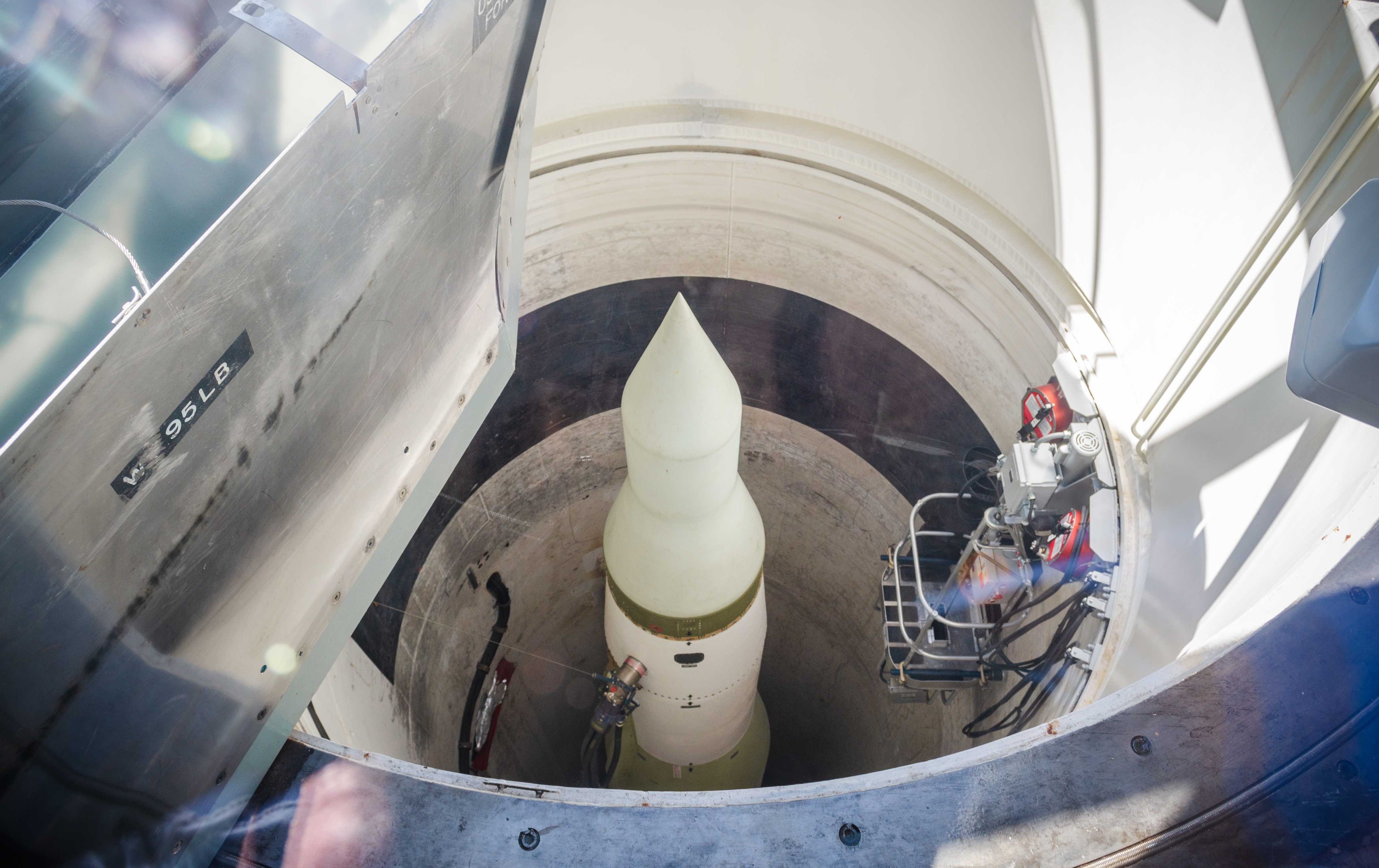
Last week, analysts from three think tanks penned a joint op-ed for Breaking Defense to make the case for mobilizing the Sentinel intercontinental ballistic missile (ICBM) program, a pivot from one exceedingly costly approach to nuclear modernization to another.
After Sentinel faced a 37 percent cost overrun in early 2024, the Pentagon was forced to inform Congress of the cost spike, assess the root causes, and either cancel the program or certify it to move forward under a restructured approach. The Pentagon chose to certify it, but not before noting that the restructured program would actually come in 81 percent over budget.
The Pentagon later revealed that a major driver of the program’s cost growth was a faulty assumption that it could refurbish existing missile silos for Minuteman III, the current generation of ICBMs, to accommodate the needs of Sentinel. Now, the Pentagon is planning to build entirely new silos, at a significantly higher cost.
The three analysts from the Hudson Institute, the Heritage Foundation, and the American Enterprise Institute — we’ll call them the Three Missileers — essentially argue that the restructured plans for the Sentinel ICBM are so over budget that mounting Sentinel on heavy trucks instead of in fixed silos would now cost less than building new silos for Sentinel. Their case rests on two assumptions. The first is that taking Sentinel on the road will cost less than building new silos, a dubious and unsubstantiated claim. The second and more fundamental assumption is that the United States needs ICBMs to maintain an effective nuclear deterrent. It doesn’t.
Regarding cost, the Three Missileers claim that “while a mobile option may have appeared too costly when Sentinel plans were set in 2014, the total cost is likely lower relative to the information we now have about the realistic cost of fixed silos.”
But they offer no evidence to support that conclusion beyond the Sentinel’s cost growth. They also don’t address the potential costs of abandoning or scaling back current contracts for the Sentinel in favor of new ones. Pentagon contracts often include provisions that penalize the government if it backs away from a planned project, and with the vast array of contracts and subcontracts involved in the Sentinel program, those costs could be significant. Without concrete plans in hand, it’s admittedly difficult to estimate the costs of a mobile approach relative to a stationary one. But even if the authors are correct that a mobile option would be cheaper, as they put it, “make no mistake, it will be costly.”
As for the strategic underpinning of their case, ICBMs are simply no longer necessary to ensure an effective and secure nuclear deterrent. As Taxpayers for Common Sense (where I work as a policy analyst) laid out in a report on the Sentinel last year, the combined explosive yield of nuclear warheads deployed on B-52s could reach up to 30 megatons if variable yield bombs are dialed up to their maximum potential. That’s 1,200 times the explosive power of the bomb the U.S. dropped on Nagasaki on August 9, 1945.
Our fleet of ballistic missile submarines likely carries warheads with a combined explosive yield of 200 megatons, roughly 8,000 times the explosive yield of the bomb dropped on Nagasaki. The notion that we need 400 ICBMs on top of all that firepower is absurd. Furthermore, ICBMs used to offer capabilities that our nuclear submarines and bombers didn’t, but no longer. With advances in the range, accuracy, and destructive power of missiles and bombs deployed on the air- and sea-based legs of the nuclear triad, ICBMs don’t belong in silos or on the back of heavy trucks — they belong in a museum.
This isn’t a radical position. As Gen. George Lee Butler, the director of U.S. Strategic Command from June 1992 to February 1994, said in a 2015 interview, “I would have removed land-based missiles from our arsenal a long time ago.”
In fact, the loudest cheerleaders for forging ahead with Sentinel despite its astounding cost growth are folks with a vested interest in the program — lawmakers in states where it’s being developed, and companies who stand to profit from modernizing an obsolete leg of the triad. According to an in-depth analysis of the ICBM lobby, “ICBM contractors have donated $87 million to members of Congress in the last four election cycles alone.” Eleven of those contractors spent $226 million on lobbying over that same period.
As programs to modernize our nation’s nuclear arsenal forge ahead, we also need to modernize our nuclear weapons strategy. That means ditching an exceedingly expensive and outdated approach to nuclear deterrence that views a nuclear triad as the only way to stand up to our adversaries. For those of us without a vested interest, two legs are more than enough to stand on.