
Follow us on social

google cta
Iran school attack

Why did mainstream media slow-walk coverage of school attack?

The civilian cost of US war on Iran continues to be a buried headline

Analysis | QiOSK
google cta
google cta

As the U.S. war with Iran rages, mainstream media’s slow response to a probable U.S. attack on an Iranian school suggests it is hesitant to report on the conflict’s growing human toll.

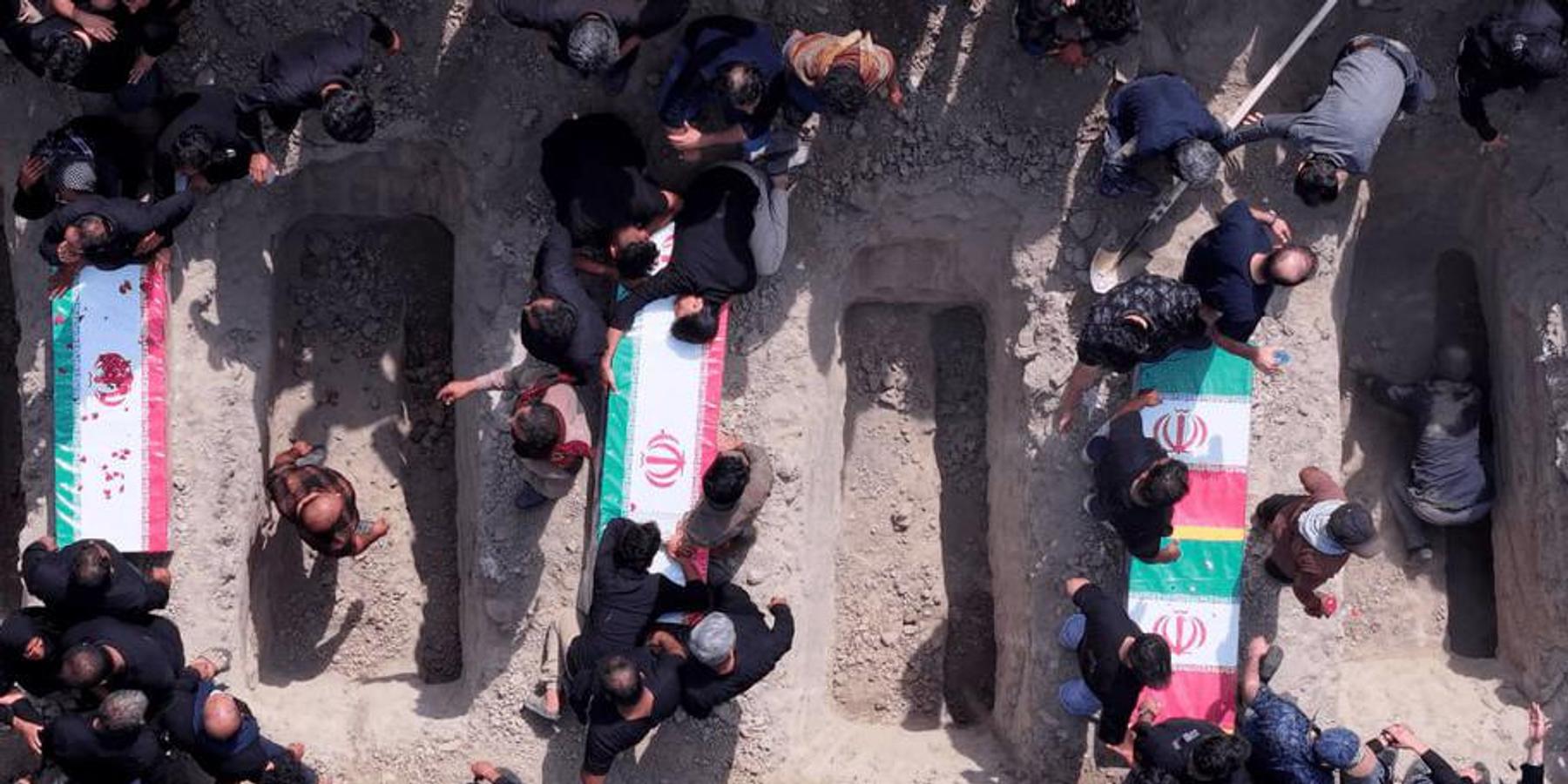
The attack occurred on February 28 in Minab, Iran, and killed at least 165 people — mostly school-aged children. Although the U.S. stresses it would not deliberately attack a school, subsequent investigation by American military investigators points the finger at Washington, as do remnants of a U.S.-made Tomahawk missile recovered from the site. (Only the U.S., the UK, and Australia have Tomahawk missiles.) CBS news reported that the strike on the school might have been an accident, perhaps sprung from outdated intelligence wrongly identifying it as still part of a nearby Iranian base.

Although the Trump administration says it is investigating the attack, President Trump has repeatedly asserted that an Iranian misfire, rather than a U.S. attack, was behind it.

That assertion is now sparking critical questions from reporters. As New York Times reporter Shawn McCreese pressed President Trump yesterday: “You just suggested Iran got a Tomahawk and bombed its own elementary school. But you're the only person in your government saying this. Even your defense secretary wouldn't say that. Why are you the only person saying this?”

That forced Trump to admit he “didn’t know enough” about the school attack, but would accept the findings of an investigation on it. “Whatever the report shows, I’m willing to live with that report,” Trump said yesterday.

But the skepticism has been slow to arrive, and the press has ultimately made some critical stumbles covering the school attack. On NBC’s Meet the Press Sunday, Kristen Welker toed the U.S. line, asking Iranian Foreign Minister Abbas Araghchi: “President Trump said Iran is responsible for [the school] strike. What is your response?” After Araghchi responded that the U.S. likely struck the school, Welker pressed him for evidence — failing to mention reporting suggesting the U.S. was behind the attack.

Moreover, the school attack did not at first receive substantive coverage in major outlets, despite its severity. As media analyst Adam Johnson observed on his Substack, the attack did not garner any front page coverage by New York Times, The Washington Post or The Wall Street Journal from February 28 through March 4.

“I am really shocked at the almost non-reporting…of the striking of a school in Iran in which 80–100 children may have been killed,” Ben de Pear, a former editor at Channel 4 News, wrote on social media. “I fear that we have become so inured to the killing of children in Gaza, that the destruction of the [girls’] school” has been “completely drowned out.”

“In the days that followed [the attack], you could watch the wall-to-wall coverage on U.S. cable news networks for hours, including the supposedly more progressive MS Now, and not see anything about the atrocity — even though there was plenty of visual evidence available,” observed James North, Mondoweiss’ Editor at Large.

As Gregory Shupak, who teaches media studies at the University of Guelph in Canada, tells RS, many articles covering the U.S.-Israeli war on Iran do not even mention the school attack. Shupak used the media aggregator Factiva to assess how much the New York Times, Wall Street Journal, and Washington Post have covered the incident. These outlets published 318 pieces that mentioned both Iran and the U.S. between from March 1 to March 9, but only 59 of those articles contained the word school, according to Shupak.

“That’s just 19%,” he said. “In other words, 81% of the material these outlets have run on the U.S.-Israeli war of aggression overlooks this horrific massacre, which suggest[s] that they don’t think the slaughter is terribly important or a crime that ought to have a major impact on how their audiences understand the war and its stakes.”

“This atrocity has received far too little attention in coverage of the U.S.-Israeli war on Iran,” Shupak stressed.

Senators Brian Schatz (D - Hawaii), Patty Murray (D - Wash.), Jeanne Shaheen (D - N.H.), Jack Reed (D - R.I.), Mark Warner (D - Va.), and Chris Coons (D - Del.), released a statement demanding a probe into the school attack Sunday, signaling public anger over it is growing.

“The killing of school children is appalling and unacceptable under any circumstance. This incident is particularly concerning in light of Secretary Hegseth’s openly cavalier approach to the use of force, including his statement that U.S. strikes in Iran wouldn’t be bound by ‘stupid rules of engagement,’ in his words,” the lawmakers wrote.

The civilian toll of the war in Iran, where Al Jazeera reports the U.S. and Israel have struck more than 20 schools, continues to mount. The Iranian government reports at least 1,300 people have died.


Top Image Credit: March 3, 2026, Minab, Hormozgan, Iran: Iran holds a funeral ceremony for students and staff members of the Shajareh Tayyebeh girls' elementary school who were killed in a strike on the school in Minab, Hormozgan, southern Iran. On February 28, 2026, 'Operation Epic Fury,' a joint Israeli-U.S. military operation, targeted multiple locations across Iran, including a girls' school in Minab near an IRGC base. The school was hit by three missile attacks, resulting in at least 201 deaths and 747 injuries, according to the Iranian Red Crescent, though the toll remains unverified due to restricted media access in Iran. While Iran blamed the U.S. and Israel, the U.S. Central Command is investigating the incident, and Israel stated it was unaware of any operations in the area. The attacks intensified after the air strike that killed Iran's Supreme Leader Khamenei and several senior commanders. (Credit Image: © Ircs via ZUMA Press Wire) Reuters Connect
google cta
Analysis | QiOSK
Dan Caine
Top photo credit: Secretary of War Pete Hegseth and Chairman of the Joint Chiefs of Staff U.S. Air Force Gen. Dan Caine conduct a press briefing on Operation Epic Fury at the Pentagon, Washington, D.C., March 4, 2026. (DoW photo by U.S. Navy Petty Officer 1st Class Alexander Kubitza)

Did Caine just announce the Morgenthau option for Iran?

QiOSK

Gen. Dan Caine’s formulation of American war aims in Iran is remarkable not because it is bellicose, but because it is strategically incoherent.

In a press conference Tuesday morning, the chairman of the Joint Chiefs of Staff did not describe a limited campaign to suppress missile fire, blunt Iran’s naval threat, or even impose a severe but bounded setback on Tehran’s coercive instruments. He described a campaign against Iran’s “military and industrial base” designed to prevent the regime from attacking Americans, U.S. interests, and regional partners “for years to come.” In an earlier briefing he put the objective similarly: to prevent Iran from projecting power outside its borders. Rather than the language of a discrete coercive operation, this describes a war against a state’s capacity to regenerate power.

keep readingShow less
Mbs-mbz-scaled
UAE President Sheikh Mohammed bin Zayed al-Nahyan receives Saudi Crown Prince Mohammed bin Salman at the Presidential Airport in Abu Dhabi, United Arab Emirates November 27, 2019. WAM/Handout via REUTERS

Is the US goading Arab states to join war against Iran?

QiOSK

On Sunday, U.S. Ambassador to the U.N. Mike Waltz told ABC News that Arab Gulf states may soon step up their involvement in the U.S.-Israeli war on Iran. “I expect that you'll see additional diplomatic and possibly military action from them in the coming days and weeks,” Waltz said.

Then, on Monday morning, Sen. Lindsey Graham (R-S.C.) slammed Saudi Arabia for staying out of the war even as “Americans are dying and the U.S. is spending billions” of dollars to conduct regime change in Iran. “If you are not willing to use your military now, when are you willing to use it?” Graham asked. “Hopefully this changes soon. If not, consequences will follow.”

keep readingShow less
Why Tehran may have time on its side
Top image credit: Iranian army military personnel stand at attention under a banner featuring an image of an Iranian-made unmanned aerial vehicle (UAV) during a military parade commemorating the anniversary of Army Day outside the Shrine of Iran's late leader Ayatollah Ruhollah Khomeini in the south of Tehran, Iran, on April 18, 2025. (Photo by Morteza Nikoubazl/NurPhoto)

Why Tehran may have time on its side

QiOSK

A provocative calculus by Anusar Farrouqui (“policytensor”) has been circulating on X and in more exhaustive form on the author’s Substack. It purports to demonstrate a sobering reality: in a high-intensity U.S.-Iran conflict, the United States may be unable to suppress Iranian drone production quickly enough to prevent a strategically consequential period of regional devastation.

The argument is framed through a quantitative lens, carrying the seductive appeal of mathematical precision. It arranges variables—such as U.S. sortie rates and degradation efficiency against Iranian repair cycles and rebuild speeds—to suggest a "sustainable firing rate." The implication is that Iran could maintain a persistent strike capability long enough to exhaust American political patience, forcing Washington toward a premature declaration of success or an unfavorable ceasefire.

keep readingShow less
google cta
Want more of our stories on Google?
Click here to make us a Preferred Source.

LATEST

QIOSK

Newsletter

Subscribe now to our weekly round-up and don't miss a beat with your favorite RS contributors and reporters, as well as staff analysis, opinion, and news promoting a positive, non-partisan vision of U.S. foreign policy.