

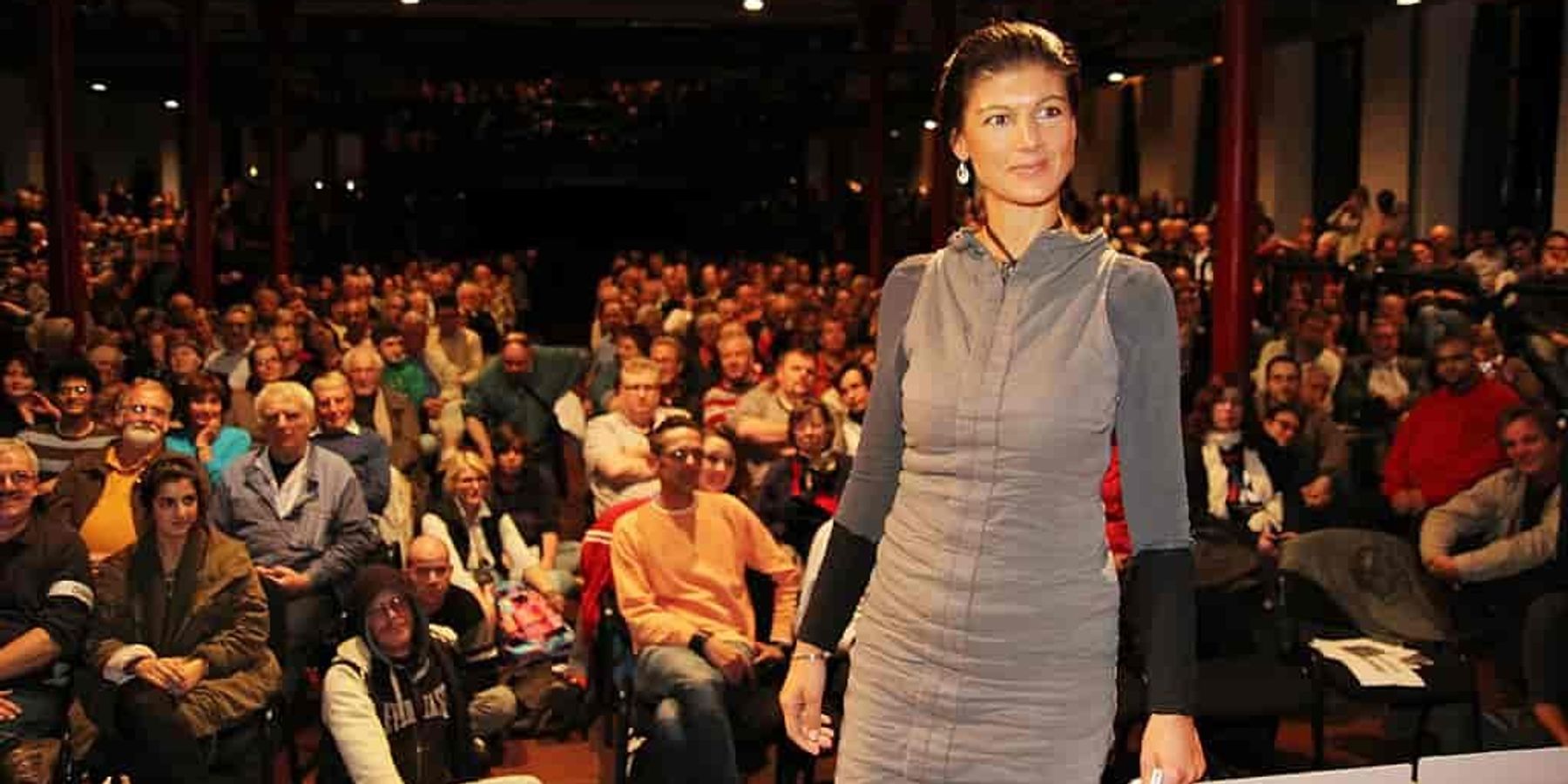
The long-anticipated move by leftist MP Sahra Wagenknecht to form a new left-populist party opens the prospect of a more active debate within Germany on the policy course taken by the now highly unpopular coalition of Social Democrats, Greens and liberal Free Democrats (FDP).
The potential appeal of this new party will depend largely on whether voters agree that the policy of supporting Ukraine is responsible for Germany’s economic downturn.
Party Configuration
The German political scene has evolved in recent decades away from the alternation in power of the center right Christian Democrats (CDU/CSU) and the center left Social Democrats (SPD), often with the FDP in coalition with one or the other of these, to present a spectrum of parties including the center left Green party, the far-left Die Linke (the Left) party and the right-wing nationalist Alternative for Germany (AfD).
With the lone exception of AfD, these parties all broadly support Ukraine’s war effort, until Ukraine itself is ready to seek a negotiated settlement. CDU/CSU support now stands at 29.4%. The AfD comes second with 21.2%. Support for the three governing parties together has fallen to 35.6%.
The AfD’s spectacular rise in polls seems to many analysts to suggest a generalized dissatisfaction with the status quo, and not necessarily the sudden conversion of many Germans to far-right extremist views. Wagenknecht has called this a “representation gap,” one that her party would seek to exploit.
The long-anticipated announcement on October 23 of the launch of a new party led by Die Linke MP Sahra Wagenknecht makes the course of German politics much less predictable. Even more than the AfD, the new party foregrounds its opposition to the prevailing stance on the war in Ukraine.
Antiwar politics and the "representation gap"
A majority of Die Linke’s Bundestag delegation has backed tough sanctions against Russia, while still opposing weapons exports to Ukraine. Tensions within the parliamentary delegation grew as Wagenknecht, in public and in the Bundestag, assailed the sanctions policy and called for the opening of negotiations to end the war in Ukraine. The party has hovered since the last election just below the 5% threshold of support needed to win representation in the Bundestag. The breaking away of Wagenknecht and her nine colleagues from the Die Linke faction reduces that party to a parliamentary group, rather than a faction, affecting its funding and other prerogatives in the Bundestag.
Wagenknecht and the nine other Die Linke MPs who have joined her effort to form the new party have provisionally named it the Sahra Wagenknecht Alliance. They plan to have the party officially formed and ready to contest the European Parliament elections of June 2024 and three state elections in Saxony, Thuringia, and Brandenburg (all in the former East Germany) later next year. This timing seems well chosen: European Parliament elections are typically favorable to smaller parties, and many voters in the eastern states are, for various reasons, favorable to the Wagenknecht initiative.
A snap poll reported on October 31 found that 14% of voters could imagine themselves voting for the new party. This would immediately place it in fourth place, behind the CDU/CSU, AfD, and the SPD, and ahead of the Green party. The new party’s impact would be felt mostly on the AfD, but would attract support from all parties other than the Greens and Die Linke itself.
Wagenknecht’s stated aim is to fill a “representation gap,” which means her party will seek to represent those German voters who do not support further arming of Ukraine and who favor efforts to settle the conflict through diplomacy. Evidence of the existence of this gap is the spectacular rise of AfD which began just after Russia’s invasion in February of 2022 (when AfD support stood at 9.5%) and more recent polls placing AfD support above 20% since mid 2023.
As of March of this year, about 30% of Germans found the arming of Ukraine to have been excessive, and a small majority — 52% — said diplomatic efforts to end the conflict had not been adequate. More recently, a majority (52%) opposed providing Taurus missiles to Ukraine.
Wagenknecht's anti-war popularity
Wagenknecht has been an MP since 2009 and was co-leader of Die Linke in the Bundestag from 2015 to 2019. Born in East Germany, she became active after 1989 in the post-communist Party of Democratic Socialism, initially heading its leftmost, avowedly communist wing. The PDS merged with disaffected leftists of the west German SPD in 2007 and became Die Linke, which for some time enjoyed some electoral success, including in western Germany. Former SPD leader and finance minister, Oskar Lafontaine, was co-founder of Die Linke and is Wagenknecht’s husband.
Because of her frequent appearances on political talk shows, Wagenknecht is fairly well known to the German public. Often the lone dissenter against the prevailing posture on Ukraine, her arguments are always persuasive, articulate and above all dispassionate. She is a controversial figure, but one that remains among the most popular German politicians. A recent poll showed her finishing third behind Defense Minister Pistorius and CSU leader Markus Söder in national approval ratings.
Ukraine War positions: AfD and Wagenknecht
Although AfD’s published program states that there can be no viable security order in Europe that excludes Russia, this issue is not often emphasized in their appeal to voters. By contrast, Sahra Wagenknecht’s notoriety is entirely wedded to her very public antiwar stance. In February 2023, Wagenknecht joined Alice Schwarzer, a leading anti-war activist and editor of the feminist journal EMMA, to put forward a Manifest für Frieden (Manifesto for Peace) and inviting signatures online.
The antiwar demonstration in Berlin on February 25, led by Wagenknecht and Schwarzer, attracted participation by about 10,000 people, but did not produce the momentum that the organizers might have hoped for.
Wagenknecht has called herself a “conservative leftist,” faulting Die Linke with having built its support base among younger, urban progressive voters while allegedly neglecting voters of the working class. This dispute has taken the form of a contest between an identity vs a class basis of leftist politics. Wagenknecht argues for the refocus of the left on defense of the interests of the German working class. She has sounded some caution about what she sees as excessive openness to flows of migrants.
What does it mean?
The launch of organizational efforts to form Wagenknecht’s new party opens the prospect of a more active debate within Germany on the policy course taken by the weak governing coalition. Wagenknecht has stated that she and her party will not cooperate with AfD. The AfD made a very strong showing in recent state elections in the prosperous western states of Hesse and Bavaria, suggesting that its own potential is not confined to eastern Germany. By filling a tempting “gap” in German politics, the Wagenknecht alliance could endeavor to to curb the rise of AfD.
- European Parliament elections: Not quite a 'Trumpian moment' | Responsible Statecraft ›
- Backlash against war, migration, economy in German elections | Responsible Statecraft ›
- Anti-war sentiment has Germany's ruling party on the run | Responsible Statecraft ›
- Economic woes stifle Germany’s governing coalition | Responsible Statecraft ›
- Does Germany’s ruling coalition have a peace problem? | Responsible Statecraft ›