
Follow us on social

google cta
Colby: Israel is fighting a different war in Iran

Colby: Israel is fighting a different war in Iran

In a Tuesday hearing, the undersecretary of defense for policy said there is no regime change objective and assassination of the ayatollah was part of ‘Israeli operations’

Reporting | QiOSK
google cta
google cta

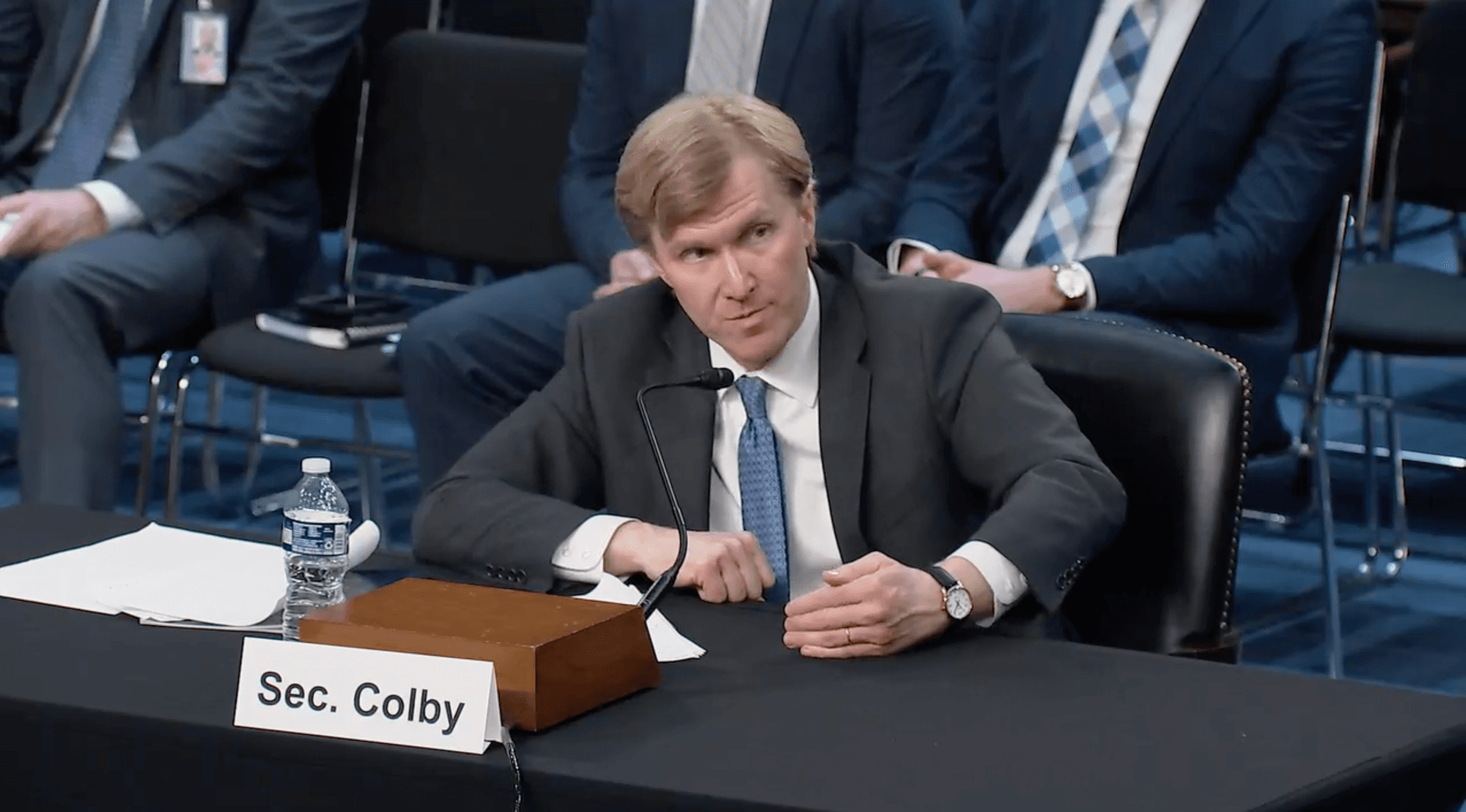
The U.S. is pursuing “scoped and reasonable objectives” in its military campaign against Iran and is not seeking regime change through force, argued Undersecretary of Defense Elbridge Colby in a Tuesday Senate hearing.

When pressed about why the campaign began with the killing of Iranian Supreme Leader Ali Khamenei, Colby declined to comment directly. “I’m talking about the goals of the American military campaign,” he told the Senate Armed Services Committee. “Those are Israeli operations.”

The comments come as the Trump administration is increasingly seeking to place the responsibility on Israel for the growing war with Iran. On Monday, Secretary of State Marco Rubio said the U.S. decided to attack because “we knew that there was going to be an Israeli action” against Iran.

“And we knew that if we didn't preemptively go after them before they launched those attacks, we would suffer higher casualties,” Rubio told reporters. “And then we would all be here answering questions about why we knew that and didn't act.”

Israeli officials have pushed back on these claims, with anonymous sources telling Axios that Israel could only have moved forward with explicit approval from Trump. “If Trump had preferred to keep negotiating, the strike would have been postponed,” Axios reported, citing anonymous Israeli officials.

The back-and-forth puts a spotlight on the Trump administration’s desire to distance itself from the history of regime change wars in the Middle East, which have often led to prolonged civil wars and instability. Sometimes this has led to confusing statements, like the comment from Secretary of Defense Pete Hegseth that “this is not a so-called regime change war, but the regime sure did change.”

Further muddying the picture have been Trump’s exhortations to the Iranian people to “take over your government” as the bombing campaign continues. Asked about these comments, Colby told the Senate that “this is objectively a historic opportunity” for the Iranian people.

“One of the reasons this isn't an example of nation-buildling” is “precisely because it is looking to the Iranian people to take the initiative,” Colby argued, adding that American goals are focused narrowly on taking out Iran’s missile program and navy.

Amid these efforts to shift responsibility for the war’s consequences, it appears that regime change efforts continue apace. On Tuesday, Israel bombed a meeting of the Iranian Supreme Council in which the government’s remaining leaders were deciding who would take over the country after Khamenei’s death.

“Israel struck while they were counting the votes for the appointment of the supreme leader,” an anonymous senior Israeli official told Fox News.


Top image credit: Undersecretary of Defense for Policy Elbridge Colby speaks at a hearing of the Senate Armed Services Committee. (Screengrab via armed-services.senate.gov)
google cta
Reporting | QiOSK
US missiles
Top photo credit: . DoD photo by Staff Sgt. Vince Parker, U.S. Air Force.

Trump: We have 'unlimited' weapons to fight 'forever' war

QiOSK

In a startling Truth Social post overnight on Monday, President Donald Trump defied reality and claimed that U.S. weapons were "unlimited" and the U.S. could fight "forever" with "these supplies."


keep readingShow less
Did the US only attack Iran because of Israel?
Top image credit: President Donald J. Trump holds a joint news conference at the White House with Israeli Prime Minister Benjamin Netanyahu on Feb. 4, 2025. (Shutterstock/ Joshua Sukoff)

Did the US only attack Iran because of Israel?

QiOSK

In the months that led up to the Iraq War, the Bush administration went to extraordinary lengths to convince the world of the need to oust Iraqi dictator Saddam Hussein. Leading officials laid out their case in public, sharing what they claimed was evidence that Iraq was moving rapidly toward the deployment of chemical, biological and nuclear weapons. When U.S. tanks rolled across the border, everyone knew the justification: the U.S. was determined to thwart Iraq’s development of weapons of mass destruction, however fictitious that threat would later prove to be.

In the months that led up to the Iran War, the Trump administration took a different tack. President Trump spoke only occasionally of Iran, offering a smattering of justifications for growing U.S. tensions with the country. He claimed without evidence that Iran was rebuilding its nuclear program after the U.S.-Israeli attack last June and even developing missiles that could strike the United States. But he insisted that Tehran could make a deal with seven magic words: “we will never have a nuclear weapon.”

keep readingShow less
operation epic fury
Top photo credit: A screengrab from a video released by U.S. Central Command (CENTCOM), which accompanied a press release describing the operation dubbed "Epic Fury", an attack by the United States and Israel on Iran, shows smoke and dust rising following an explosion at an unknown location. The location and the date when the video was filmed could not be verified. (Reuters)

Six US service members killed in 'Operation Epic Fury': CENTCOM

QiOSK

Update: 3/3 9 a.m. ET: CENTCOM announced two more U.S. military deaths from Sunday's Iranian attack. The Washington Post reports that this was part of the attack on a U.S. base in Kuwait.

Update: 3/2, 8:30 a.m. ET: CENTCOM announces that a fourth member of the U.S. military has died from injuries sustained from Iranian attack Sunday. The brief announcement does not go into any detail in regards if this is the same attack in Kuwait reported below.

keep readingShow less
google cta
Want more of our stories on Google?
Click here to make us a Preferred Source.

LATEST

QIOSK

Newsletter

Subscribe now to our weekly round-up and don't miss a beat with your favorite RS contributors and reporters, as well as staff analysis, opinion, and news promoting a positive, non-partisan vision of U.S. foreign policy.