

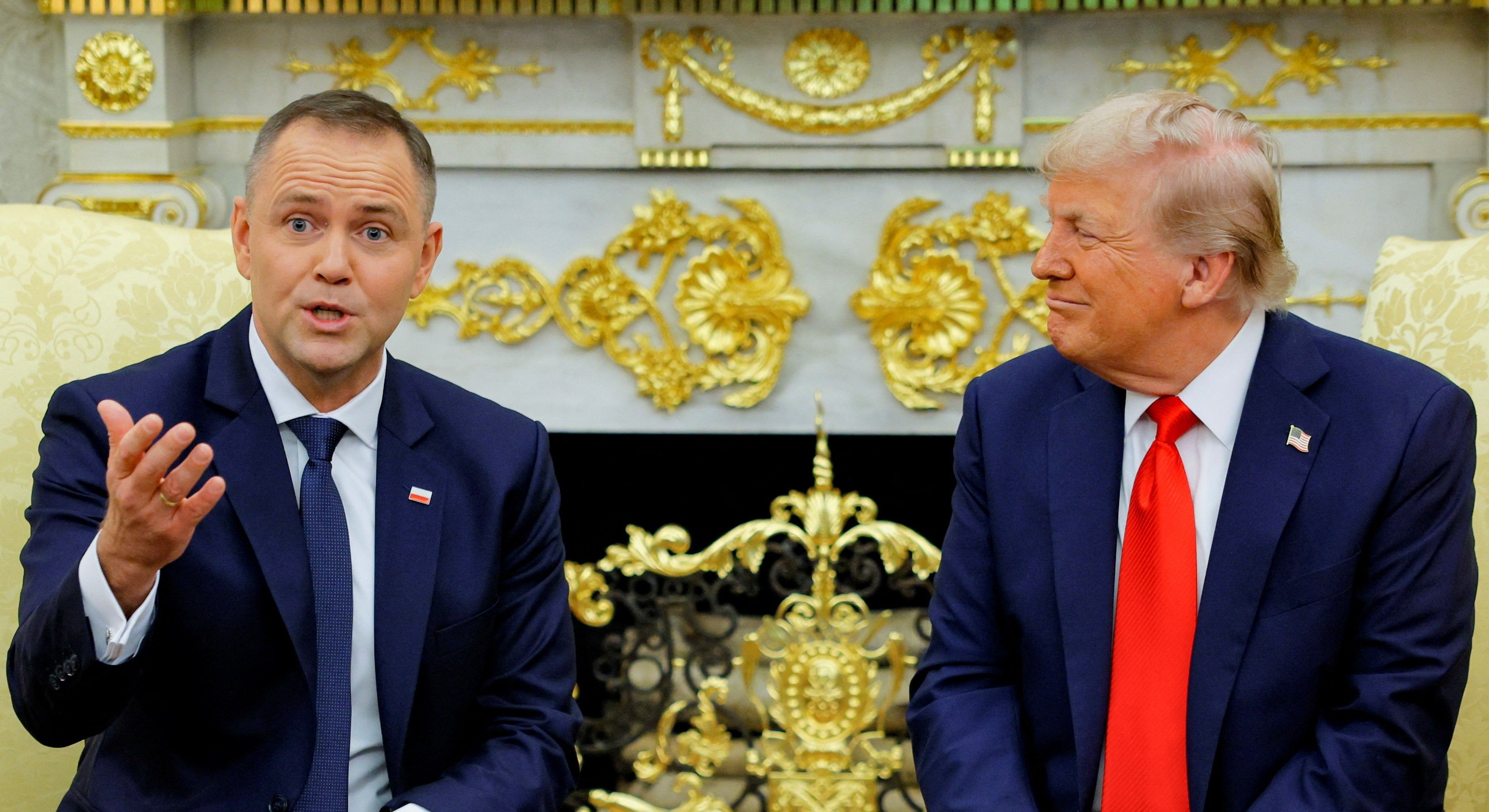
Since taking office on August 6, Poland’s president Karol Nawrocki has stood in sharp opposition to Prime Minister Donald Tusk and his cabinet, drawn from a somewhat fragile coalition of center right and center left parties.
Nawrocki’s challenge to Tusk primarily revolves around disputed judicial reforms, abortion rights, migration, and the role of the Catholic church — all emblematic of a conservative political and social agenda.
But foreign and security policy differences matter as well. Both men see Russia as Poland’s primary threat and agree that the U.S. military support is crucial. Neither Tusk nor Nawrocki want to commit Polish troops to a “reassurance force” in postwar Ukraine, prioritizing instead Poland’s own national defense. Poland spends 4.5% of GDP on defense, a higher share than any other NATO member, and it has a strong preference for American equipment and weapons.
There are, however, substantial differences between Nawrocki’s outlook and that of Tusk on the European Union and bilateral relations with Germany and Ukraine. Nawrocki, backed by the right populist Law and Justice Party (PiS) that governed Poland from 2015 to 2023, has clearly chosen foreign and defense policy to focus his challenge to Tusk’s government, in the expectation that PiS and parties to its right can prevail in the next parliamentary elections, to be held no later than 2027.
Contending for Trump’s favor
Nawrocki’s visit to the White House on Wednesday followed an open dispute with Tusk and his foreign minister Radoslaw Sikorski. Although the prime minister has the principal constitutional authority in foreign policy, Nawrocki has staked out an independent role for himself. He clearly has a better rapport with Trump than the pro-EU and pro-Ukraine Tusk. A conservative “sovereigntist,” Nawrocki is aligned with Trump’s domestic policy agenda on migration and social issues.
Breaking with established practice, Nawrocki invited no one from the Foreign Ministry nor even Poland’s ambassador to attend the meeting.
Though at odds on several other issues, Nawrocki and the Tusk government agreed that he should seek assurances that the U.S. troop deployments in Poland would not be reduced. Trump enthusiastically agreed to this in the presidents’ press availability on Wednesday.
In an X post addressed to Nawrocki on the eve of the meeting, Sikorski asked Nawrocki to “make clear” to Trump Putin’s “real intentions” in Ukraine and to insist that Trump agree to pursue a “just peace.” Seated beside Nawrocki, Trump told reporters he wanted to stop the daily loss of life by both Russian and Ukrainian soldiers, and that he would continue to try to end the war. Nawrocki did not interject anything, and appeared throughout to agree with all of Trump’s responses to reporters’ questions. Trump also declined a reporter’s invitation to “send a message” to Putin.
Nawrocki views on Ukraine
During his winning presidential campaign, Nawrocki declared his opposition to NATO membership and EU accession for Ukraine, positions that are sharply at odds with the Tusk government’s stance. He recently vetoed a proposed extension of financial support for Ukrainian refugees in Poland, which may also have implications for Poland’s funding of Starlink communications for Ukraine.
Nawrocki’s career has been devoted to advancing a strongly nationalist interpretation of Poland’s history in the 20th century, as director of the Institute of National Remembrance (IPN) and of the World War II history museum in Gdansk. The Volhynia massacre, mass killings and expulsions in 1943 of Poles by Ukrainian nationalists in two regions of eastern Poland (now western Ukraine) has been a major preoccupation of the IPN. Ukraine’s leaders cannot readily condemn the Ukrainian nationalists who perpetrated the massacre, because of the esteem they enjoy among many Ukrainians. This controversy remains an obstacle to unreserved reconciliation with Ukraine in the minds of nationalist-traditionalist Poles, the core of Nawrocki’s electorate. Nawrocki has recently called for banning the display in Poland of Ukrainian nationalist flags.
Nawrocki views on Germany and the EU
Nawrocki commemorated the September 1 anniversary of the beginning of WWII in the 1939 German attack on the port of Gdansk with a passionate speech calling for German reparations for the deaths and destruction Poland suffered under occupation. This demand was a source of tension with Germany during the PiS government.
Tusk replied that Poland should prioritize its strong rapport with Germany and not to allow the reparations issue to undermine the spirit of European unity, especially given the danger posed by Russia. Germany for its part continues to argue that the reparations issue has long been closed. Tusk has accepted Germany’s repeated official admissions of responsibility and contrition, in part to protect Poland’s standing within the EU. Nawrocki clearly does not have the same sensitivities.
Tusk and his cabinet are also committed fully to the EU and to respecting the European Commission’s critique of the PiS-era judicial reforms, seen as undermining judicial independence. Tusk and his government value American military support, but also see Poland’s security enhanced through rising to the top table of EU decision making in the so-called Weimar group with Germany and France.
Nawrocki shares in part the worldview of Hungary’s Viktor Orban or Slovakia’s Robert Fico, but does not support their inclination to accommodate Russia’s demands on Ukraine. Nawrocki is interested in prioritizing relations with neighbors in Central and Eastern Europe, the Baltic countries, Denmark and Sweden. He clearly intends to conduct presidential diplomacy without seeking permission from the Tusk government.
Effects of the power struggle
A Poland riven by conflict is certainly bad news for the EU. The bitter contest in a polarized political environment is tantamount to a permanent election campaign, with actual elections nearly two years away. While the Tusk government stands firm with the EU consensus on full support for Ukraine, Nawrocki seems to believe his Euro-skepticism, strong commitment to increased defense spending, and unambiguous preference for falling in behind American leadership will see Poland through turbulent times.
- Polish elections: One place where the war isn't splitting voters ›
- Poland, Romania and the nationalist populist challenge ›
- Trumpism finds a home in Poland ›
- Populist, EU-Ukraine skeptic wins big in Czech elections | Responsible Statecraft ›
- Poland’s Janus face on Ukraine is untenable | Responsible Statecraft ›
- Euroskeptics in France, Germany suddenly gain steam in elections | Responsible Statecraft ›