

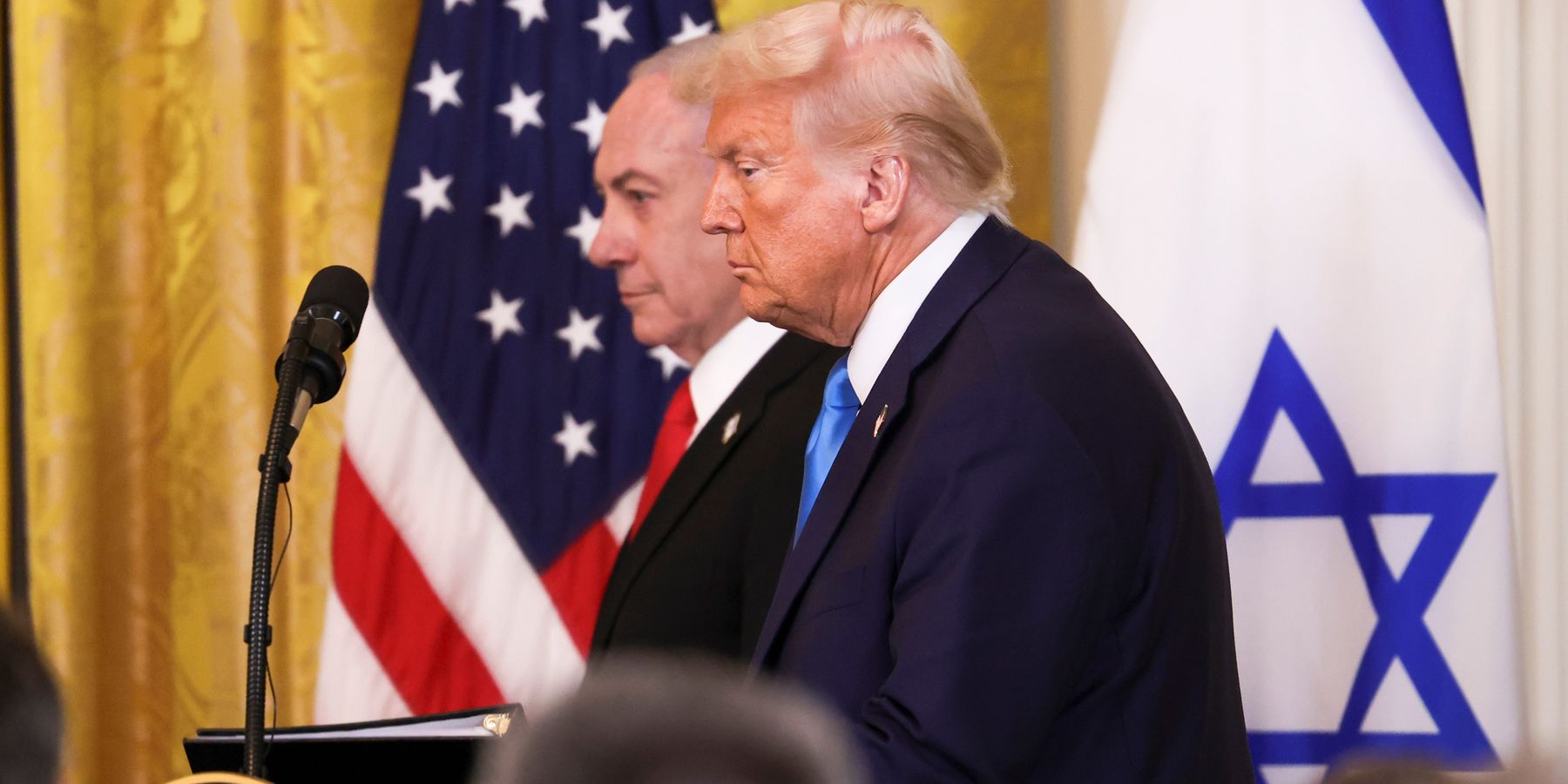
On Monday, Israeli Prime Minister Netanyahu will arrive in Washington for his third visit of Trump’s second term. Today also marks 21 months of Israel’s war on Gaza. The purpose of the visit remains unclear, and speculation abounds: will Trump and Netanyahu announce a real ceasefire in Gaza? Will Syria join the Abraham Accords? Or might Trump greenlight even broader Israeli action against Iran?
Before Netanyahu’s visit, Trump posted an ultimatum on Truth Social, claiming Israel had agreed to a 60-day ceasefire. He urged Hamas to accept the terms, threatening that “it will only get worse” if it doesn’t. Although Trump intended to pressure Hamas, reiterating a longstanding narrative that portrays the group as the obstacle to peace, Hamas has long maintained that it will only accept a ceasefire if it is part of a process that leads to a permanent end to Israel’s war and its complete withdrawal from the enclave. Netanyahu, for his part, remains adamant that the war must continue until Hamas is eliminated, a goal that even the IDF has described as not militarily viable.
As of Thursday, the purported terms of the U.S.-proposed ceasefire deal were shared on social media, although neither Hamas nor Israel has publicly committed to it.
Trump’s diplomatic theatrics extend beyond a possible Gaza ceasefire. Instead of leveraging U.S. military assistance to end Israel's bombardment and humanitarian blockade of the Strip, Trump signaled he might condition continued American security assistance on Israel halting ongoing corruption proceedings against Netanyahu. “The United States of America spends Billions of Dollar [sic] a year, far more than on any other Nation, protecting and supporting Israel,” Trump posted on his Truth Social. “We are not going to stand for this.”
By publicly linking U.S. military support — Israel’s lifeline — to Netanyahu’s personal legal battles, Trump is effectively exerting pressure on Israel’s judiciary, a remarkable intervention in its domestic affairs on the prime minister’s behalf. Such bold statements are meant not only to influence Netanyahu's decisions, but also to focus public and international attention around Trump’s preferred outcomes.
Meanwhile, the humanitarian crisis in Gaza worsens daily. The Gaza Humanitarian Foundation (GHF), backed by Israel and the U.S., which this week announced it was providing $30 million to the group, faces severe international condemnation. On Thursday, reports emerged that U.S. military contractors have been firing on starving civilians, echoing previous reports from IDF soldiers that they were ordered to shoot at desperate Palestinians seeking food aid.
Over 170 humanitarian and human rights NGOs, including international heavyweights like Oxfam, Save the Children, and Doctors Without Borders, have called for the immediate shutdown of the GHF, pointing to the deaths of more than 600 Palestinian civilians near GHF aid distribution hubs since the controversial group began operating with IDF support in late May. Adding credibility to these criticisms, the Swiss government recently dissolved GHF's Geneva branch, citing grave operational and legal violations amid ongoing reports of violence at GHF sites. These developments highlight the tragic politicization and increasing danger associated with humanitarian relief in Gaza.
Trump also appears determined to expand the Abraham Accords. White House Press Secretary Karoline Leavitt told the press that when Trump met Syria’s new president, Ahmed al-Sharaa, in Saudi Arabia last month, he asked the former Islamist insurgent to normalize relations with Israel and then lifted some targeted U.S. sanctions on Syria. Israeli Foreign Minister Gideon Sa’ar echoed this sentiment, publicly supporting expansion of the Accords to include Syria and Lebanon, while firmly reasserting Israel’s claims to the Golan Heights.
Damascus confirmed that it was engaged in both direct negotiations and UAE-facilitated backchannels with Jerusalem. However, much like Trump’s ceasefire messaging, the Syria angle risks being primarily political theater. Expanding the Accords without tangible progress on Palestinian rights or ending the Gaza siege will ring hollow, serving mainly to bolster the domestic political positions of both Trump and Netanyahu while masking the lack of meaningful steps toward peace.
While regional actors, especially America’s Gulf allies, warily watch the fragile ceasefire between Israel and Iran, Israeli media report that Netanyahu intends to seek Trump’s backing for another attack on Iran. The recent 12-day war with Iran has strengthened Netanyahu politically at home, allowing him to emerge as the bold leader who confronted Iran rather than the embattled and widely distrusted prime minister who failed to prevent Hamas’s October 7 attacks or secure the release of Israeli hostages still held in Gaza.
After narrowly surviving a no-confidence vote on June 11 that exposed his political vulnerabilities, Netanyahu leveraged his attack on Iran conflict to consolidate power. Some observers hope this newfound strength could encourage Netanyahu to finally end the war on Gaza, given that he may be less beholden to the most extreme right-wing members of his coalition. However, others fear his renewed confidence might prompt even more aggressive regional actions, further destabilizing an already volatile situation.
Ultimately, Monday’s meeting may amount to political theater — a high-profile, but substantively empty spectacle as Israel continues to use American weapons to blockade and bombard Palestinians in Gaza. Without genuine U.S. pressure to end illegal military aggression, halt ongoing atrocities, and genuinely pursue peace and Palestinian rights, megaphone diplomacy will remain little more than noise, amplifying tensions rather than resolving deep-rooted conflicts.
- Polls: Americans don't support Trump's war on Iran ›
- Israeli-fueled fantasy to bring back Shah has absolutely no juice ›
- Netanyahu’s ‘total victory’ rhetoric takes an extreme turn | Responsible Statecraft ›