

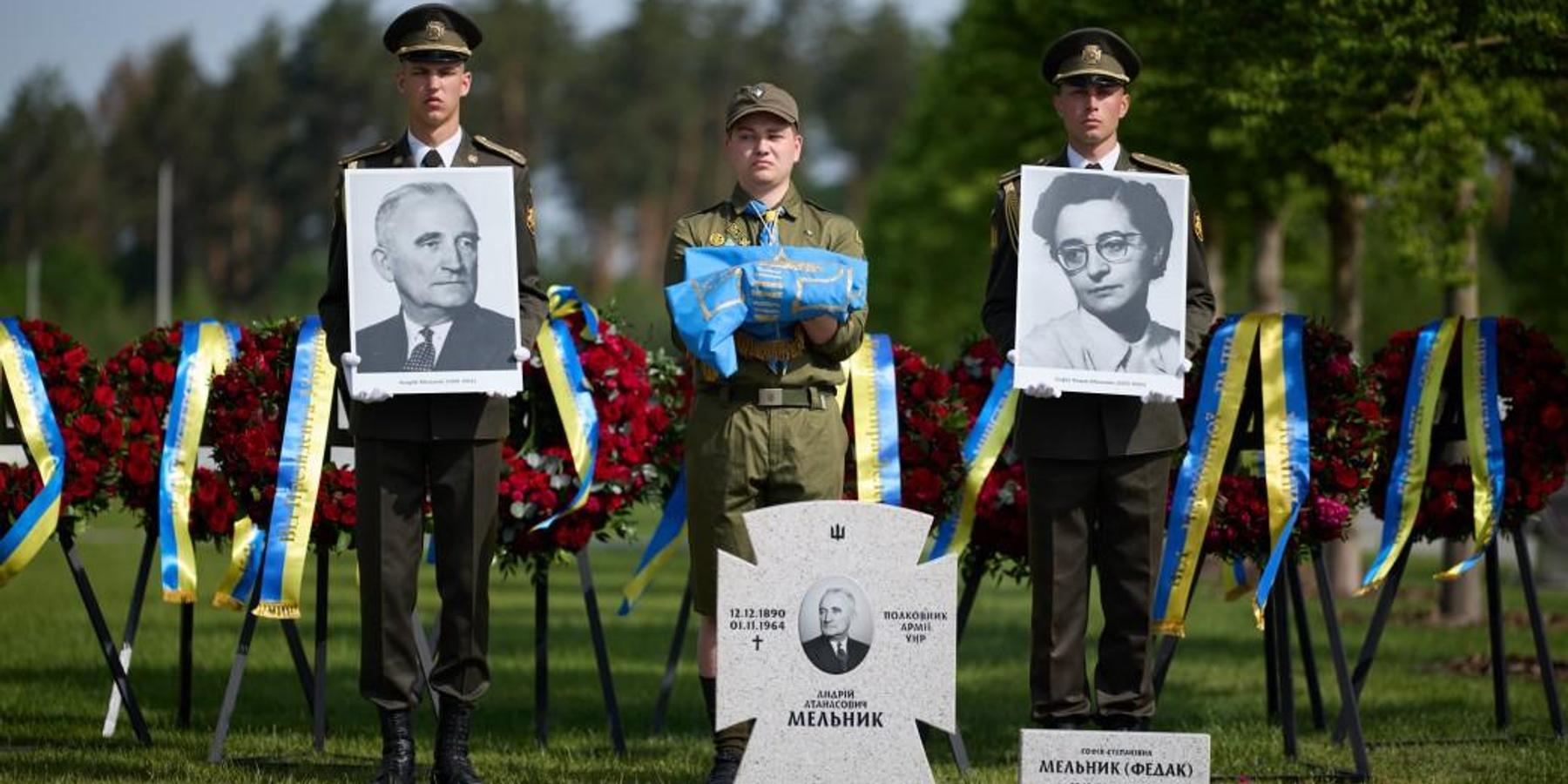
Polish President Karol Nawrocki made headlines recently for stripping his Ukrainian counterpart Volodymyr Zelensky of Poland’s highest honor over Kyiv’s decision to name a military unit after the Ukrainian Insurgent Army (UPA), a partisan formation responsible for massacres during World War II that killed roughly 100,000 Poles. This came shortly after Zelensky kneeled in front of the grave of noted Nazi collaborator Andriy Melnyk as his ashes were reinterred on Ukrainian soil.
More than four years of war have clearly affected the politics of historical memory in Ukraine. Russia’s invasion has given a new impetus to the process of “de-Sovietization” and “decommunization,” with historical symbols that reflect resistance against Russia gaining currency. This trend highlights the importance of achieving a settlement to the war – not only to prevent Ukraine from drifting further away from a European future, but also to preserve the historical memory of the Holocaust, which lies at the core of the postwar European compact.
Zelensky won a landslide victory in 2019, pledging to end what was then a five-year-old war in the Donbas and promising a more inclusive vision than the ethnolinguistic nationalism that had come to define his predecessor Petro Poroshenko’s presidency. The year of his election, he visited the grave of his grandfather, Semen Zelensky, who fought in the Red Army against Nazi Germany. The scale of the volte face is difficult to fathom.
The longer the war with Russia continues, the more remote Ukraine’s European future becomes. This is not only because the task of economic reconstruction will grow more difficult or because the country’s demographic outlook will worsen as refugees become less and less likely to return home. It is also because the replacement of civic nationalism with ethnolinguistic nationalism places Kyiv on a collision course with European norms on minority rights.
Those who tolerate the normalization of the UPA say it is remembered not for its anti-Polish attacks but for its anti-Soviet roots. They note that other countries also celebrate national heroes with a checkered past – Winston Churchill in Britain, Napoleon Bonaparte in France, and the wartime Polish Armia Krajowa, which often killed Ukrainian civilians in its reprisals against the UPA. But this is a false equivalence, and advancing it only makes it more difficult to complete the task one day of building a common European home.
Accusations of genocide have become increasingly commonplace, leveled at China for its human rights abuses in Xinjiang, at Russia for acting on Vladimir Putin’s belief that Russians and Ukrainians are one people, and at Israel for its conduct during its war against Hamas in Gaza. With this term used increasingly liberally, and as World War II fades from living memory, the tendency is for many to assume that the Holocaust was a “genocide” like any other. But this ignores how uniquely evil the Nazis were.
The Nazis did not just commit massacres; they treated genocide like a factory production line. Their atrocities were not driven by traditional aims such as territory, resources or security, but rather by a racial ideology that sought to wipe out every single Jew (along with other Untermenschen, including the Roma and Slavs, who were also targeted for eradication, murder, enslavement or expulsion). For them, World War II was as much a racial war as a great power war.
The Nazis diverted substantial manpower from the frontline to ensure that the gas chambers could operate day and night. At the peak of the Holocaust during Operation Reinhard, they murdered two million Jews in just four months from July to October 1942 – the fastest rate of genocidal killing in history, with roughly 15,000 Jews killed every day. In mid-1944, even as the war effort was growing precarious, they prioritized employing their rail network not to transport materiel to the front, but rather to send more than 430,000 Hungarian Jews in cattle cars to Auschwitz in less than two months.
In 1940, my maternal grandfather’s uncles Yosef and Zyndel Nachtygal were imprisoned along with their families in the ghetto in Łódź, Poland, leaving them trapped inside a mass slave labor camp whose purpose was to supply the Wehrmacht with textiles and other goods. (Half a million Jews died from starvation, disease and overcrowding in Nazi-established ghettos, including nearly 100,000 in Warsaw alone.) Then, in March 1942, those who hadn’t yet died were deported to Chełmno extermination camp, including Yosef’s roughly two-year-old grandson Israel.
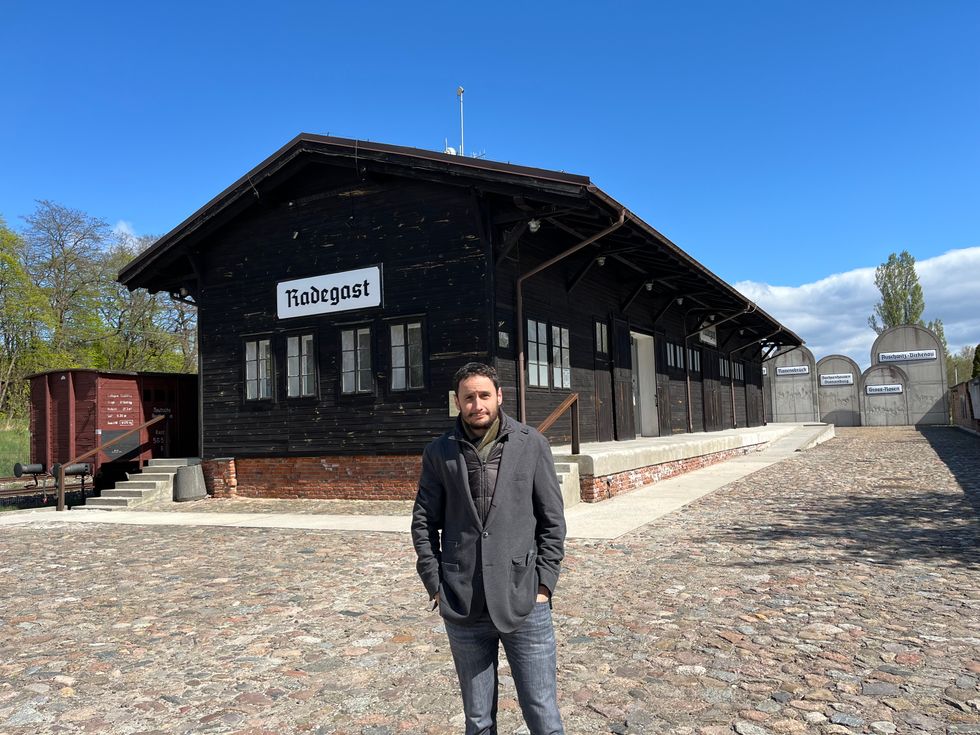 The author stands at Radegast Station in Łódź, Poland, from where his grandfather’s relatives were deported to Chełmno extermination camp. Taken April 29, 2026. (Courtesy of Zachary Paikin)
New arrivals at Chełmno were typically murdered within 60-90 minutes, herded 50-70 people at a time into the cargo hold of a truck under the false impression that they were being transferred elsewhere. In reality, once sealed, the compartment was pumped full of fuel exhaust. Asphyxiation took 10-15 minutes, with victims screaming and banging on the walls for several minutes before their horrific deaths by carbon monoxide poisoning were complete. Their bodies were then disposed of in a nearby forest, the victims’ blood and excrement were cleaned up, and the process was repeated.
The Nazis murdered up to 200,000 Jews at Chełmno using this method. But these mobile “gas vans” were a mere pilot project. Committed to improving the efficiency of their machinery of mass murder, the Nazis later established stationary gas chambers at extermination camps such as Treblinka, Bełżec and Sobibór. Roughly 1.5 million Jews were murdered at those three camps alone, among them my septuagenarian great-great-grandfather Bendet Perelsztajn. From these three locations, fewer than 150 Jews survived.
As the European Union enlarged eastward after the fall of the Iron Curtain, competing historical memories were brought into the same bloc. As a result, today’s discourse depicts the Nazis and Soviets as equal instigators of World War II through the Molotov-Ribbentrop Pact and frames the war as a mere prelude to the enslavement of half of Europe during the Cold War. But while communist regimes committed horrible crimes – indeed, Russians were among their primary victims – this pales in comparison to the extermination and ethnic cleansing of tens of millions of Slavs that the Nazis planned to carry out had they won the war and implemented their “Generalplan Ost.”
These rival historical memories contributed directly to the worsening of relations between Russia and the West and helped to make war in Europe possible again. A stable and durable regional security order will not return until the interests of all stakeholders – including Russia – are reflected in the continent’s main bargains and institutions.
Ukrainian history during World War II is complex. While the UPA and its political architects in the Organization of Ukrainian Nationalists shared in the Nazis’ anticommunism and antisemitism, collaborated with German intelligence, and came to rely on the Nazis for weapons and supplies, the UPA also fought against the Germans for much of the war. And, of course, millions of Ukrainians served in the Red Army.
At the same time, Ukrainian auxiliaries were essential in rounding up and marching more than 33,000 Jews to their deaths in just two days at Babi Yar, where they were systematically murdered by machine-gun fire. Many ethnic Ukrainians served as brutal guards at Nazi extermination camps and helped to liquidate Jewish ghettos. Two Ukrainian battalions marched alongside the Wehrmacht during its invasion of the Soviet Union, and later in the war, a Waffen SS division of Ukrainian volunteers was formed and fought directly under Nazi command.
For the European peace project to succeed, all of its members must be sufficiently socialized into its founding logic. A secure Ukraine anchored within a secure EU will only be possible if Kyiv’s partners forcefully oppose the normalization of figures and entities that knowingly collaborated with modern history’s greatest monsters.
- Far-right Azov quietly grew to tens of thousands in Ukraine military ›
- Ukraine's military has a real Nazi problem ›
- Stepan Bandera is haunting the Ukraine War and Polish elections | Responsible Statecraft ›