

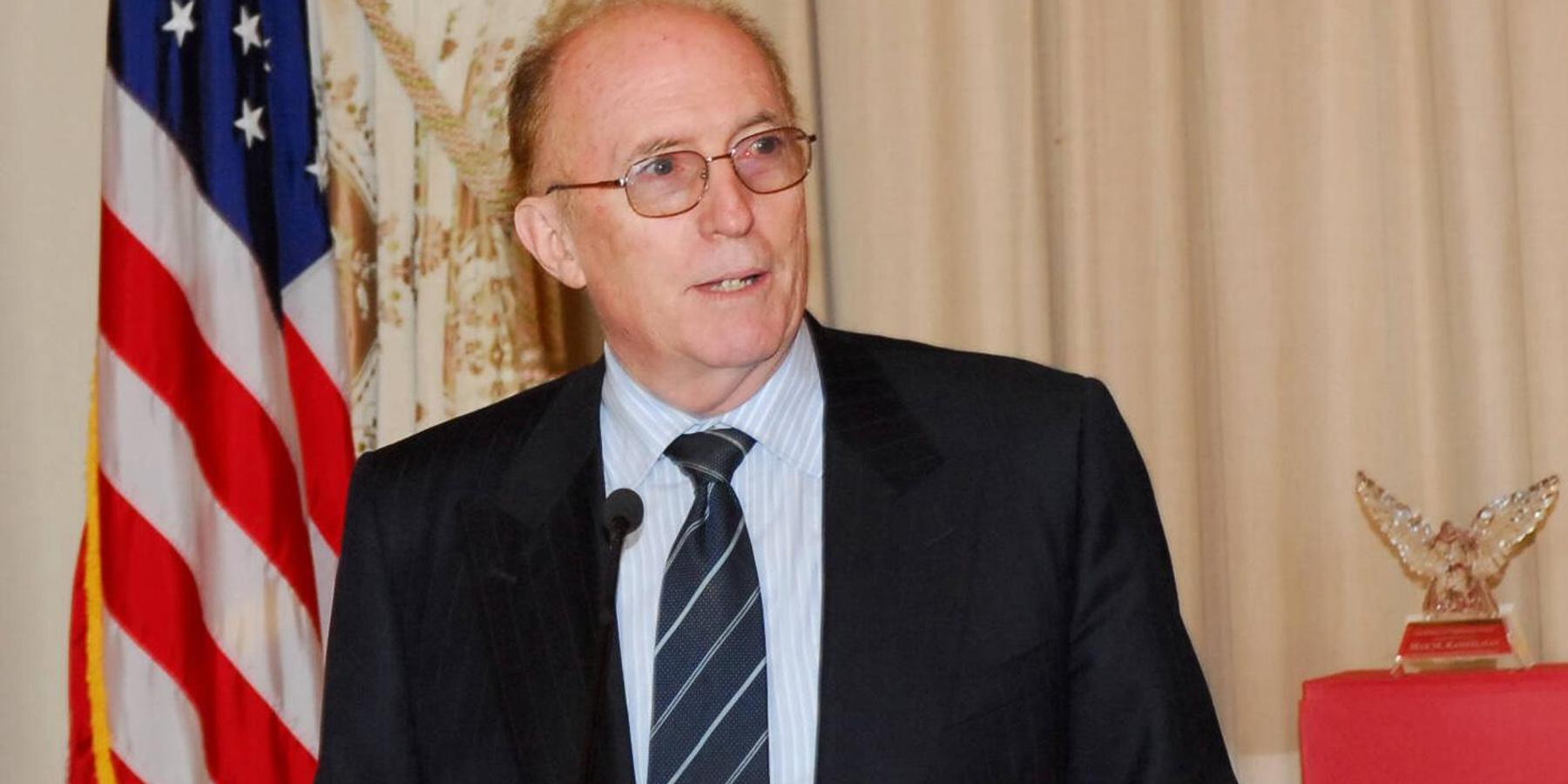
The world of foreign policy restraint is poorer today with the passing of Robert Hunter, an American diplomat, who was the U.S. ambassador to NATO in 1993-1998. He also served as a senior official on both the Western Europe and Middle East desks in President Jimmy Carter’s National Security Council.
For decades, Hunter was a prominent, sober, and necessary voice of restraint in Washington. To readers of Responsible Statecraft, he was an occasional author who shared his insights, particularly on Europe. To those of us who knew Robert personally, he was a mentor and a friend whose tremendous knowledge was matched only by his generosity in sharing it.
Hunter’s strategic vision was forged during the post-Cold War transition, a period of both immense promise and profound peril. While the demise of the Soviet Union prompted many to declare a unipolar “end of history,” Hunter focused on seizing on the momentum to build a durable peace and stability
Drawing historical lessons from the Versailles Treaty at the end of the WWI that imposed harsh surrender terms on Germany and played a major role in fueling a Nazi rise, he warned that excluding Russia from a new security order in Europe would be a fatal mistake. He sought to implement the President George H.W. Bush’s vision of “Europe whole and free.”
In that frame, his views on NATO expansion were characteristically farsighted. He understood and — as the U.S. ambassador — defended the Alliance’s value, but warned that its unbridled eastward expansion devolved more into a triumphalist project rather than a stabilizing one, risking deepening the very divisions it ostensibly sought to heal.
That’s because for Hunter, the ultimate goal was not a larger NATO per se, but a secure Europe — an architecture that would, in time, find a way to include Russia. This conviction made him view the NATO Bucharest Summit decision in 2008 to open the alliance’s doors to Ukraine and Georgia with deep skepticism.
He saw it as a geopolitical turning point, where the inclusive vision of a "Europe whole and free" was sacrificed to the demands of hawks and a misguided sense of hubris that have taken over the U.S. foreign policy since the end of Bill Clinton’s tenure and accelerated on George W Bush’s watch. His warnings that this move would provoke Russia while offering no real security to Kyiv or Tbilisi, turned out to be tragically prescient, foreshadowing the conflicts in Georgia in 2008 and Ukraine from 2014 onward, culminating in the Russian invasion of Ukraine in 2022.
Hunter was not just a theorist; with the like-minded officials in the early Clinton years, he offered an alternative to new divisive lines in Europe in the shape of the Partnership for Peace (PfP). PfP was a creative instrument designed to offer security through a web of practical military and political cooperation across the old Iron Curtain – i.e. including Russia and Ukraine - without the immediate step of formal enlargement of NATO to the exclusion of Russia.
Multiple testimonies, such as M.E.Sarrotte’s “Not One Inch” and Jonathan Haslam’s “Hubris. The American Origins of Russia’s War Against Ukraine,” acknowledge Hunter’s role in nurturing the PfP and the fact that the idea was initially enthusiastically received by Russia’s then-president Boris Yeltsin as a means of ushering the post-Soviet Russia into a more cooperative relationship with the West.
Soon, however, the win-win mindset behind the PfP was brushed aside thanks to the lobbying of Central and Eastern countries, such as Czech Republic, Poland and Hungary, hawks in both Republican and Democratic parties and foreign policy establishment (blob) who saw an opportunity to push for American primacy through the NATO enlargement.
Few officials embraced this new approach with a greater zeal than Clinton’s second secretary of state Madeleine Albright, herself a descendent from Czech refugees, who saw the NATO enlargement as her personal political crusade.
The tragedy of the enlargement was that, once set in motion in a hubristic atmosphere of the post-Cold War era, it has acquired a political and bureaucratic inertia of its own leading to that fateful decision in Bucharest in 2008. While Russia swallowed the Central and Eastern European, and even Baltic countries joining the alliance, it has drawn a thick red line in Ukraine — only to be disregarded by the Western policymakers. For Robert Hunter, such disregard was nothing short of diplomatic malpractice.
That is not to say that Hunter was not clear-eyed about Russia. In our conversations, he lamented that Moscow never really invested in making the NATO -Russia Council work. The Council was another innovative mechanism launched to smooth Russian concerns over the NATO expansion. It was always seen by Moscow as a second-rate consolation prize rather than a serious forum. In Hunter’s view, however, even the format’s inherent limitations do not justify a failure to make a better use of the opportunities it then offered to Moscow.
Further, it was not just the perceived American perfidy, but Yeltsin’s own increasingly erratic ways that undermined the relationship. Post-Soviet Russia failed to modernize into a successful market democracy, instead devolving into a lawless kleptocracy — a major factor explaining Vladimir Putin’s rise. Yeltsin’s dissolving of the Russian parliament and, especially, his horrid war in Chechnya, doubtlessly reinforced the case for NATO membership among Russia’s frieghtened neighbors, especially as the Baltic states.
Robert’s life was richly complemented by his marriage to Shireen Tahmaseeb Hunter, a formidable intellectual force in her own right, the first female Iranian diplomat in history and a pre-eminent scholar of Iran.
Robert’s takes on the Middle East reflected his non-ideological, pragmatic worldview oriented towards conflict resolution. In 2010, he pioneered a study for RAND Corporation on a new security architecture in the Persian Gulf that would include Iran.
Consistent with these views, he strongly supported the 2015 nuclear pact between Iran and the world powers known as JCPOA. He was also scathingly critical of President Trump for foolishly abandoning it in his first term and “painting himself in a corner where war with Iran is the only way out.”
Just few days before his passing, he shared in the Gulf2000, an online community, established by the pre-eminent American Iran hand and Robert’s former colleague at Carter’s national security council, Gary Sick, that “as long as U.S. policy toward the Middle East (including Iran) is not run in the interests of the U.S. but of domestic lobbies, don’t expect anything ‘good’ to come out of it. We paid a heavy price — lives and money — for this in Iraq. Did we learn nothing?”
Personally, I will miss his counsel on both Europe and the Middle East immensely. As a European, it pains me particularly that Hunter’s vision of an inclusive European security architecture not only remains unfinished, but even farther away than at any time since the end of the Cold War. As we face the new era of division, we would do well to re-engage with the serious and sober thinking of Robert Hunter. The architecture he envisaged, and the tragic mistakes he warned against, together should form our essential guide.