

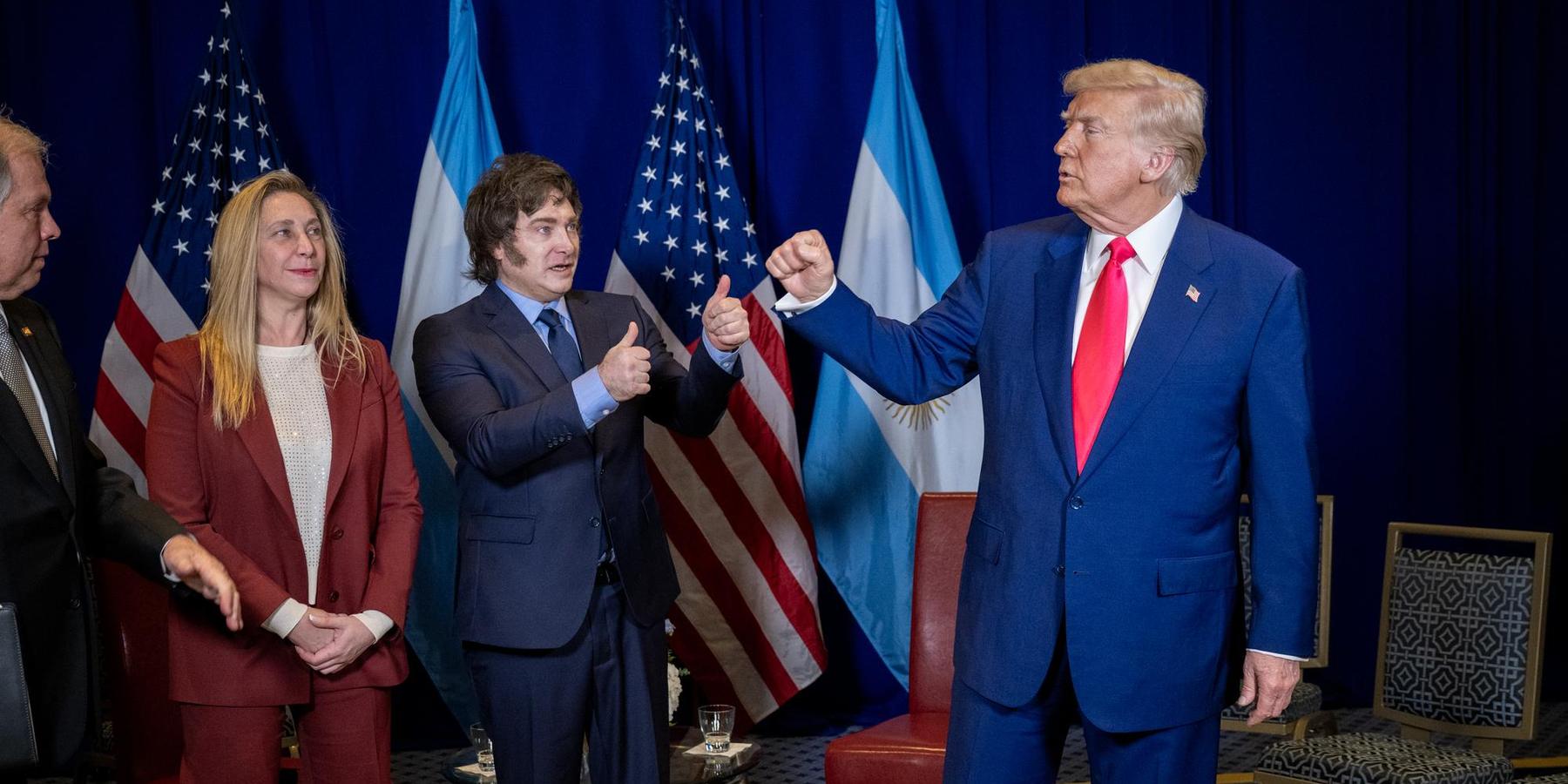
The territorial dispute between Argentina and the United Kingdom over the Falkland Islands (or Islas Malvinas in Spanish) continues to escalate.
Last week, Argentine President Javier Milei, a close ally of U.S. President Donald Trump, announced a series of new measures aimed at pressuring Britain over the future of the islands. The most significant announcement was of new sanctions on companies involved in oil extraction in the waters around the Falklands, which Argentina has long claimed as its own. Argentina’s attempt to prevent the exploitation of the Falklands’ natural resources is a reminder that beneath the often farcical relitigating of sovereignty claims dating back to the 18th century is a very modern geopolitical conflict with real stakes for energy and maritime resources.
Yet what was most remarkable about Milei’s announcement was what Milei did not announce — namely, a shift in U.S. policy regarding the Falklands. Given the hype that Milei built up ahead of his announcement, many observers speculated he would announce U.S. support for Argentina’s claim. Those expectations had been further raised by a steady trickle of reporting going back to April that the Trump administration has been considering recognizing Argentina’s claim to the Falklands, bolstered by Trump’s recent comment that the U.S. position on the islands was “one of many” under review.
The Falklands question, though easily dismissed as a curiosity in the United States, has long presented a genuine dilemma for U.S. policymakers torn between its transatlantic alliance and the Western Hemisphere. Despite being officially neutral in the territorial dispute, the U.S. decided to side with Britain over Argentina in the 1982 conflict, providing significant material support to the British war effort. This support caused lasting damage to U.S. standing in Latin America. Now, geopolitical shifts in the United States, Europe and Latin America have all converged to Argentina’s advantage, and help explain why Milei sees an opportunity to push Britain over the Falklands without risking broader diplomatic isolation.
It’s time to ask: what would it take to get Donald Trump to give Milei what he so clearly wants?
Milei’s self-proclaimed ability to obtain U.S. support for Argentina’s claim has become a major part of Milei’s domestic pitch. As is often noted in Argentina, Milei’s recent focus on the Falklands is a new development. Milei had risen to power with bitter and divisive attacks on left-wing domestic opponents, whom the president blamed for Argentina’s economic problems. Milei’s belated embrace of the Falklands issue comes as his economic reforms have largely failed to deliver the widespread prosperity he promised.
Milei’s bet is that close alignment with the U.S. will translate to U.S. support for Argentina’s territorial claim, reversing the recent pattern of Argentine diplomacy, which searched for allies in the Global South. In this effort, Milei may well be repeating the error of the Argentine military junta, which believed the U.S. would stay neutral or even support Argentina in the 1982 war over the islands. Milei is betting this time will be different.
For the United States, however, most of the recent consideration about whether to back Argentina over Britain in the South Atlantic has not revolved around the Falklands at all. For Trump, the Falklands question is clearly about Iran, with reports pointing to his notable frustration with Britain for its perceived failure to support the U.S.-Israeli war. Yet regardless of Trump’s frustration, Britain remains a far more useful ally in the current Middle Eastern conflict than Argentina could ever hope to be. British bases on Cyprus and Diego Garcia have served as logistical hubs for U.S. operations, and even briefly came under fire from Iran and its allies. While Trump no doubt wants Britain to do more, he also wouldn’t want Britain to do less.
Milei’s government has acted in lockstep with the United States on the diplomatic front, designating Iran’s IRGC a terrorist organization. Washington is clearly interested in such support, as indicated by the State Department’s trumpeting of Peru’s recent decision to break off diplomatic relations with Iran.
Yet these diplomatic “wins” are more about recognizing U.S. dominance over the Western Hemisphere than anything else; neither Peru or Argentina can make any real military contribution to the actual armed conflict. Undersecretary of Defense Elbridge Colby effectively acknowledged as much in his recent Americas Quarterly essay, writing “we will not ask neighbors to project power out of this region.” This gives Britain the upper hand for now.
Closer to home, though, the case for U.S. recognition of the Argentine claim is far more straightforward: the U.S. has a clear and permanent interest in close ties with Latin America. The Trump administration has embraced the Monroe Doctrine, the original purpose of which was to defend the newly independent states of Latin America from exactly the sort of European imperial predations that Britain accomplished by seizing the Malvinas from Argentina by threat of force in 1833. If the United States truly means to prioritize the Western Hemisphere over Europe or the Middle East, then trading Britain for Argentina makes much more sense.
The Falklands also occupy another strategic waterway — the approaches to the Strait of Magellan and Cape Horn. Before the construction of the Panama Canal (another Trump obsession), the Falklands commanded the only maritime corridor between the Pacific and Atlantic oceans. Indeed, this is why Britain seized them in the first place, as part of its global network of maritime bases from Singapore to Suez to Cape Town to Gibraltar. The Falklands’ strategic importance was proved by the 1914 Battle of the Falklands, when the Royal Navy annihilated the German East Asia Squadron as it attempted to enter the Atlantic. More recently, U.S. aircraft carriers have traveled through the Strait of Magellan, a useful practice in case the Panama Canal becomes unavailable for any reason.
Milei’s pitch to Donald Trump then seems to be this: in exchange for U.S. support against Britain, Argentina would offer unprecedented access to its South Atlantic territories to both the U.S. military and U.S. business interests. Yet there are good reasons to doubt that Milei, already increasingly unpopular domestically, can keep that promise.
Many prominent leaders on the Argentine left who vocally support confrontation with Britain nevertheless see the U.S. as a similar threat to Argentine sovereignty, specifically warning against U.S. control of Argentine naval bases in Tierra del Fuego. Argentines are undoubtedly united on the Falklands across ideological lines, but they also envision the islands and the crucial sea lanes and natural resources around them returning to Argentine sovereignty, not U.S. control. The divisive and partisan governance style of both Milei and Trump makes any long-term U.S.-Argentine partnership fragile, particularly when, as seems likely, the Argentine left returns to power.
For now, Milei seems to be waiting in vain for U.S. support. Trump has already done extraordinary political favors for Milei. From facilitating a $20 billion U.S. Treasury bailout to importing Argentine beef, Trump has done more for Milei’s political fortunes than any prior U.S. leader has for any Argentine counterpart. It is also clear that the calculus of 1982 no longer holds: Britain is militarily weaker, more diplomatically isolated, and less geopolitically relevant to U.S. security needs in 2026 than in 1982. Yet Milei still needs Trump far more than Trump needs Milei.
Milei has increasingly staked his presidency on proving that his subordination to the United States will allow him to win the Falklands, the White Whale of Argentine foreign policy. Yet Milei’s needs are not Washington’s. The U.S. has no real reason to change position as long as it can string both of its nominal allies along. That is likely what Donald Trump, who is much better at talking about deals than closing them, will do.
- The road to Trump's heart goes through Israel ›
- Trump bet $40B on Milei, but what do Americans get out of it? ›