

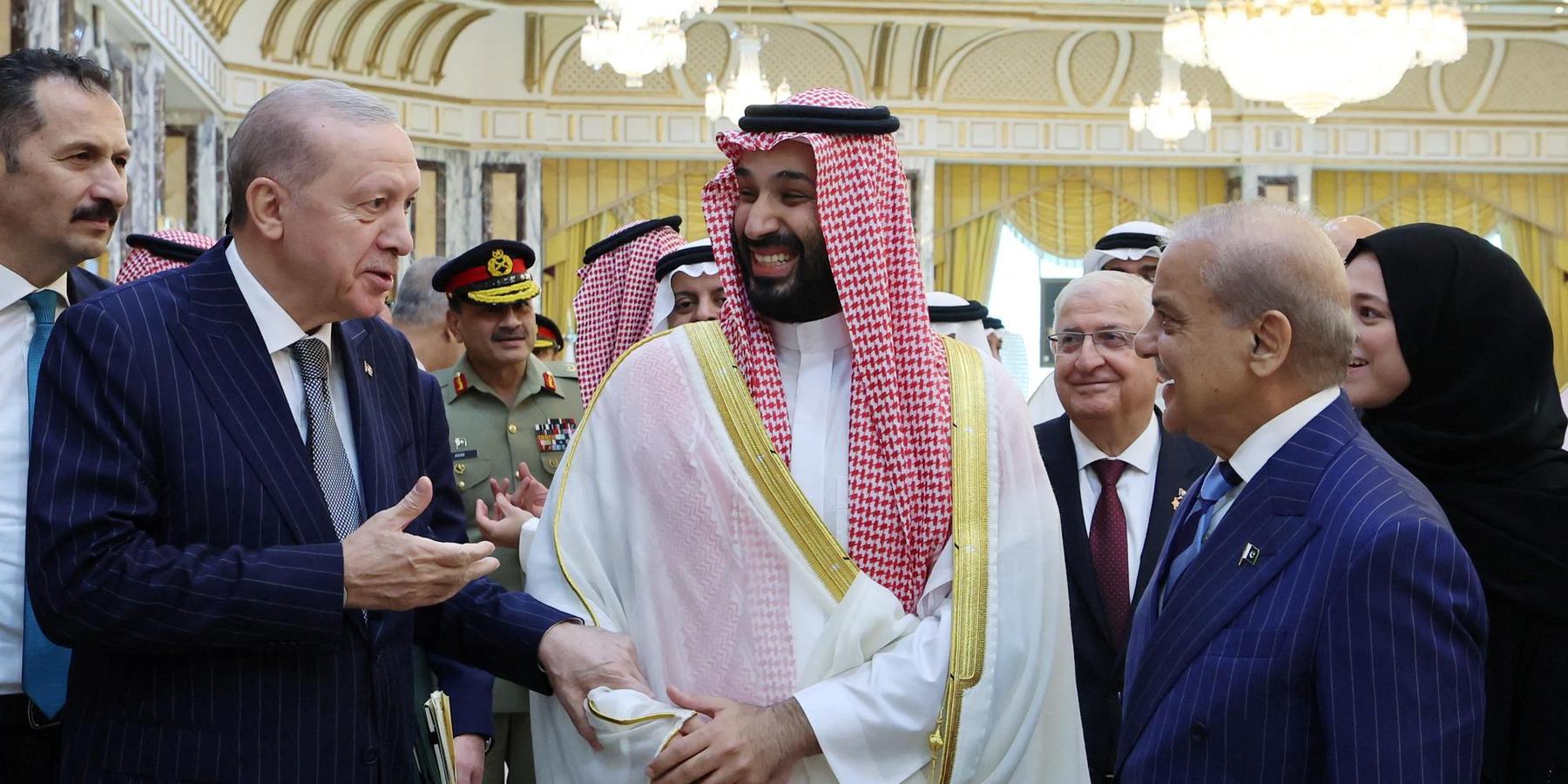
When Saudi Arabia, Turkey, and Pakistan signed their joint defense agreement in Mecca on August 7, the alliance’s first test was already taking shape.
A day before the signing, Saudi Arabia was preparing for the possibility of attacks by the Houthis in Yemen alongside threats from Iran-linked groups in Iraq, amid concerns that energy facilities, ports, and airports could be targeted.
The new pact establishes a striking principle: an armed attack on any one of the three countries is to be regarded as an attack on all of them. Yet what has been made public does not specify the military obligations that would follow, whether assistance would be automatic, or what form of response the other signatories would be expected to provide.
So far, there are no indications that Turkey and Pakistan are preparing to enter the Yemen war directly. But a new Houthi missile or drone attack on Saudi Arabia could force the three countries to answer the question the agreement leaves unresolved: What does it actually mean to say that an attack on one is an attack on all?
The threshold for mutual defense
The Houthis present a more complicated case than a conventional attack by one state against another.
The group controls large parts of northern Yemen, possesses missiles, drones, and maritime capabilities, and maintains close political and military ties with Iran. At the same time, it remains a Yemeni actor with its own leadership and domestic calculations.
That makes any future attack a test of a gray area the agreement has not publicly defined.
Would a missile landing in Najran, just across the border from Yemen, activate the trilateral commitment? What if a drone struck an oil facility? Would the pact apply to a Saudi vessel or installation outside the kingdom’s territory?
Those questions matter more than the prospect of Turkish or Pakistani troops fighting the Houthis directly.
In practice, the pact’s first actions could be far less dramatic: the two partners could provide intelligence sharing, early warning, air defense, counter-drone systems, maritime surveillance, or defensive reinforcements deployed inside Saudi territory.
In that sense, the new alliance could begin to function without turning Ankara or Islamabad into direct parties to the war in Yemen.
A new strategic problem for the Houthis
For years, the Houthis’ missile and maritime capabilities have allowed them to project military pressure beyond Yemen’s borders, sometimes to great effect. But the Mecca agreement could alter their tactical calculations.
Ahmed Saleh, a political scientist and observer of Yemeni affairs, argues that the agreement’s importance for Yemen lies in its potential to reshape the political and security environment in which the Houthis operate.
“If the Houthis continue targeting Saudi Arabia after the Mecca agreement, the calculations of escalation will no longer remain confined to the Houthis and Riyadh as they were before,” Saleh said. “Every new attack could push Turkey and Pakistan toward deeper security involvement alongside the kingdom, meaning the Houthis could find themselves facing a wider circle of states for whom Saudi security has become a direct interest.”
That could also create a strategic dilemma for Iran. Tehran does not dictate every Houthi military decision, but it does work closely with the militant group and help shape Houthi strategy. If continued pressure from Yemen leads to broader defense cooperation around Saudi Arabia, Iran will have to reckon with the fact that one instrument of its influence could end up encouraging closer alignment among states seeking to counter Iran.
What could change militarily?
Saudi Arabia does not need Turkish or Pakistani troops on Yemen’s front lines to benefit from the agreement.
The nature of the Houthi threat makes air defense, early warning, electronic warfare, counter-drone systems, maritime reconnaissance, and intelligence sharing more important than simply adding ground forces. Both Turkey and Pakistan can bolster Saudi capacities in these areas.
The key military question, therefore, is whether Ankara and Islamabad will help Riyadh make Houthi attacks harder to carry out, less effective, and more costly.
“The important military change would be in how quickly a threat can be detected and dealt with before it reaches its target,” said Salah Moayed, a military commander under Yemen’s internationally recognized government based in the country’s western coastal region along the Red Sea. “If the agreement improves early warning, air defense, reconnaissance, counter-drone capabilities, and intelligence sharing, the cost of carrying out the same attack will rise for the Houthis, even if not a single Turkish or Pakistani soldier enters Yemen.”
That does not necessarily mean, however, that the balance of power inside Yemen’s war will be transformed. There is a fundamental distinction between helping Saudi Arabia defend its territory and supporting a military campaign aimed at changing control on the ground inside Yemen.
The pact is a defensive agreement among its signatories, not a commitment to reverse territorial control inside Yemen. Turkey or Pakistan could help intercept a missile heading toward Saudi Arabia without providing any support for operations within Yemen.
The Red Sea test
The first test may not come across the land border at all.
The Red Sea has become a central part of the Houthis’ regional strategy since 2023, when it first launched a series of attacks on Israel-linked ships in an effort to pressure Israel to stop its war in Gaza. Attacks on shipping have turned Bab al-Mandab — the narrow strait between the Indian Ocean and the Red Sea — into an arena of confrontation.
For Saudi Arabia, the Red Sea is a vital corridor for energy and trade and is home to ports and major economic projects of strategic importance.
That means the first practical application of the pact could emerge at sea: intelligence sharing, aerial and maritime surveillance, protection of energy infrastructure and shipping lanes, or cooperation against drones and missiles. Such cooperation would carry less political risk than strikes inside Yemen, yet it could still narrow the Houthis’ operational space.
Washington faces a new equation
For the United States, the agreement could produce two contradictory effects.
On one hand, Washington has spent years urging allies and partners to shoulder a greater share of responsibility for their own security. If Saudi Arabia, Turkey, and Pakistan can better protect infrastructure and maritime routes and intercept threats without continuous reliance on U.S. forces, that would fit the logic of burden-sharing.
But greater regional capability also means greater independence in decision-making.
That tension could emerge quickly in Yemen. Washington may support stronger defenses for Saudi Arabia while simultaneously seeking to prevent a Houthi attack from triggering a new round of war in Yemen. Riyadh, Ankara, and Islamabad, meanwhile, may make collective decisions about the appropriate scale of response that do not always align with Washington’s preferences.
Deterrence, or a new path to escalation?
The success of the Mecca agreement will not be measured by how many aircraft or troops the three countries can assemble. The real test is whether it can make an attack on Saudi Arabia more costly without making a wider regional war more likely.
If the response to a major attack is so limited that it exposes the weakness of the collective commitment, the Houthis may test the pact’s boundaries again.
But if every attack produces a broad response or renewed escalation inside Yemen, the agreement itself could become a mechanism for widening the kind of confrontation it was meant to deter.
Between those two outcomes lies the hardest equation: building credible deterrence without opening the door to a new war.
The Mecca agreement was not announced as an alliance against the Houthis. But the Houthis may be the first to test its limits.
- Will Trump meet his Suez moment & seize Hormuz deal on the table? ›
- Why the Trump administration will have to accept a Hormuz toll ›
- The Mecca Pact could be an opportunity for Iran | Responsible Statecraft ›
- How Saudi Arabia's anti-Houthi strategy crashed and burned | Responsible Statecraft ›
- Does Mecca Pact demand Pakistan enter Yemen conflict? | Responsible Statecraft ›