

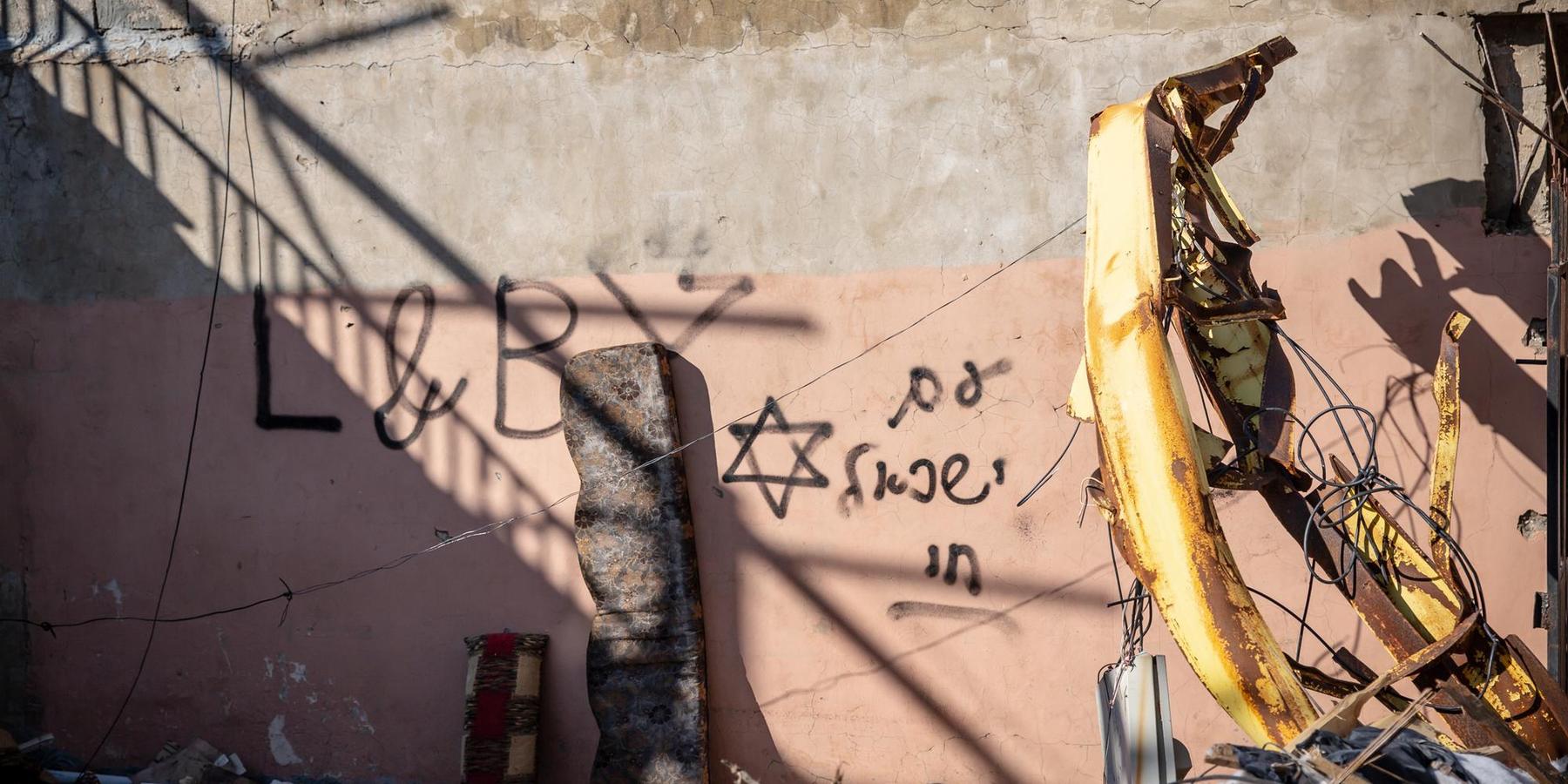
The Israeli military’s demolition of an entire village in Lebanon is “a Nakba of 2026,” the presence of hunting rifles and a Hezbollah flag is enough to have a Lebanese home designated “terrorist infrastructure,” and Israeli soldiers have operated there and in Gaza out of a “sense of revenge.”
Those are some of the observations of a recently returned Israel Defense Forces (IDF) reservist, whose testimony further calls into question continuing U.S. support for Israel’s war efforts in the region and starkly underlines the risks of a proposal currently on track to become law that would yet more deeply fuse the U.S. and Israeli militaries together.
The interview with the ex-soldier was conducted by a Palestinian journalist and by Ariella Steinhorn, the co-founder of a whistleblower advocacy organization, and provided on the condition that the identities of both the IDF reservist and the journalist remain anonymous. The reservist, who has fought in multiple Israeli wars over the past decades, recounted his experience of several deployments in Lebanon since 2023, including Israel’s current invasion and occupation of southern Lebanon, as well as a stint in Gaza after the invasion of Rafah in 2024.
Responsible Statecraft has verified the reservist’s identity and his deployments. The Israeli embassy in Washington did not respond to a request for comment.
The “Nakba of 2026” that the reservist was referring to was the IDF’s razing of the southern border village of Aitaroun, where satellite imagery dated to late April 2026 shows almost every building totally flattened. He described the military rationale for this destruction:
The orders are very clear, to destroy. We got a map of all the homes that were considered terror infrastructure. ... Every home that was used by Hezbollah, it could be used as a hiding place, it could be used as a place where they put ammunition, it could be used as a gathering point, every home like that was destroyed.
Yet the reservist also indicated that the standards for what is considered terrorist infrastructure could be remarkably loose — for instance, in terms of the weaponry it held:
Every home almost has shotguns and rifles that may be hunting rifles. That’s in every home, literally. ... I probably was in 15, 20 homes I guess, I didn’t count exactly. I would say maybe three of them had actually the big arms, the PK [machine gun] and the kalash [the Kalashnikov assault rifle] and explosives. The rest, it was very clear they were Shia, because there were pictures of [former Hezbollah leader Hassan] Nasrallah, pictures of [former Supreme Leader of Iran Ruhollah] Khomeini, and then you saw the rifles and other weapons. ... If you find evidence — even a hunter's weapon — under international law, if it comes with a terrorist organization flag, that is a terrorist outpost. Check the law.
The IDF has previously publicly posted images of hunting rifles it discovered to justify the leveling of civilian infrastructure in southern Lebanon.
Later, when challenged that the demolitions amounted to collective punishment, the reservist suggested that simply the iconography used in the town made it de facto terrorist infrastructure:
We entered Aitaroun, all the streets of Aitaroun had Hezbollah flags. The town hall had a huge Hezbollah flag. So you could say, this entire town is used as infrastructure for terror.
The ex-soldier’s experiences were not limited to Lebanon. In Gaza, where he had served in the summer of 2024 as a driver for a medical unit in the Netzarim corridor — a supply route bisecting the territory into north and south that the IDF carved out early in the war — he described a soldier who boasted about committing a war crime:
When we came to our post in Netzarim, he was already there. He was bragging about how he keeps doing more and more duty because he almost enjoys it. That’s his life now. And it’s very strange. Most of us, we don’t like doing duty. ... Once we were home for the weekend and we came back, and he bragged about killing people who tried to cross and it was very disgusting, okay? And we insisted that that guy doesn’t stay with our unit anymore. ... I heard from people who were there at the time that he wasn’t just making it up, that there was an incident. ... He said, ‘three people were trying to cross and I shot them.’ It was traumatizing for us to hear it. ... I know he was then taken somewhere else, I don’t know if he was charged.
The reservist blames the soldier’s presence on a manpower shortage within the IDF. But while stressing that most Israeli soldiers were nothing like this “lunatic,” and were motivated by the desire to get back the hostages taken on October 7, he also admits that many were driven by less pure motives, too:
When we went into Gaza the first time and we saw entire areas wiped out ... I’m not going to lie, I think a lot of Israelis felt that sense of revenge, meaning, this is what happens after October 7. ... I can tell you there was a sense of satisfaction. Including myself by the way, and I hate to say it out loud.
He later says the same thing about the motivation of his fellow soldiers in this most recent flattening of villages in southern Lebanon: “People want to destroy because of revenge.” When asked by Steinhorn about a previous statement he had made that some IDF soldiers deployed there had a “lust for destruction” that bothered him, he replies, “100%.”
These criticisms are notable given the overall support for both wars by the IDF reservist, who describes himself as a right-wing Israeli who “voted right his entire life.” In fact, he spends much of the interview rationalizing and justifying the IDF’s indiscriminate demolition of homes, even as he describes it as unsettling and disturbing, enough that it led him to speak out.
The interview is part of a trend that has seen Israeli soldiers admit to witnessing or even personally carrying out war crimes in Gaza and elsewhere. Soldiers early on in the Gaza war described to +972 Magazine widespread practices that likely amount to war crimes by IDF troops there, including ones similar to the “bad apple” the reservist met, with soldiers being permitted to shoot any Palestinian who came too close to Israeli forces.
Israeli newspaper Haaretz has previously published the accounts of soldiers who, similar to the reservist, served in Gaza’s Netzarim corridor, and who described the creation of a “kill zone” where “anyone who enters is shot,” even children. A number of soldiers have disclosed to the paper the “moral injury” they have suffered as a result of carrying out various atrocities in the territory.
Most recently, five soldiers told the paper about their conduct in Lebanon “that the IDF has become like an army of Vikings” rampantly looting houses, and that in the country’s south, “our mission was one thing – to leave no structure standing, to destroy everything.”
Soldier testimony compiled by IDF veteran group Breaking the Silence likewise held that troops were ordered to indiscriminately shoot anyone who entered certain parts of Gaza, and that troops were driven by a desire for revenge against a population they viewed as collectively guilty for October 7.
“A lot of us went there, I went there, because they killed us and now we’re going to kill them,’ one soldier told the Guardian. “And I found out that we’re not only killing them – we’re killing them, we’re killing their wives, their children, their cats, their dogs. We’re destroying their houses and pissing on their graves.”
Perhaps the last word should be given to the IDF reservist, who worries that Israeli troops, their adversaries, and the civilians caught in the crossfire are all now caught in an unending loop of trauma-driven violence.
The people of Aitaroun, they‘re going to come home to a town that doesn’t exist anymore. ... Is this going to put an end to this cycle, or is this just starting a way, way worse cycle?
- If Trump wants out of war he needs to stand up to Israel on Lebanon ›
- ‘Burn the lawn’: Israel pursues ‘Rafah model’ in southern Lebanon ›