

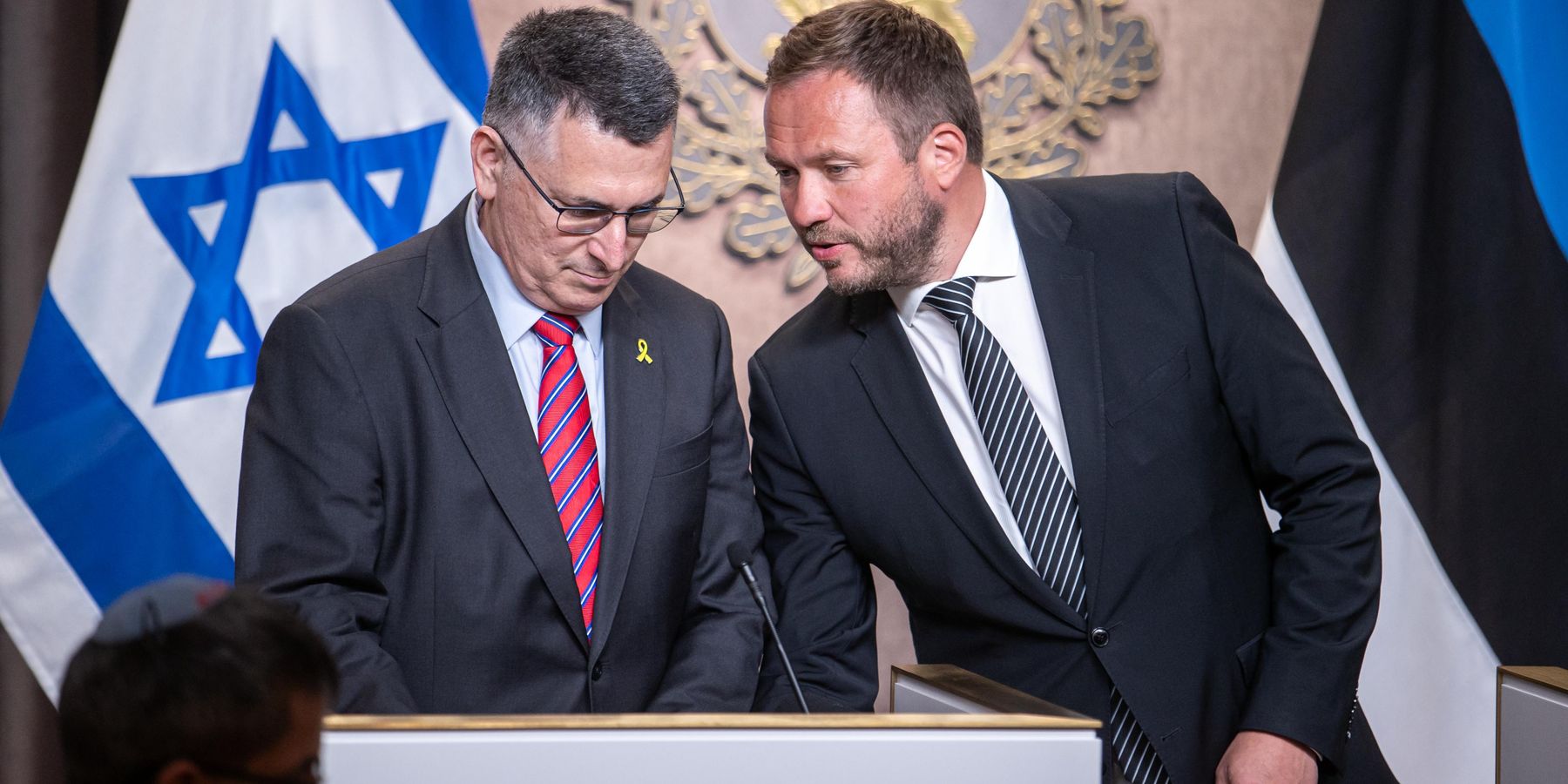
As the European Union struggles to agree on a coherent response to Israel’s war on Gaza, Estonia’s and Latvia’s foreign ministers recently warmly welcomed their Israeli counterpart, Gideon Sa’ar.
This diplomatic embrace, occurring as Israel stands accused before the International Court of Justice (ICJ) and International Criminal Court (ICC) of crimes against humanity and plausible acts of genocide, reveals a profound and damaging hypocrisy. It is also a strategic blunder.
Estonian Foreign Minister Margus Tsahkna this week welcomed Sa’ar to open the Israeli Embassy in Tallinn. During the ceremony, Tsahkna and his Latvian counterpart Baiba Braze reaffirmed Israel’s “right to self-defense” and condemned “Iran’s destabilizing role.” This is the second visit by Israel’s foreign minister to the region in the last few months: Sa'ar's first destination after the "12 day war" with Iran was to the Baltic trio of Estonia, Latvia, and Lithuania, where his narrative of the conflict received a sympathetic hearing.
But the contradiction in these Baltic states’ posturing is staggering. Latvia, Lithuania, and Estonia have built their entire post-Soviet foreign policy and identity on an uncompromising stance toward Russia. Their historical trauma from the Soviet occupation was only reinforced by the Russian invasion and ongoing war in Ukraine.
Understandably, the Baltic states were at the vanguard of a resolute response to the 2022 Russian invasion — lobbying for international sanctions, shunning diplomacy with Moscow, and even advocating for measures implying a collective responsibility of Russian citizens for the crimes committed by the country’s leadership. For example, EU High Representative for Foreign Affairs Kaja Kallas, the former prime minister of Estonia, pushed for blanket visa restrictions on all Russians. While Baltic state officials cite security concerns as their justification, Russian dissidents criticized the measure as counterproductive and playing right into the hands of the Kremlin.
Yet, when it comes to Israel, these same principles evaporated. A diplomatic red carpet is rolled out for the top diplomat of a state whose military campaign has killed more than 69,000 Palestinians, according to Gaza health authorities, displaced vast numbers of the inhabitants, and brought famine to the beleaguered enclave. The ICJ has ordered Israel to take measures to prevent acts of genocide and allow humanitarian aid. The ICC has indicted Israeli Prime Minister Benjamin Netanyahu for war crimes — alongside Russian President Vladimir Putin.
Israel has also violated U.S. President Trump’s ceasefire by killing hundreds of Palestinians and conducting more 124 bombardments after it supposedly entered into force (as of Nov. 11).
The rulings of the international courts and Israeli violations of the ceasefire should, at the very least, give any nation claiming to champion a “rules-based order” serious pause. Instead, the Baltics offer full normalization and support.
This selective application of international norms does not go unnoticed. It is seen clearly in Madrid, Dublin, Ljubljana, Brussels, and even Paris, where leaders have publicly criticized Israel’s conduct. The governments of Spain and Ireland, in particular, have been vocal in demanding that the EU hold Israel accountable, framing it as a fundamental test of the bloc’s values.
When Baltic diplomats then lecture these same partners on the existential need for unwavering solidarity with Ukraine, their words increasingly ring hollow. How can they demand absolute, value-driven support for one victim of aggression while actively legitimizing a government accused of gross violations in another?
This hypocrisy is not just a moral failure; it is also a profound strategic miscalculation. While it’s true that some EU countries, like Hungary, the Czech Republic and Austria, are even more explicitly pro-Israel, none of them is as vulnerable as the Baltics. As small countries at Russia’s doorstep, Baltic security depends almost entirely on EU-NATO cohesion. With doubts growing about Washington’s long-term commitment to European security, the reliance on European solidarity is more vital than ever.
Alienating key EU member states by dismissing their views on Gaza is therefore strategically myopic. It provides ammunition to those in Western Europe who are growing increasingly frustrated by what they see as unhelpful sanctimony expressed by figures like Kallas and other Baltic leaders. The Baltics should actively avoid creating an impression that they champion a “rules-based order” only when it suits their immediate geopolitical interests — and yet they appear to be doing exactly the opposite.
This strategic error is compounded by a fatal misreading of Israel’s own calculus. The Baltics are courting a country whose interests are vested infinitely more in its relationship with Russia than in them. Indeed, Israel’s primary concern is not to help Ukraine, but to deter Iran. That includes preventing Tehran from rearming and, notably, rebuilding its air defenses after the June war with Israel.
Russia has capabilities it can offer to Iran to bolster its defenses. In fact, its deputy foreign minister, Sergey Ryabkov, said that since Moscow does not recognize the snapback of the U.N. Security Council sanctions against Iran, triggered by the European powers, it is looking forward to expanding its military-technical cooperation with Tehran.
While the true extent of such cooperation remains to be seen, the mere possibility is a source of deep anxiety to Israel. Therefore, Jerusalem has consistently — and remarkably successfully — sought pragmatic, cordial relations with Moscow in order to minimize the latter’s support for Tehran. The dynamic is extensively described in former Mossad chief Yossi Cohen’s memoir, in which he glowingly describes Putin as a strategic mastermind open to understanding Israel’s concerns.
For Israel, limiting Russia’s support for Iran will always be immensely more consequential than whatever marginal gains it could accrue from cultivating the Baltic states. It is a failure of Baltic diplomacy not to recognize this obvious hierarchy of interests. Tallinn and Riga are investing diplomatic capital in an actor whose own strategic necessities align it with their primary adversary — all while risking alienating partners in the EU and NATO and undermining their own moral high ground.
To be a credible champion for Ukraine, one must be a consistent champion for international law. There is no other way. If the Baltics continue down this path of selective morality and legality, they risk fracturing the very unity that constitutes their first and most important line of defense. The embrace of Israel today could pave the way for a much colder reception in the councils of Europe tomorrow — precisely when they can least afford it.
This won’t happen overnight, as credibility can erode over time, especially when it is being needlessly undermined. International law is not a menu; you cannot stand for the main course in Ukraine while treating Gaza as a dispensable side dish. And much less so when the strategic benefits of doing so are highly dubious.