

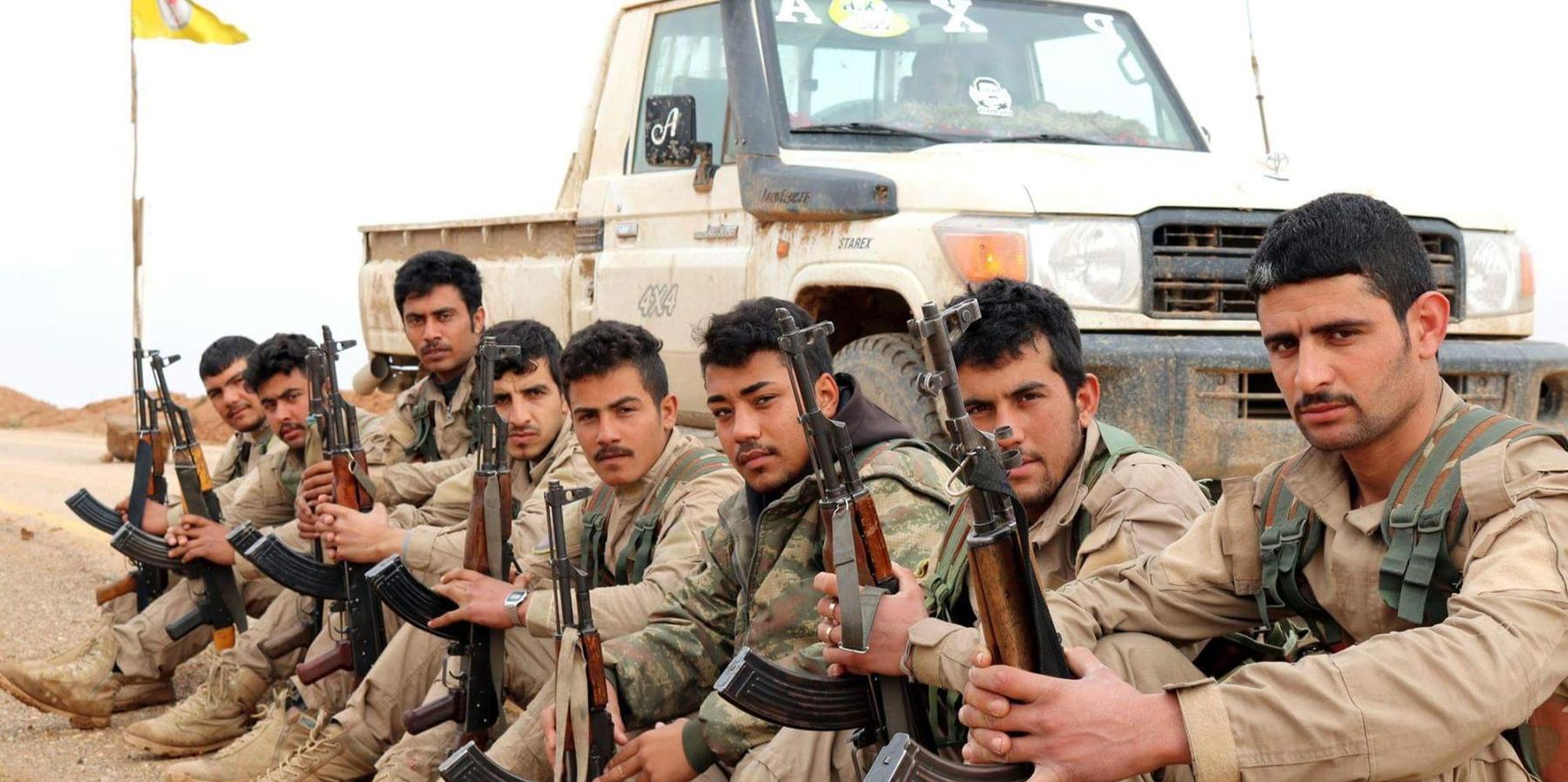
On March 4, Donald Trump spoke with Mustafa Hijri, president of the Democratic Party of Iranian Kurdistan, as well as leaders of the two main Kurdish parties in Iraq. He urged Iranian Kurdish groups to launch attacks inside Iran while warning Iraqi Kurdish leaders not to stand in the way of Washington's plans.
Moreover, reports indicate that the CIA has armed and trained Iranian Kurdish opposition groups as part of a broader U.S.-Israeli war plan to engineer the collapse of the Iranian regime alongside an aerial campaign.The administration has denied any of it.
Amid rising tensions between Iran and US-Israel, five Kurdish armed groups, including The Kurdistan Democratic Party of Iran (KDPI), the Kurdistan Free Life Party (PJAK), the Kurdistan Freedom Party (PAK), Komala and Khabat, formed the Coalition of Political Forces of Iranian Kurdistan on February 22, days before U.S. and Israeli strikes began. A sixth group, the Komala Party of Iranian Kurdistan, joined on March 4 after initially hesitation. The rationale behind this appears to be opening a ground front in western Iran, stretching IRGC forces across multiple axes, and accelerating regime destabilization while reducing pressure on the GCC states and Israel.
The coalition's formation before the war started strongly suggests that Washington was already in contact with these groups, working to bring them under one umbrella to coordinate military planning. The model has hallmarks of previous U.S. efforts to unify Iraqi Kurds against Saddam's regime.
As a tactic, arming the Kurds has real operational merit. But the question is whether the United States intends to convert Kurdish wartime service into a lasting institutional and political commitment after regime change. In Iraq, Washington largely followed through: Kurds secured constitutional recognition, a federal region, and their own Peshmerga forces.
In Syria, the outcome was the opposite. When the U.S. withdrew political and military support, the Kurds were left exposed to the new regime in Damascus. Arms can flow, but whether a binding alliance follows is the only question that determines if this venture ends in some form of Kurdish self-determination or another cycle of mobilization, abandonment, and reprisal.
The record
The record resists a simple narrative of unbroken betrayal. On balance, Kurds have gained from their association with the United States. The 1991 uprising was crushed, but the humanitarian catastrophe that followed produced Operation Provide Comfort and the northern no-fly zone, giving Iraqi Kurds a 12-year window to build self-governance from scratch.
Without American air cover, no Kurdistan Regional Government (KRG) would exist today. The 2003 invasion toppled Saddam, and Kurds emerged as the most stable, pro-Western pillar of the new Iraqi state. The anti-ISIS campaign transformed Syrian Kurds from a marginalized minority into a governing authority that administered roughly a third of Syria for nearly a decade.
These are real achievements. But every one of them was situational, born from moments when Kurdish interests happened to align with American geopolitical priorities. When those priorities shifted, Washington treated Kurdish loyalty as a spent asset. Now the same geopolitical alignment between Washington's interests and Iranian Kurdish inspiration for self-rule appear to have emerged at least for now.
In 1975, the CIA withdrew backing for Mustafa Barzani's revolt the moment the Shah and Saddam signed the Algiers Accord. In 1991, the Bush administration encouraged an uprising, then stood aside as Saddam's Republican Guard crushed it. In 2019, Trump withdrew from northeastern Syria, opening the door for a Turkish incursion into land the SDF had taken from ISIS at the cost of over 20,000 lives.
The 2017 Kurdistan independence referendum tested whether wartime service could be redeemed for political recognition. Iraqi Kurds voted 93 percent for independence. Within weeks, Iraqi federal troops and Iranian-backed Hashd al-Shaabi militias launched a coordinated offensive. The Kurds lost Kirkuk, the Nineveh Plains, and roughly 40 percent of the territory the Peshmerga had held. Washington chose nonintervention: no military response, no diplomatic ultimatum to Baghdad. The prospect of contiguous Kurdish control collapsed within 72 hours.
The lesson was hard to miss. Territory secured through American-aligned campaigns carried no guarantee of American protection once the original rationale for cooperation ran out. The U.S. declined to spend political capital defending Kurdish positions even in Iraq, where it maintained a formal military presence and relations with both Baghdad and Erbil.
January 2026 sharpened the lesson further. On January 20, U.S. Special Envoy Tom Barrack declared that the Kurdish-led SDF's role as the primary anti-ISIS force had "largely expired." Washington then brokered the transfer of Kurdish-held ground, oil fields, border crossings, and ISIS detention facilities to the government of Ahmed al-Sharaa, the former Abu Mohammed al-Julani, who went from an al-Qaeda affiliate to a recognized head of state in under a decade. Kurdish fighters were ordered to integrate into the Syrian military. Their autonomous governance structures, built over 10 years of war, were dissolved in weeks.
Forty-four days later, the same administration reached out to Iranian Kurdish leaders about launching a new armed campaign. That sequencing says everything about how Washington treats the Kurds: each policy cycle could reset Kurdish utility to zero. The Syrian Kurds served one purpose; the Iranian Kurds now serve another. No mechanism now exists to translate proven service into a durable commitment.
The pattern is not one of consistent broken promises but a deep disillusionment for Kurds, in which Kurdish loyalty, demonstrated again and again, has never been locked into a binding compact. The White House has relied on Kurds as a counterweight and a ground force against its adversaries, yet has never cemented that reliance through treaty obligations, security guarantees, or congressional mandates, as it has with Taiwan.
The problem is not that America has never helped the Kurds. It is that the help has always been revocable.
The operational trap
The geography of Iranian Kurdistan compounds these risks. To the west, Turkey views all Kurdish armed movements as existential threats. Ankara has already threatened military intervention inside Iran under the pretext of containing a refugee flow if order collapses.
Further west, Baghdad and the KRG have declared they would not permit cross border operations, and north and east stands the full apparatus of the Islamic Republic: IRGC ground units, Basij networks, ballistic missiles, and drone systems that have already struck Kurdish positions in Sulaymaniyah and Erbil.
In the event of a popular uprising against the Iranian regime, Kurdish fighters possess generations of mountain warfare experience and can melt into terrain they know intimately. The asymmetry falls on the civilian population if Tehran could retake Kurdish dominated areas in Iran. Millions of Kurds in Sanandaj, Kermanshah, and Ilam cannot retreat to the ridgelines. The IRGC's counterinsurgency record, from mass arrests and brutal violence against Kurds to assassination campaigns across Europe in the last four decades, shows a consistent doctrine: the regime punishes the accessible population, not the mobile insurgent. In closed geography, that calculus is lethal. The fighters withdraw; the civilians absorb the reprisal, unless the U.S. and Israel provide direct security and protection.
Iraqi Kurdistan faces parallel exposure. Since U.S.-Israeli strikes began on February 28, Erbil has absorbed over 70 Iranian missiles and drones. The IRGC has hit KDPI bases in Koya, PAK positions in Sulaymaniyah, and Peshmerga headquarters near Degala. The Khor Mor gas field suspended supply to regional power stations, producing blackouts across the KRI. Pro-Iranian militia groups have attacked the Kurdistan Region, including its energy sector. Any weapons pipeline to Iranian Kurdish groups necessarily transits the Kurdistan Region, converting the KRG into a forward staging area. Tehran has vowed to target KRG institutions and draws no distinction between the groups receiving arms and the territory hosting them.
The KRG— already weakened by the 2017 referendum fallout, squeezed between Baghdad's centralizing authority and Turkey's cross-border offensives — now risks becoming the primary Iranian retaliation target in a war shaped by American, not Kurdish, objectives. This could reverse Kurdish hard-won gains of the last three decades if Washington fails to throw its weight behind them.
Without security guarantees and clear backing for Kurdish political representation in any post-regime settlement, Kurds will fight, gain temporarily, and then face the consequences alone as U.S. attention shifts elsewhere.
- Trump's ‘move fast and break things’ war slams into economy ›
- Exclusive: Iraq's First Lady says 'this is not our war' ›
- Is Ukraine peace toast, now that the Middle East is on fire? | Responsible Statecraft ›
- Neocons wanted an Azeri uprising against Iran. They didn't get it. | Responsible Statecraft ›