

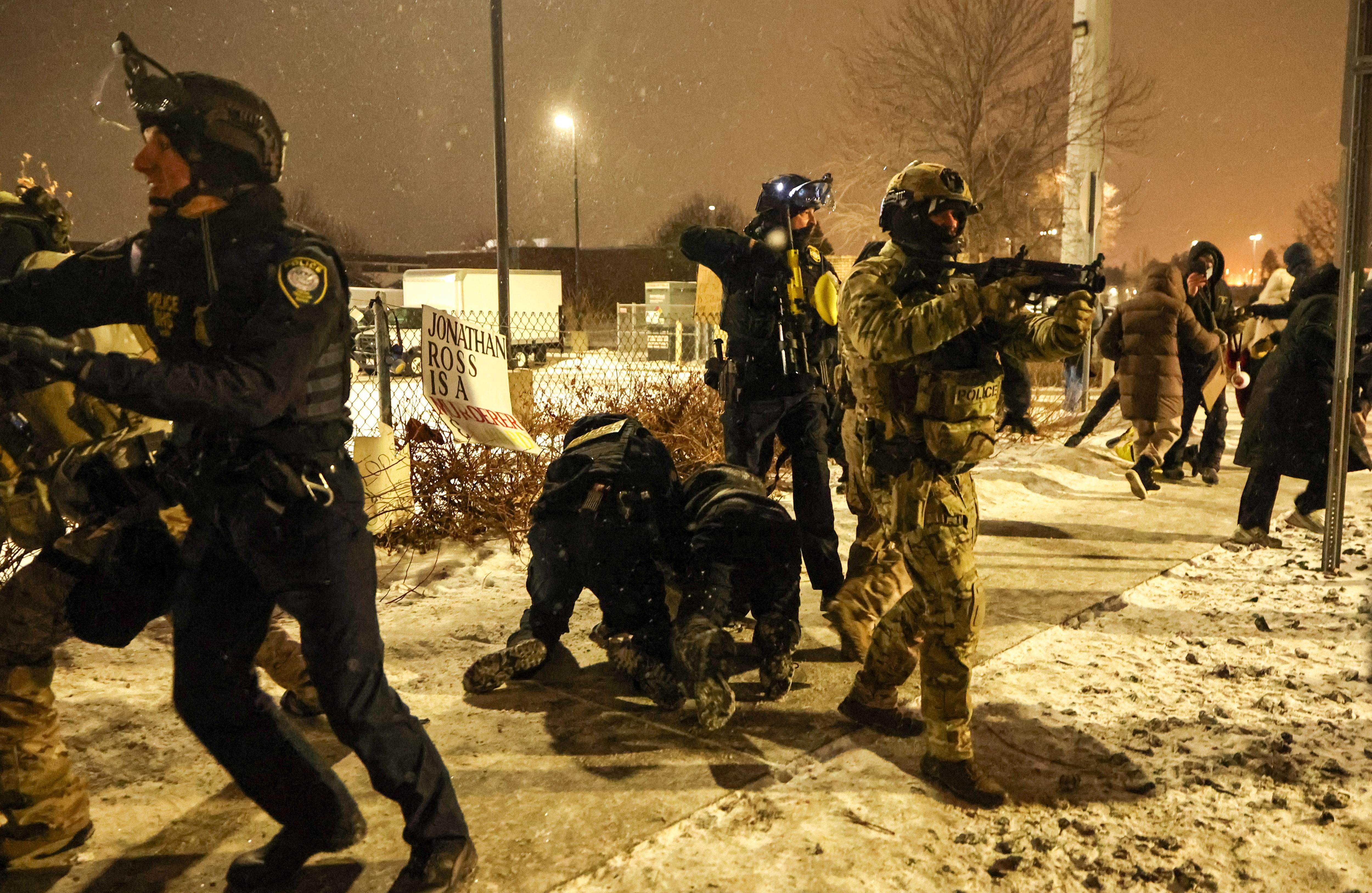
In the past few weeks, thousands of federal law enforcement officials have descended on Minneapolis. Videos show immigration officers jumping out of unmarked vans, tackling and pepper-spraying protesters, and breaking windows in order to drag people from their cars.
Prominent figures in the Trump administration have defended this approach despite fierce local backlash. When federal agents killed a protester named Alex Pretti on Saturday, for example, Secretary of Homeland Security Kristi Noem quickly accused him of “domestic terrorism.”
For observers of the conflict in Israel-Palestine, these scenes can seem eerily familiar. That similarity may not be a coincidence.
Over the past two decades, U.S. immigration officials have maintained a close relationship with the Israeli government. This collaboration has included trips ferrying high-level U.S. law enforcement officials around Israel, joint training for immigration officers, and technology transfers that have put sophisticated surveillance capabilities in the hands of Immigration and Customs Enforcement (ICE). The result has been an increasing mind meld between security agencies in Israel and the United States.
The primary focus of this collaboration is preventing acts of terrorism — a necessary, if fraught, objective. But, as the Trump administration has increasingly reframed its crackdown on undocumented immigration as a sort of new war on terrorism, it has applied these counter-terror tactics to an ever-growing number of people in the United States. This shift, which has drawn backlash despite broad public support for countering illegal immigration, is now giving Americans a taste of how the Israeli military operates in the West Bank, according to Josh Paul, who previously led the arms transfer office at the State Department.
“There are some striking parallels there,” Paul said. “You have units of a security force that are imposed on the local authorities, imposed on the local police, that engage in checkpoints, detentions, including of children [...] And it seems to operate broadly with impunity.”
A two-decade relationship
When Bill Ayub returned from his trip to Israel, he was impressed — but a bit wary. Israeli surveillance software is “a little more invasive than you would see here in the U.S.,” the former Ventura County sheriff told Jewish Currents in 2022. And the use of force in arrests was “shocking,” Ayub said. “It was like, ‘Wow, you do that?’ [...] We’d be in jail if we did something like that here.”
Ayub is one of hundreds of senior American law enforcement officers who, over the last two decades, have toured Israel and met Israeli law enforcement officials with the help of non-profit organizations like the Anti-Defamation League (ADL) and the Jewish Institute for National Security of America (JINSA). Public information about these trips, which focus on counter-terrorism, is limited. But an itinerary from a 2016 ADL delegation showed meetings scheduled with Israeli officials at a notorious prison and in Hebron, a segregated city in the West Bank.
Publicly available information shows that ICE officials participated in eight ADL trips between 2013 and 2016. Joseph Harhay, the current assistant chief of Customs and Border Patrol (CBP), joined a JINSA junket back in 2018.
These privately-funded trips are just one facet of the relationship. The Bush administration created ICE and CBP in 2003, when it restructured the federal government following the 9/11 attacks. The agencies, both of which are part of the Department of Homeland Security, became part of a government-wide effort to combat terrorism. “ICE has grown with the global war on terror,” said Anthony Aguilar, a retired Army officer and activist.
Congress quickly looked abroad for help, setting up a DHS office focused primarily on learning from Israeli officials, according to supporters of the legislation. “I think we can learn a lot from other countries, particularly Israel, which unfortunately has a long history of preparing for and responding to terrorist attacks,” Sen. Susan Collins (R-Maine) said at the time.
ICE and CBP agents have since developed a close relationship with their counterparts in Israel, allowing them to trade notes on tactics and technology. DHS has organized conferences with Israeli security officials, held joint training sessions, and even given grants to Israeli officers in order to do research on areas like countering violent extremism, according to a former senior DHS official.
The official, who said some of the tactics recommended by Israeli officials amounted to racial and ethnic profiling, recalled a senior colleague wondering, “Why are we giving a foreign government funding for this stuff? Why is the Department of Homeland Security doing this?”
ICE officers in particular have regularly participated in training alongside Israeli police, according to Aguilar, who said he personally witnessed some of these sessions at Israel’s National Urban Training Center while serving in the Army. (The former senior DHS official confirmed that ICE officers often train in Israel; DHS did not respond to a request for comment.)
Technology transfer has been another important point of collaboration. Part of this is due to the close ties between the military and surveillance tech industries in both countries. The Israeli military, for example, uses software from American companies like surveillance giant Palantir, which also works with ICE.
ICE, for its part, has purchased sophisticated phone hacking technology from controversial Israeli companies like Cellebrite and Paragon. These tools have helped ICE build what critics call a surveillance “dragnet,” gathering data on large portions of the American public, including citizens.
It is unclear whether the U.S. government has facilitated these transfers of surveillance technology. But we do know that American officials are interested in promoting this sort of collaboration. Since 2015, the Binational Industrial Research and Development (BIRD) Program has brought together DHS and Israel’s Ministry of National Security to “develop advanced technologies for homeland security needs,” according to DHS. In 2022, the Biden administration launched another initiative aimed at promoting collaboration between DHS and Israel’s National Cyber Directorate.
Other similarities may simply stem from the close relationship that U.S. and Israeli officials have maintained over the years. DHS Secretary Kristi Noem, for example, met last year with Israeli Minister of National Security Itamar Ben Gvir, a controversial official who shares Noem’s commitment to hard-nosed policing.
And some parallels have nothing to do with the U.S.-Israel relationship per se. Israel’s military, for example, has shown a lack of discipline and combat readiness during the war in Gaza, which some experts blame on poor training and a rapid expansion of active duty call-ups. ICE has faced similar discipline challenges amid its head-spinning growth under the Trump administration, which has boosted the agency’s annual budget by roughly 200% and more than doubled its officer headcount in less than a year to more than 20,000 agents. (3,000 ICE and CBP officers have been sent to Minnesota alone.)
“It's kind of every man for himself. They are obviously not operating under any standard operating procedures,” said Aguilar, who observed protests in Minneapolis this week and worked as a military contractor in Gaza during the war. “This is exactly how the Israel Defense Forces operate in Gaza.”
Of course, scenes in Minneapolis have sparked a reaction that the administration will be hard-pressed to ignore. Indeed, President Trump has already started to shift his approach in recent days, demoting a controversial CBP commander and sending his border czar, Tom Homan, to oversee operations with an eye toward de-escalation. Trump has even changed his tune about the killing of two U.S. citizens by ICE, calling both incidents “terrible.”
But, given the extent of U.S.-Israel security collaboration and Trump’s desire to move quickly on deportations, Minnesota may not be the last state to see these sorts of tactics — and technologies — deployed on its streets. “None of this surprises me,” the former senior DHS official said, adding that they still hope internal pressure could encourage the administration to change course. “I'm kind of shocked that people are just now making these comparisons.”