

If the U.S.-Israeli war against Iran is ultimately assessed as a defeat, some measure of blame could be cast on five pro-Israel “think tanks” that consistently promoted military action against the Islamic Republic in the eight months before it began, according to analyses by four different widely used AI programs.
The Foundation for Defense of Democracies (FDD), the American Enterprise Institute (AEI), the Hudson Institute, and the Washington Institute for Near East Policy (WINEP) ranked among the top six think tanks identified by the AI models as the “most prominent in promoting military action against Tehran” during the period between the “Twelve-Day War” in June 2025 and the current war’s launch on February 28.
A fifth think tank, the more traditionally right-wing Heritage Foundation, was also included by three of the apps as among the top six think tanks promoting military actions against Iran.
Unsurprisingly, four platforms – Gemini, ChatGPT, Claude, and Grok – identified the same five Washington-based institutions as also having played leading roles in promoting the U.S. invasion of Iraq 23 years ago.
Of the five, FDD, AEI, Hudson, and WINEP fall squarely into the neoconservative camp of U.S. foreign policy hawks in that support for Israel is a central principle of their world views and work. Indeed, the organization that claimed the top spot for prominence in promoting war against Iran in all four AI apps was FDD, whose original submission to the IRS in 2001 described its mission as “provid(ing) education to enhance Israel’s image in North America and the public’s understanding of issues affecting Israeli-Arab relations.”
The Heritage Foundation — which identifies itself as pursuing an “America First” foreign policy — has long promoted close ties with Israel. A “Special Report” published by Heritage in March 20025 called for transforming U.S.-Israeli relations from a mere “special relationship” to a “strategic partnership.”
“Experts” from all five organizations repeatedly propounded some or all of the same themes — that Iran’s nuclear program and missile arsenal posed an unacceptable threat to Israel and eventually to the U.S. homeland, that the regime was still “the world’s leading state sponsor of terrorism,” and that it was at the weakest point since the 1979 Revolution.
They pressed these points in congressional testimony, on the op-ed and news pages of major print and online publications, in broadcast television and radio interviews, and on social media, notably X, in what were clearly efforts to persuade elites and the public to accept the necessity of military action against the Islamic Republic. These arguments echoed the same themes as those propagated by Israeli Prime Minister Benjamin Netanyahu, as well as well-known pro-Israel hawks in the U.S. Congress, such as Sen. Lindsey Graham, in their appearances on U.S. broadcast media.
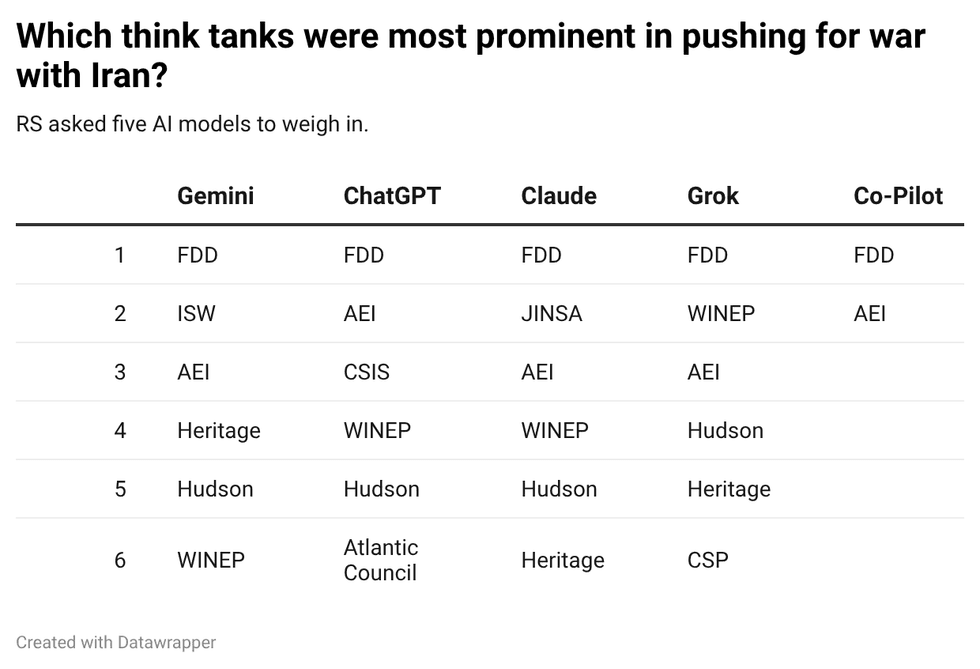
As can be seen in the table below, three of the AI apps identified several additional neoconservative-led think tanks among the six most prominent promoters of military action, including the Jewish Institute for National Security of America (JINSA), the Center for Security Policy (CSP), and the Institute for the Study of War (ISW), which was founded by neoconservative military analyst Kimberly Kagan in 2007. “While ISW positions itself as analytical rather than explicitly advocacy-oriented, its framing of Iranian threats consistently supported the case for military actions,” according to Claude.
Over the past quarter century, the foreign policy orientation of FDD, AEI, Hudson, JINSA, and CSP has been hardline neoconservative; their positions, particularly with respect to the Middle East, have generally reflected the views of Netanyahu’s Likud Party. WINEP, which was created in 1985 as a spin-off of the American Israel Public Affairs Committee, hosts fellows with a more diverse range of views, especially regarding Israeli-Palestinian relations.
ChatGPT also included the Center for Strategic and International Studies (CSIS) and the Atlantic Council (AC), which it described as “mainstream security think tanks,” among the six most prominent war promoters. Regarding CSIS, ChatGPT noted that its position was “often framed as ‘strategic analysis,’ but many publications discuss feasibility and strategic benefits of military strikes.” As for the Atlantic Council, ChatGPT said, “Mixed views internally, but several fellows have supported military action as a deterrent.”
All four apps were asked to “identify the ten U.S. think tanks that were most prominent in U.S. print media, broadcast media, online media, and social media in promoting a U.S. attack on Iran between July 1, 2025, and February 27, 2026, in order of prominence.”
Each defined “prominence” in its own way. ChatGPT, for example, defined it as “the institutions most consistently visible” in the various media, while Grok ranked only those “whose experts dominated congressional testimony on Iran, produced supportive op-eds/policy papers, appeared on broadcast panels justifying or advancing strikes/escalation, and drove online/social-media content framing the actions as necessary for regime weakening or surrender.” Unlike the other apps that ranked ten think tanks, Grok identified only six, noting that the “top tier (was) clear but that the prominence of others in the media that could be characterized as “pure ‘promotion’” drops sharply after #6…”
These were the results:
The four apps were then asked, “What is the overlap between these think tanks and those that promoted the military invasion of Iraq in the eight months prior to March 19, 2003?”
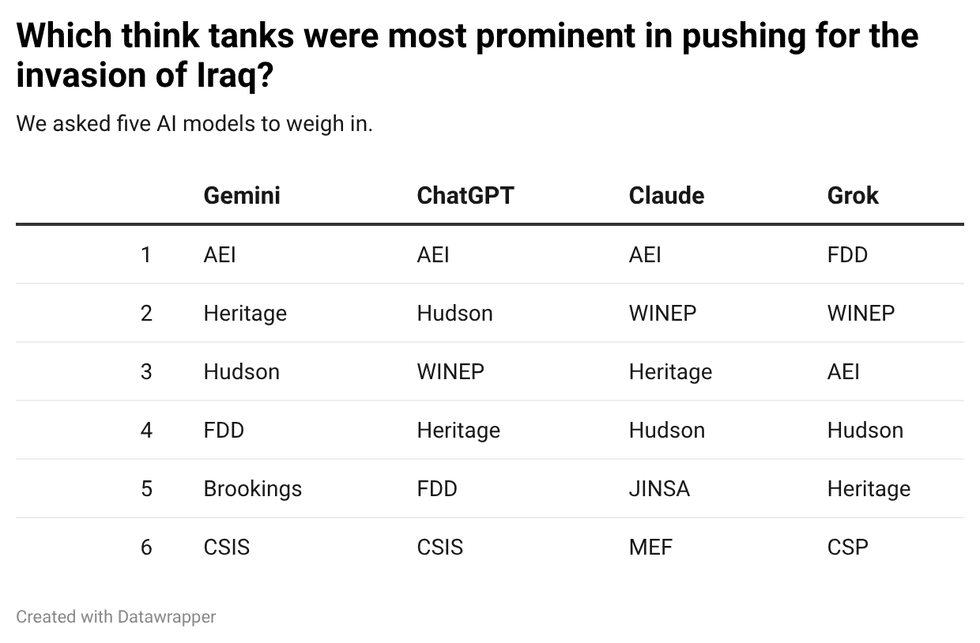
As noted by Gemini, “The overlap between the think tank environments of 2003 and 2026 is significant, as several institutions that provided the intellectual architecture for the Iraq War remained the primary drivers of the narrative favoring military action against Iran.”
While Grok cited FDD at the top, it bears noting that the group was only two years old in 2003 and worked very much in the shadow of more established neoconservative think tanks, of which AEI was clearly dominant due in large part to its “Prince of Darkness,” Richard Perle. Perle, who had served on the advisory or executive boards of FDD, WINEP, Hudson, CSP, and JINSA, and was a charter signatory in 1997 of the Project for the New American Century (PNAC) along with the most determined champions of invading Iraq inside the future George W. Bush administration, including Dick Cheney, Donald Rumsfeld, Paul Wolfowitz, and Elliott Abrams, all of whom Perle had worked with going back to the 1970s.
Given these well-established connections and as Rumsfeld’s Defense Policy Board in the run-up to the invasion, Perle and his neoconservative collaborators played a unique role, from both within and outside the administration, in building and enhancing an echo chamber whose coordinated messaging resonated much more effectively with the mass media and the public at large than was the case in the run-up to U.S.-Israeli war against Iran.
Compared to the most prominent Iran hawks, “the Iraq promoters were a tighter neoconservative core (AEI, Heritage, Hudson, CSP, PNAC, FDD) focused on regime change, WMD fears, and post-9/11 opportunity,” according to Grok. Those themes helped prepare the ground and effectively amplified the messaging coming out of the Bush White House and the Pentagon, particularly between Cheney’s American Legion speech in August 2002, in which he stressed the (non-existent) nuclear threat posed by Saddam Hussein, and the March 2003 invasion.
By 2005, it had become abundantly clear that the invasion had turned into a quagmire, and the neoconservative hawks within the administration, including Wolfowitz and his undersecretary of defense for policy and Perle protege Douglas Feith were effectively purged, joining Cheney’s national security adviser, Scooter Libby, on the outside. (Both Feith and Libby retreated to Hudson.) PNAC dissolved itself early in 2006, while Rumsfeld was gone by the end of that year.
In May 2007, FDD hosted an all-expenses paid weekend workshop at the Our Lacaya Resort in Freeport, Bahamas, attended by more than two dozen mainly neoconservative luminaries from various think tanks and media entitled “Confronting the Iranian Threat: The Way Forward.” Soon after, two Perle proteges, Reuel Marc Gerecht and the late Michael Ledeen – both fixtures at AEI’s standing-room-only “black coffee briefings,” in the run-up to the Iraq invasion – moved to FDD, which, according to Claude, has become “effectively the successor-vehicle for the Iraq War neoconservative network, rebranded and refocused on Iran.” Grok noted, however, that FDD “has since scrubbed some pre-[Iraq] war content, but archives confirm its role in the echo chamber.” The torch had passed.
But “(t)he personnel and ideological continuity (revolving doors to government, threat inflation, media amplification) is striking,” according to Grok. “(T)he same networks drove both campaigns two decades apart.”
- How a misleading report on Iran from a hawkish 'think tank' made its way to Trump administration talking points ›
- The Iran War cheerleaders and the weapons industry that funds them ›
- Fox News screaming desperately into wind as Trump loses grip | Responsible Statecraft ›