

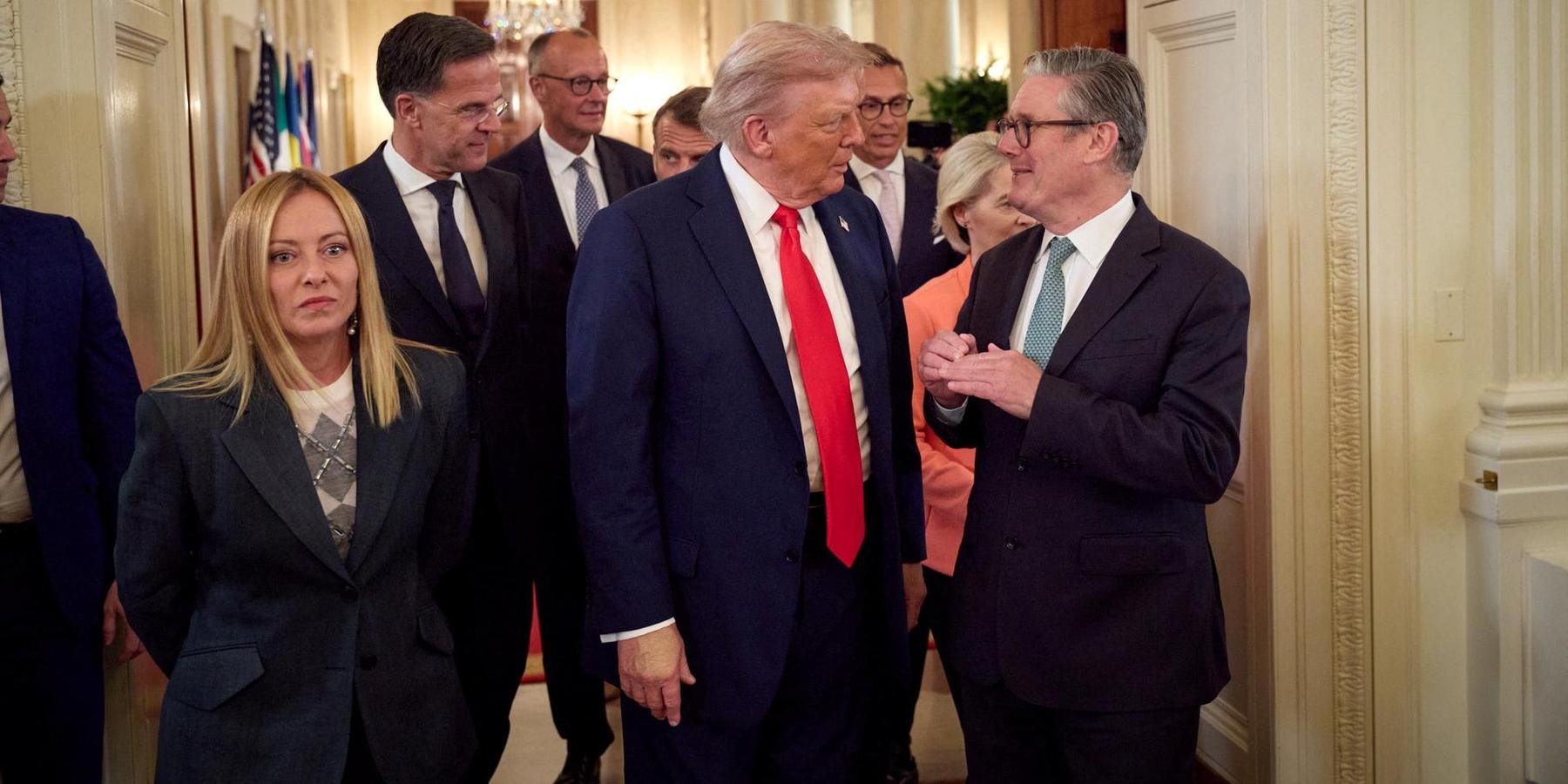
In the view of General de Gaulle, “Treaties are like young girls and roses; they last while they last.” By that standard, the North Atlantic Treaty Organization seems to be wilting pretty fast. The Israeli-U.S. war on Iran has opened up (or revealed) divisions that may prove fatal.
This week, in the first call of its kind from the European right, Tino Chrupalla, federal spokesman of Germany’s Alternative For Germany (AFD) party, declared, “Let’s begin to put into practice what our party manifesto says: the withdrawal of all U.S. troops from Germany.” He said that Germany cannot call itself a truly sovereign country while it hosts foreign bases over which it has no real control.
Chrupalla praised the Spanish government’s action in closing U.S. bases and Spanish airspace to participation in the Iran War: “Ships under the Spanish flag are allowed to pass the Strait [of Hormuz]. Why are the Spaniards allowed to cross? Because Spain has closed its bases for the Iran war. And that is totally right.”
This is an obvious riposte to President Trump’s latest remark that “countries like the United Kingdom”, that refused to get involved in the Iran War” should “Go get your own oil.” Iran has in fact allowed ships with oil destined for neutral countries to pass the Strait of Hormuz.
Understandably however, Tehran does not consider European countries that host bases from which the U.S. is attacking Iran to be truly “neutral.” If the war continues and energy shortages in Europe worsen, calls for other European countries to follow Spain are bound to intensify. The fate of the Gulf Arab states in this war has underlined the risks of hosting foreign military forces that you do not control.
France and Italy are indeed beginning to head in this direction. Italy has denied permission for U.S. planes headed to the war to refuel in Italy. France has closed its airspace to U.S. flights linked to the war. Trump’s response has been predictably furious, posting that “The U.S. will remember” France’s lack of help, and warning Britain and France that, “You’ll have to learn how to fight for yourself, the U.S.A. won’t be there to help you anymore, just like you weren’t there for us.”
This is despite the fact that Britain has allowed the U.S. to use its bases for strikes on Iran — officially, only ones “defending” the Strait of Hormuz, but who is checking?
In a more measured but therefore perhaps even more menacing way, Secretary of State Marco Rubio has said, “If NATO is just about us defending Europe if they’re attacked but then denying us basing rights when we need them, that’s not a very good arrangement. That’s a hard one to stay engaged in and say this is good for the United States. So all of that is going to have to be reexamined.”
NATO has of course been through crises before. President Eisenhower brought the Anglo-French seizure of Suez in 1956 to an end through economic pressure. President Johnson was furious with the British refusal to send troops to Vietnam. The U.S. strongly opposed the creation of the network of gas pipelines from Siberia to Europe in the 1970s. France and Germany attracted great anger from the Bush administration by refusing to take part in the attack on Iraq in 2003.
This crisis does however look significantly worse. Apart from Suez (where it was the U.S. that brought the war to an end) none of these cases touched on the vital interests of Europe or the U.S. On the U.S. side, Washington was well aware that European participation in the wars in Vietnam and Iraq would in any case have been almost entirely symbolic. By contrast, a united European move to close airspace to U.S. flights would critically undermine the U.S. campaign against Iran.
On the European side, none of the previous clashes with the U.S. had direct and obvious consequences for European economies and political systems. The Iran War risks creating an economic depression leading in turn to increased radicalization and polarization in Europe.
Finally, in the case of the Iraq War there was at least a facade of consultation and reasoned justification by the Bush administration. The Trump administration launched the attack on Iran without any consultation at all with NATO allies, and on the basis of justifications that are both incoherent and transparently false.
In their refusal to participate in the Iran War, West European governments have solid support from their own populations, where large majorities in every country oppose the Israeli-U.S. campaign. European public opposition to the war has been greatly increased by Trump’s deep personal unpopularity in Europe, and his crude insults against European countries. This has been a key factor in shifting right-wing populist movements like AfD into distance from or opposition to the war.
As self-styled patriotic movements, they cannot be seen to be siding with attacks on their nations. In the case of Britain, the most instinctively pro-U.S. of all the NATO countries, Trump caused outrage by his insults to the British armed forces, and forced even the opposition parties to come to the defense of Prime Minister Keir Starmer when Trump insulted him personally. Almost 60% of British respondents to a poll oppose the U.S. using British bases for the war.
In the background to these European responses also lies the growing unpopularity of Israel in European populations, and especially in the younger generation. Even before the attack on Iran, Israeli atrocities in Gaza had led 63-70% percent of European respondents to take an unfavorable view of Israel. Significantly for the future of European policy, these figures are considerably higher in the younger generation.
One massive barrier to European distancing from Washington has been the Ukraine War, European fears of an attack by Russia, and consequent desire for continued U.S. military support. However, as both Russian interests and the grindingly slow and appallingly costly progress of the Russian ground war against Ukraine both indicate, this alleged Russian threat is both completely hypothetical and grossly exaggerated; whereas the threat of the Iran War to European economies is all too real and imminent.
The longer the Iran war goes on, the greater will be the pressure in Europe to cut a deal with Iran — especially if European establishments have come to believe that the NATO guarantee of U.S. military protection no longer holds.
Lastly, there is the question of what Trump does after the Iran War. It has been suggested — let us hope wrongly — that one way in which he could distract attention from failure in Iran, and gain some compensation for it, might be by seizing Greenland. This would end NATO, for no alliance can survive an open attack by its leading member on another one; and after all, Russia has not claimed a single inch of NATO territory.
If the U.S. no longer defends and instead attacks Europe, and Europe no longer acts as an airstrip for U.S. force projection elsewhere in the world, then the basic rationales for NATO’s existence will have vanished.
- Iran war could cripple the 'Yuxi Circle' or 55% of world population ›
- Putting boots on the ground could kill Trump’s presidency ›