

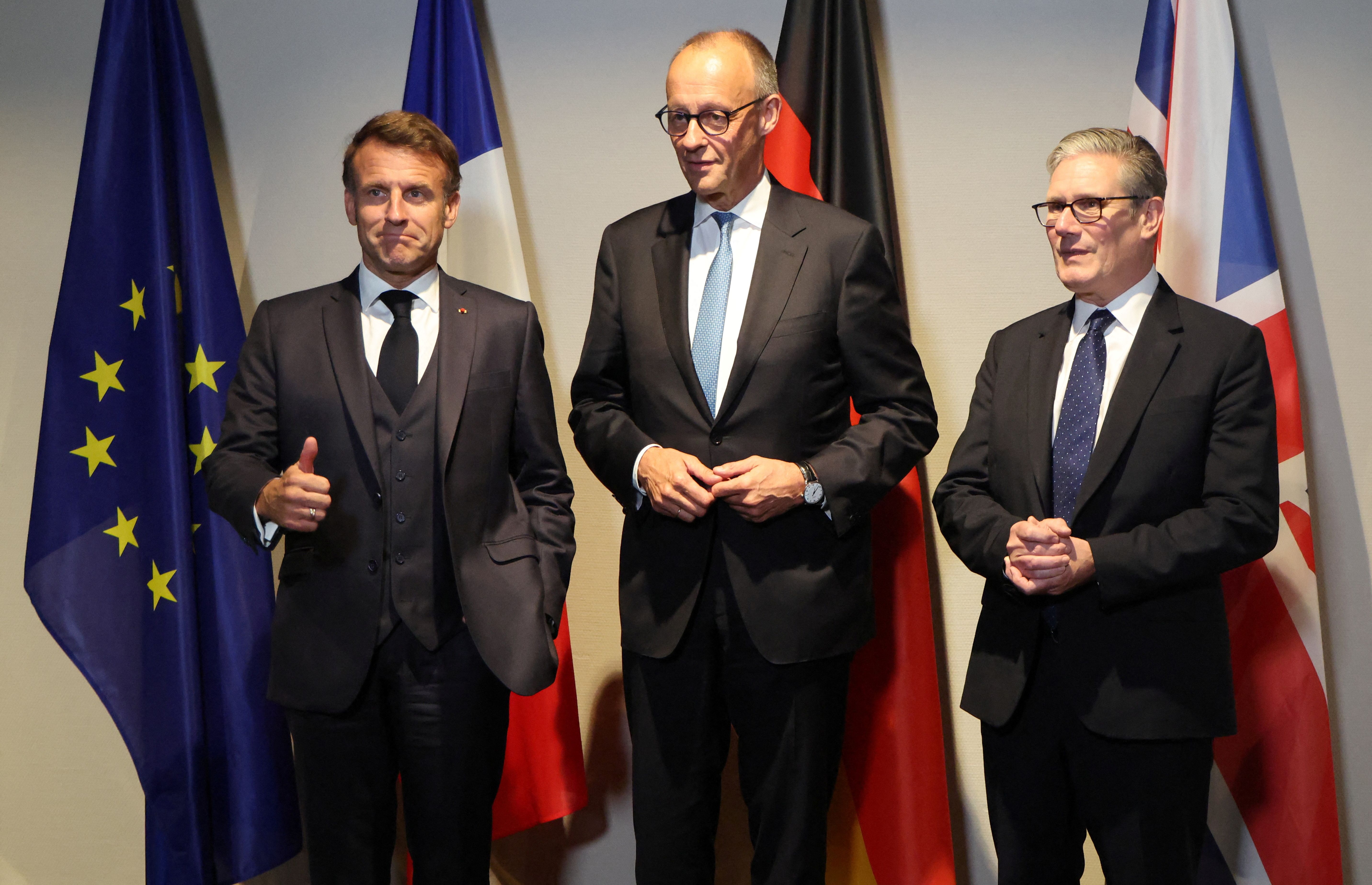
The United Nations Security Council today will reinstate via “snapback” all of the U.N. sanctions formerly lifted under the 2015 Iran nuclear accord. This trigger comes from Germany, France, and the UK — the very powers that engineered the 2015 deal — and now they are extinguishing the final diplomatic exit ramp, consolidating a trajectory toward confrontation.
As I suggested when the E3 first activated the snapback mechanism, this is no longer about Iran’s nuclear program; it is an EU stratagem to corral the U.S. into alignment over Ukraine:
Iran’s deepening partnership with Russia in the Ukraine war has recast it, in Europe’s eyes, as a direct threat. The EU’s economic ties to Tehran are negligible after years of sanctions. Meanwhile, Europe’s reliance on the transatlantic relationship—military, political and economic—is far greater than it was in 2003.
In this context, escalation with Iran serves two European objectives. First, it punishes Tehran for aligning with Moscow, sending a message that supporting Russia comes with heavy costs. Second, it aligns Europe with hawkish elements of the Trump administration, at a time when transatlantic relations are under historic strain. For European leaders desperate to maintain American goodwill, Iran has become a convenient sacrificial offering.
None of this is speculation. Germany’s chancellor recently acknowledged that Israel, by bombing Iran in June, “is doing the dirty work for all of us.” The remark was unusually candid. It underscored what many in European capitals privately concede: that Israel’s military actions against Iran serve European interests by weakening a state now aligned with Russia.
That is why I have long doubted the efficacy of courageous efforts to forestall the snapback. If one party is resolutely determined to trigger it for its own ends, then nuclear concessions alone are unlikely to suffice.
Reportedly, the Iranians have engaged directly with the U.S. and proposed a compromise: as an initial step, they would reclaim and dilute their stockpile of 60 % enriched uranium in exchange for a temporary postponement of the snapback deadline by a few months. During that interval, the U.S. should furnish ironclad guarantees that no military reprisals will be taken against Iran.
Once Iran has retrieved the enriched uranium, the snapback provision should be abolished permanently; the uranium stockpile should be diluted to 20%; and the U.S. should lift the sanctions previously agreed upon. This would constitute a provisional accord, to be followed by negotiations for a comprehensive, final settlement. Other contentious issues — such as scope of enrichment and the intensity of IAEA inspections — will be deferred to the final deal.
Rumors abound that the Trump administration will spurn the offer — since its strategy is premised on ratcheting up “maximum pressure” sanctions, under the conviction that Iran is on the brink of collapse, and that just a further squeeze will produce results. The E3, for their part, intend to furnish Washington with snapback authority, hoping thereby to anchor a more hawkish U.S. policy toward Russia.
Since Russia is more important to Europe than Iran, and since appeasing Israel is more important to Washington than avoiding confrontation with Iran, it appears that the substance of Iran’s compromise seems moot.
This situation echoes a similar negotiation in 2011, as I described in my book on Obama’s nuclear diplomacy: Turkey and Brazil succeeded in extracting Iranian acquiescence to U.S. demands to forestall U.N. sanctions. Yet unbeknownst to Brasilia and Ankara, the Obama administration had already cemented an understanding with Russia — one premised on Moscow agreeing to U.N. sanctions — and had reassured pro-Israel hawks in Congress that Iran would ultimately be sanctioned, no matter what.
So, in their moment of triumph — having elicited a “yes” from Iran to U.S. demands after marathon negotiations — Obama spoiled the fête by repudiating the very deal he’d urged Lula and Erdoğan to procure. The talks with Tehran were a mirage; the true bargaining was among other actors, with the nuclear question serving merely as a gambit.
Diplomacy to avert snapback gives the same impression. The real contest isn’t over Iran’s enrichment program, but between the U.S. and the EU over Russia, Ukraine, and the transatlantic relationship. Iran’s nuclear dossier appears just a pawn in the courts of the E3.
A version of this article originally appeared on Trita Parsi's Substack.