

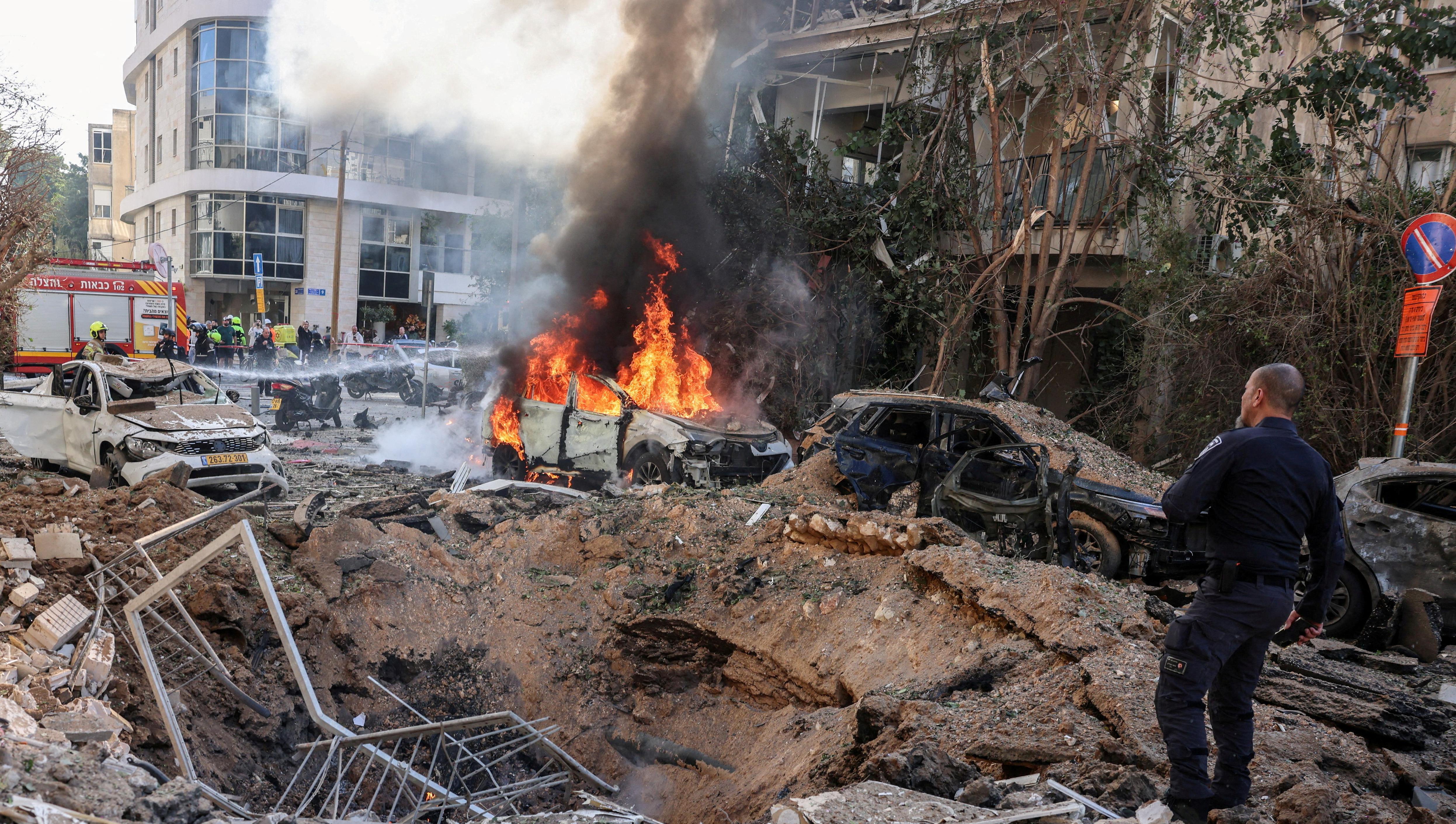
A month into the U.S. military campaign against Iran, Israel’s vaunted air defense system is showing its limits. Just in the past 10 days, major cities including Tel Aviv, Dimona, and Arad sustained significant damage when Iranian missiles successfully evaded Israel’s network of interceptors.
The most obvious explanation for the apparent failures is that depletion of Israel’s interceptor stockpiles is forcing the Israel Defense Forces to ration munitions or prioritize targets. But the faults in Israel’s air defenses almost certainly have deeper roots. After all, even if forced to defend only the most important locations, Israel would almost certainly place Dimona — a city located near several of Israel’s key nuclear facilities — at the top of the list.
The more worrisome reality is that gaps in Israel’s air defenses may be detection (rather than interception) failures resulting from damage to the radars and sensors that underlie the integrated air defense network shared by the United States, Israel, and Gulf partners. If true, the implications would be dire. Operating without the “eyes” that the American military relies on to identify and mitigate threats, U.S. forces and assets would be much more vulnerable than previously understood.
Until recently, Israel’s layered air defense system was seen as nearly impenetrable. The first layer, known as the Iron Dome, protects Israel’s cities and infrastructure against short-range rockets, like those fired by Hezbollah and Hamas. Though the Iron Dome stood up under significant pressure in the days and weeks after the October 7 attack, it is less useful against a much stronger Iranian adversary armed with ballistic missiles and long-range drones.
To protect against the medium- and longer-range cruise and ballistic missiles that pose the greatest threat in the current war, Israel has relied on three additional air defense layers: David’s Sling, Arrow 2 and 3, and U.S.-provided THAAD systems. While the David’s Sling intercepts missiles inside the Earth’s atmosphere, the Arrow system targets missiles outside that atmosphere, making them much more effective against ballistic missiles. Israel also receives support from U.S. THAAD systems inside Israel as well as air and naval assets in the region.
The redundant nature of Israel’s air defense system is why recent Iranian successes have been so surprising to observers who have questioned why Israel’s airspace suddenly seems penetrable, even against a wounded Iranian military.
There is no one answer to this puzzle, but the simplest explanations seem insufficient. Israel has indeed burned through much of its air interceptor stockpile. Some reports suggest that as much as 80% of the IDF’s most advanced air defense munitions were expended in the first three weeks of war, forcing Israel to rely increasingly on other systems. This rapid exhaustion suggests Israel’s defenses were more fragile than they seemed, and clearly not set up to defend against the volume of attacks that Iran is now able to mount.
A second factor in Iran’s successes is the country’s use of large numbers of drones and cluster munitions that are able to swarm an air defense network and overwhelm its capacity. No air interceptor system is perfect, so Iran’s ability to increase the number of munitions confronting Israeli defenses could explain its higher hit rate compared to past conflicts. But Iran used similar weapons in the 12-day War to less effect, so this, too, is an unsatisfying rationale.
The problem with these initial explanations is that they are too narrow and focus on shortcomings inside Israel. The more likely possibility, however, is that observed vulnerabilities in Israel’s air defense systems originate not within Israel but outside, in the broader U.S.-Israeli air defense network that spans the Middle East region.
Although Israel owns and even produces many of its own air defense systems and munitions (some through joint ventures with the United States), its air defense network is integrated with that of the United States, allowing the two countries to share intelligence and data from sensors and radars across the region. Damage to this network of sensors and radars would fatally undermine Israel’s air defenses — and those of the United States.
Even with limits on real time satellite information, evidence of this type of systemic failure is piling up. Reports based on available satellite imagery suggest that at least 10 U.S. radar sites in the Middle East have been hit by Iranian drones since the start of the war. These include multiple AN/TPY-2 radars used in the THAAD air defense systems, and an AN/FPS-132 Phased Array Radar in Qatar. Though the loss of a single radar would not disable the whole air defense network, the loss of 10 or more radars or sensing systems would significantly degrade the U.S. ability to identify and respond to incoming threats.
More concerning is the apparent inability of the United States to protect its own Middle Eastern bases. Last week, reports surfaced that U.S. personnel are no longer able to live and work on many military bases in the Gulf region, forced to move to hotels or alternative locations, because the bases themselves are too vulnerable to attacks by Iranian drones and missiles.
Indeed, successful attacks on U.S. aircraft parked at regional bases and continued U.S. casualties at locations where U.S. personnel remain confirm such vulnerabilities. In the most recent incident at Prince Sultan air base in Saudi Arabia, Iranian missiles and drones injured 12 servicemembers and damaged several planes, including a rare E-3 early warning aircraft (a target the U.S. surely would have acted to protect, even with scarce interceptors, had it detected the threat in time).
Since most major bases in the Middle East that host U.S. forces also house or are covered by advanced air defense systems, the apparent vulnerability of these locations suggests a problem far larger than a lack of sufficient interceptor missiles or counterdrone systems.
News that the Pentagon is moving parts from THAAD and Patriot systems based in Asia into the Middle East offers a final data point. First, since these systems are primed for ballistic and other advanced missiles, their redeployment implies the urgent threat is not, in fact, drones. Second, if more capacity were needed, whole systems might be moved. That only pieces were reallocated suggests that the goal may have instead been repair of damaged systems or replacement of damaged parts, including sensors and radars.
The implications of even a partial failure of the U.S. air defense network in the Middle East would be far reaching, threatening U.S. operations in the current war, future conflicts in other theaters, and homeland defense. While the Pentagon has spent much time talking about magazine depth and the need to rebuild munitions stockpiles, the more urgent post-war requirement may instead be repairing and hardening the U.S. network of ground-based sensors and radars on which U.S. air defense relies, in the Middle East and elsewhere.
This is a much harder challenge than simply speeding up munition production. Repairing advanced radars and sensors is time consuming, expensive and complex. And the war with Iran seems to have fundamentally challenged the U.S. approach to air defense, especially its heavy reliance on ground-based systems, and suggests that U.S. air defense capabilities are not ready for modern warfare. The problem is therefore strategic, not merely technical.
Going forward, reliance on ground-based sensors and radars may become increasingly ineffective and unsustainable, especially in conflicts against well-equipped adversaries. The Pentagon will need to rapidly speed up its shift toward space- and satellite-based systems for tracking and interception. Since new technologies will take time to mature and may have their own limitations, hardening of U.S. military infrastructure will also be required and should receive significant and immediate investment.
Finally, U.S. defense officials should reevaluate the current U.S. military posture in the Middle East and elsewhere. The United States routinely places soldiers in vulnerable locations, close to adversary borders, in the name of deterrence. More fallible air defense will require removing personnel from these locations for good.- Trump: We have 'unlimited' weapons to fight 'forever' war ›
- What happens when we give Europe first dibs on US missiles for war ›