

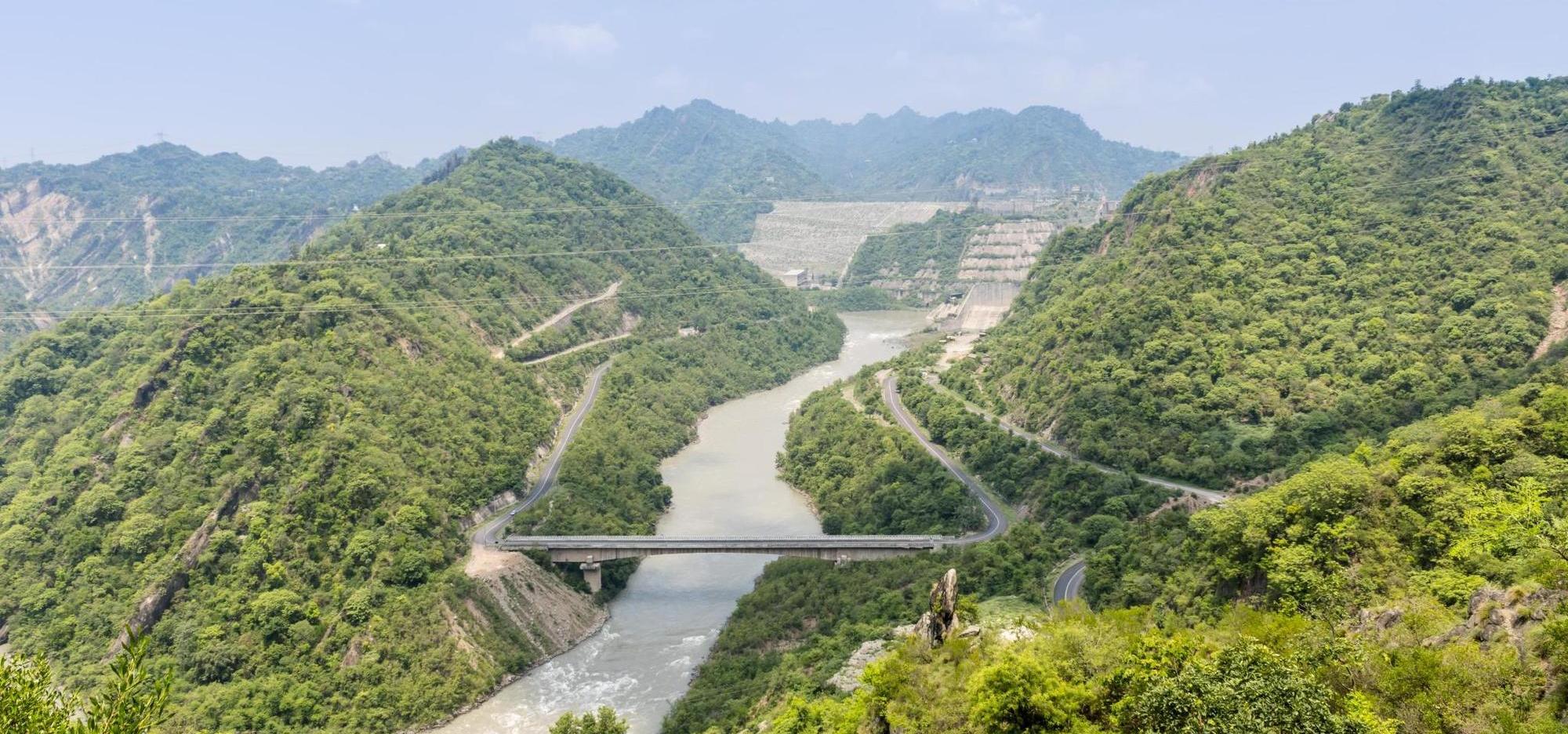
Last week, water became a focal point in the Iran war, as airstrikes hit desalination plants in Iran and Bahrain. Further east, a slower motion water war was playing out — one that is heightening tensions between two nuclear armed powers.
The Shahpur Kandi Dam project was first conceptualized in the late 1970s. In 1982, former Indian Prime Minister Indira Gandhi laid its foundation stone and set a 1988 deadline for the project. But inter-state conflicts between Punjab, Jammu, and Kashmir stalled construction for decades.
It wasn’t until September 2018 that the Indian and Pakistani governments reached an agreement and the dam construction regained momentum. Now, almost 50 years after the dam was first envisioned, it is expected to be completed by March 31.
The dam, which sits on the Punjab–Jammu and Kashmir border, will not stop the flow of water from the Ravi River entirely, but it will effectively reduce the surplus river waters flowing into Pakistan and ensure that India captures and uses water that it previously allowed to pass downstream unused.
Although redirecting this water toward Indian farms and power grids is permitted under existing agreements, experts say the dam’s completion reflects worsening relations between India and Pakistan and may signal a shift in the norms that have governed the region’s water politics for decades.
The framework for sharing the water system was established by the 1960 Indus Waters Treaty, which allocates the three eastern rivers to India and the three western rivers to Pakistan, giving India exclusive rights to the Ravi.
But, experts point out, the timing of the dam construction may reflect increasingly strained relationships between New Delhi and Islamabad. Last year, following a terrorist attack that killed 26 people, India charged Pakistan-based militant groups for the massacre and put the Indus Waters Treaty in abeyance.
“There's a case going on about whether the suspension is meaningful or not,” said Hassaan Khan, an assistant professor in the Department of Urban and Environmental Policy and Planning at Tufts University. “But we're starting to see that the norm that had been established over 60 years no longer holds.” What happens next is “anybody’s guess,” Khan told RS. “We're seeing it play out in real time.”
After a four-day conflict last year that ended in a weak truce, tensions between India and Pakistan have remained high. The completion of the Shahpur Kandi dam could be just one part of a “broader strategy of trying to increase the cost on Pakistan for what India views as bad behavior,” Christopher Clary, a nonresident fellow with Stimson Center’s South Asia program, told RS. Clary said the move is more of a “symptom of relations being bad, rather than a cause of them worsening further.”
It’s possible that the dam would have been constructed now even if relations between the two nations were stable. However, David Michel, a senior fellow for water security with the Global Food and Water Security Program at the Center for Strategic and International Studies, argues that the attacks accelerated infrastructure development not only on the Ravi River but across the broader Western basin.
“That policy step has opened the floodgates, in some ways, to an acceleration of many projects of which this is one,” Michel told RS.
Regardless, the construction of the dam is “symbolically relevant,” according to Sarang Shidore, the Director of the Global South Program at the Quincy Institute, which publishes RS. “It tells us that the situation is continuing and that tensions are incrementally increasing,” Shidore said. “There isn’t any breakthrough publicly in sight, and that tense situation is contributing to a general sense of insecurity in the region. It is another sign that the situation is fraught, difficult, and tense.”
The effects of the dam being installed will be “negative, but modest,” for Pakistan, Clary told RS. Pakistan receives water from elsewhere, and losing access to this specific river isn’t likely to monumentally affect the nation, Clary said. However, the stakes are still high — especially if the “water war,” as Pakistan has described the conflict, continues further.
Agriculture accounts for roughly a quarter of Pakistan’s GDP, and the sector relies heavily on water from the Indus system. And though this specific dam construction may have negligible effects on the amount of water flowing into Pakistan, the political effects could be quite extreme, according to Michel.
“It would be registered in Pakistan, downstream, that India was intentionally manipulating these flows for the express purpose of harming Pakistan, which could be interpreted in Pakistan as quite an aggressive posture,” Michel said. “Pakistan has previously [said] that interruptions in this flow would be considered acts of war.”
Michel believes that the benefits to Indian populations derived from the dam construction seem almost secondary to preventing water flow to Pakistan. The pressure and damage that the dam construction could inflict on Pakistani communities may be the primary motivation for India, he said.
“The geopolitical and policy impacts have the potential to be significantly more important in the near term” than any environmental effects, Michel told RS.
And the ramifications of these geopolitical impacts may be felt not just in Pakistan, but across the broader region. In January, Pakistan’s Permanent Representative to the United Nations, Asim Iftikhar Ahmad, said the dam construction was not “merely a bilateral concern” but a “test case for the international system.”
Indeed, India has concerns about dams that China is looking to build upriver, and Bangladesh is worried about further dam construction in India, suggesting that South Asian water disputes could carry broader international implications.
“This is the beginning of probably many years and decades of water conflict news cycles we're likely to see in southern Asia,” Clary said.