

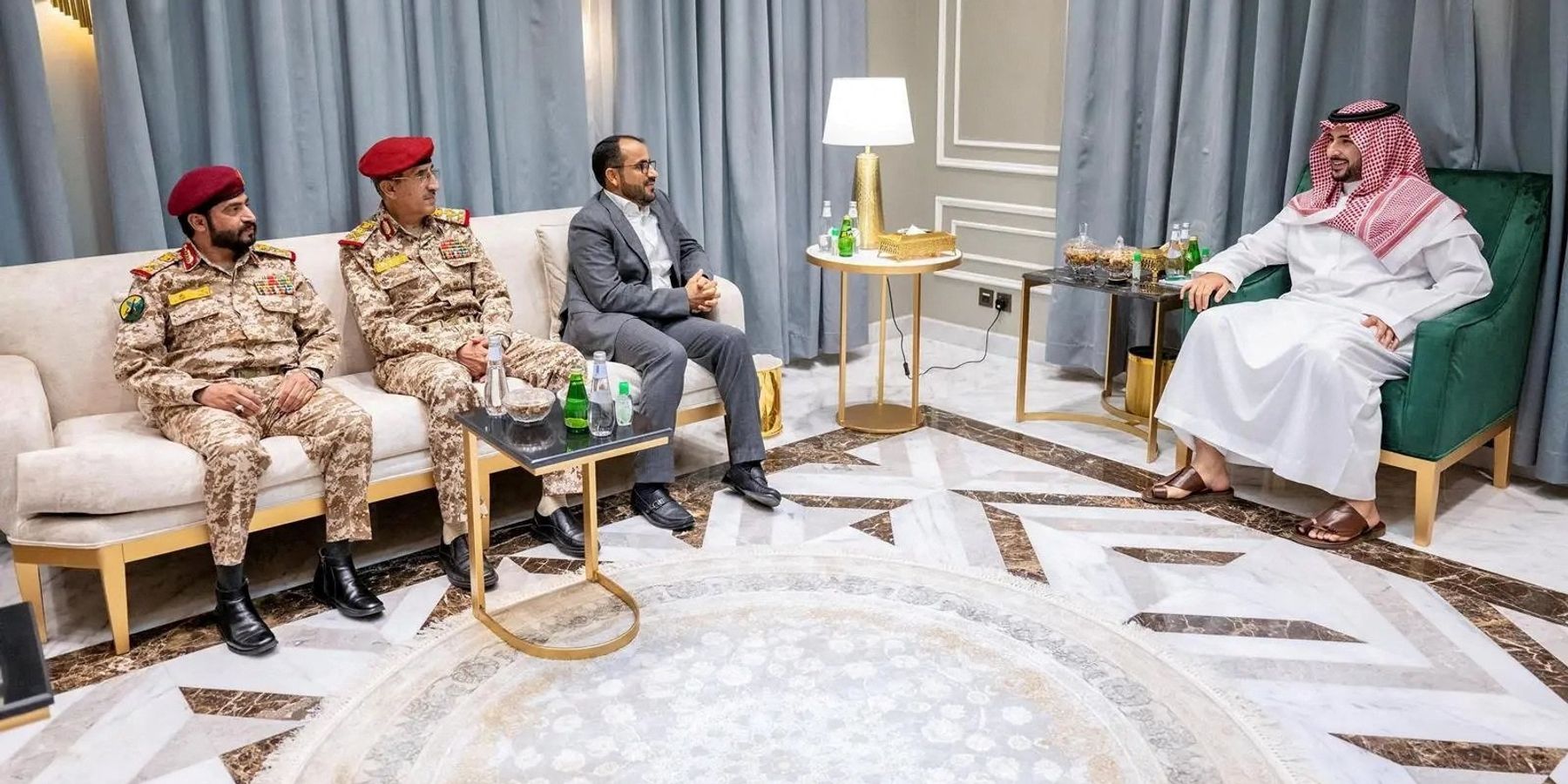
On September 14, a Houthi delegation and a team of Omani diplomats flew to Riyadh for talks on resolving the Yemeni conflict(s), constituting the highest-level Houthi-Saudi official negotiations on Saudi soil since Yemen’s civil war began nine years ago. On September 20, Saudi officials said the visit produced “positive results.”
The talks followed a five-month hiatus in peace negotiations since after the last round of Omani-facilitated Houthi-Saudi negotiations that took place in Sana‘a in April. The most recent talks appeared to offer more hope for a sustained truce between the Houthis and the kingdom, which would be necessary for bringing lasting peace to Yemen. But concerns persist that a final peace accord between those two parties to what has been a devastating conflict may lead to renewed warfare between the Houthis and other Yemeni factions.
New Saudi Language
In Riyadh, the Houthi delegation met with Saudi Defense Minister Prince Khalid bin Salman, who referred to the visiting Houthi representatives as the “Sana‘a delegation,” rather than “the Houthis” or “Ansar Allah,” the official name of the Houthi militia. Such terminology appeared to signal Riyadh’s recognition that the Houthis are indeed running a government, underscoring Saudi Arabia’s growing willingness to find a modus vivendi with the powerful force that has effectively consolidated power in northern Yemen.
“The shift in language to ‘Sana‘a delegation’ is significant,” according to Elisabeth Kendall, who teaches Arab studies at the University of Cambridge. “The Houthis and Ansar Allah have long been vilified in the Saudi media, so removing references to them appears designed to de-stigmatize the talks and avoid any notion of a Saudi climb-down,” she told RS.
“The significance of new naming stems from re-positioning and pre-understandings: the desire to improve [the] diplomatic atmosphere, flip the page of full tensions at any cost, confer symbolic recognition, and gradually shift public perceptions,” agreed Ibrahim Jalal, a non-resident scholar at the Washington-based Middle East Institute. (Editor's note: MEI counts the Saudi government among its major donors.)
Obstacles to a Houthi-Saudi Pact
Despite recent progress, the Houthis and Saudis have yet to finally reach a permanent truce, and more work will be required. At least four delicate issues remain unresolved.
First is the issue of salary payments for public sector employees in the Houthi-controlled north, where approximately 80% of Yemen’s population lives. The Houthis demand payments of salaries of public sector workers in areas under their control. But their adversaries worry that the money will fund Ansar Allah’s war machine. Nonetheless, there is some vagueness to this Houthi demand because sometimes Ansar Allah frames their demand as if the Houthis want all the back payment while on other occasions making it seem as though they are only demanding salary payments moving forward.
The third concern has to do with Houthi demands that the Saudis permit the unrestricted- reopening of Sana‘a international airport, as well as other airports in Yemen, and the country’s seaports. While these airports and ports have already opened up significantly over the past year, the Houthis demand that they fully reopen. Additionally, Ansar Allah demands flights to and from Sana‘a airport from more countries than currently permitted.
The final issue regards the Houthis’ access to funds in Yemen’s Aden-based Central Bank. The talks thus far have addressed how the Central Bank can be reunited, either in Yemen or possibly in another country such as Oman or Jordan. “The idea is again a Houthi demand that money going into the central bank should be available to them as well. The logistics of this will be an important consideration,” according to Khoury.
Largely thanks to Oman’s much-lauded mediation skills, momentum behind the negotiations appears to have accelerated. However, these talks will probably move slowly, with progress coming incrementally given the long-standing distrust that exists between the Houthis and the Saudis. Although trust-building between the two sides can’t happen overnight, it is significant that the Houthis sent a senior delegation to Riyadh.
Moreover, a September 25 Houthi drone attack along the Yemeni-Saudi border, which resulted in the death of at least three Bahraini soldiers, may set the talks back. According to Jalal, this attack was part of a Houthi effort to “exercise pressure to secure more Saudi concessions…and flip the page at any cost.” It will be important to see if and when the Houthis carry out more such attacks and how Saudi Arabia and the United Arab Emirates (UAE) might respond.
Yemen’s Bigger Picture
There is more to the Yemeni civil war than the Houthi-Saudi conflict. There are many other conflicts in the country that will require hard work to resolve. If a Houthi-Saudi pact is in fact achieved, it will not guarantee peace between Ansar Allah and other armed groups in Yemen. Many communities in Yemen fear that the Houthis could turn their formidable military power on them after they sign a potential truce with Riyadh.
“This issue is that the Houthis will have reached a deal with the Saudis, not with their domestic enemies and rivals,” according to Kendall. “If the Houthis no longer face any military threat from Saudi, they may feel empowered to push their advantage domestically to gain further territory, more resources and greater political power.”
“Currently, there is no shared domestic vision for the future shape of Yemen, neither between the Houthis and the internationally recognized government, nor even between the nominally allied members of that government. With the domestic parties themselves so heavily factionalized, the risk of civil war or a frozen conflict remains high,” she added.
Jalal echoed those concerns. “While efforts to end the conflict are welcome, all non-Houthi Yemeni groups and political parties have legitimate concerns, as they should, given the very domestic root causes of the conflict and multiplicity of stakes and interests.
“Ongoing Saudi-Houthi talks are one layer but have yet to address the complexity of what matters most to Yemenis, who shall the seek to improve the quality, content and design of any peace agreement because in the past [they] paid the price of fragile peace,” he noted.
The weak and fragile Presidential Leadership Council, which is Yemen’s internationally recognized government, has not participated in the Houthi-Saudi talks. Nor has the UAE. As Khoury told RS, there are signs that Abu Dhabi is “quite miffed” by its exclusion. What this means is that a potential Houthi-Saudi Arabia truce could result in Ansar Allah consolidating its hold on the north, while a regime led by the UAE-backed Southern Transitional Council (STC) that governs Aden and other parts of southern Yemen declares its independence. The STC has been clear that it will not accept a Houthi-Saudi pact imposed on all of Yemen without its agreement.
Ultimately, the latest talks held in Riyadh with the Houthi delegation will ideally pave the way for inclusive Yemeni-Yemeni talks to establish a roadmap toward broader peace across all of Yemen. But the fear is that Yemen’s civil war will reignite once Saudi Arabia exits. Time will tell whether a Houthi-Saudi pact would push Ansar Allah toward making concessions to other Yemeni groups or wage war against them.
- Despite a lull in violence, Yemen still strangled by humanitarian crisis ›
- Biden’s problem in Yemen: The Houthis are winning ›