

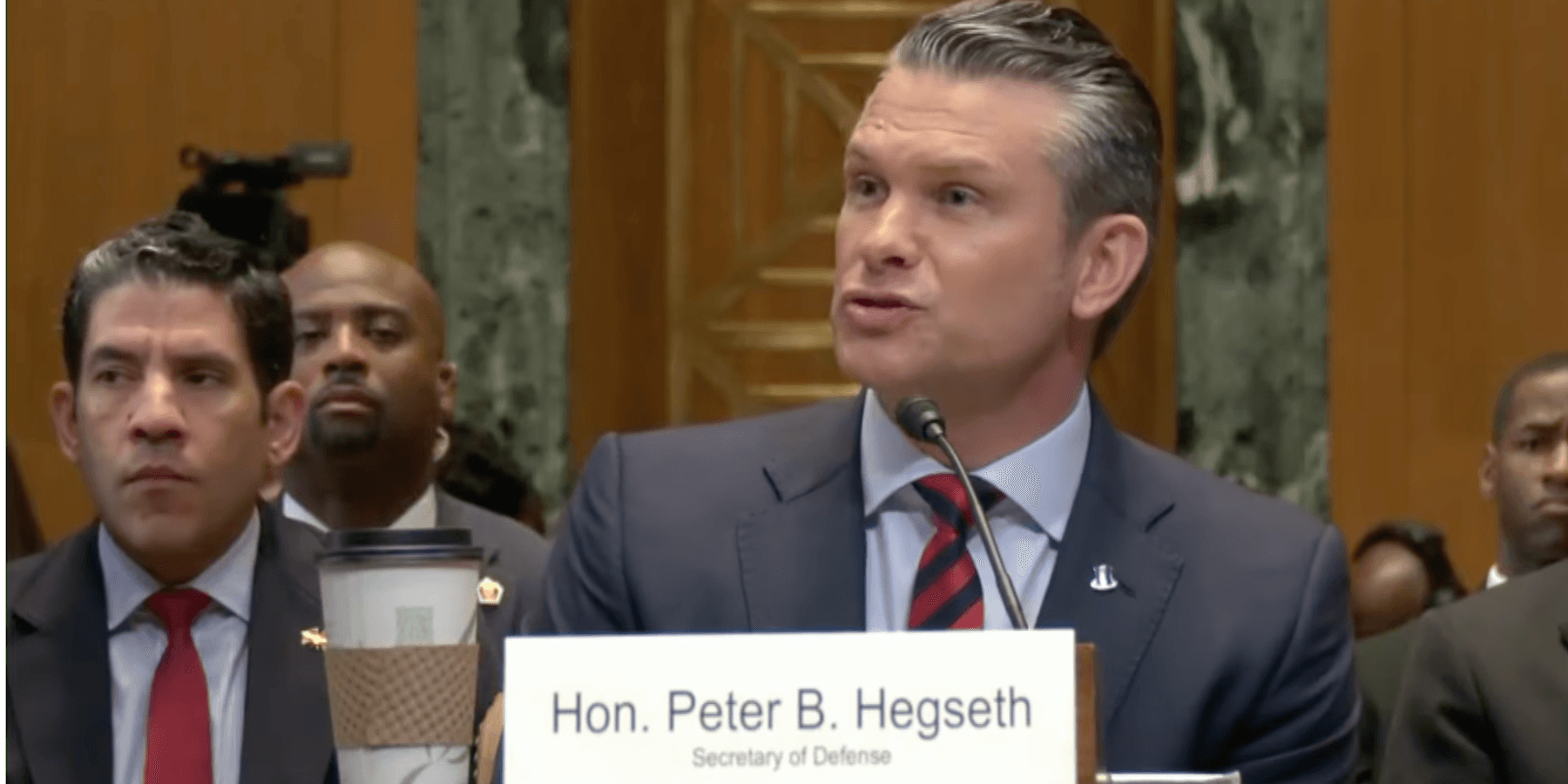
Secretary of Defense Pete Hegseth and Chairman of the Joint Chiefs of Staff Dan Caine testified before the House and Senate Appropriations Committees on Tuesday ostensibly to justify the President’s request for an historic $1.5 trillion budget. Unfortunately, they offered no strategic justification for this nearly $500 billion increase in military spending and, instead, raised even more questions about the Pentagon budget and the cost of the war in Iran.
What was most surprising about the hearings was perhaps what was missing: a real enemy. Historically, increases in Pentagon spending have been justified by a monster abroad we’re told we must destroy. The Soviet menace justified Reagan’s military buildup and the war on terrorism justified George W. Bush — and later Barack Obama’s — surge in military spending, for example. While the usual suspects —China, Russia, and Iran — were all mentioned in the hearings today, neither Hegseth nor Caine made the case that they were enough to justify the enormous increase in military spending they are asking Congress for.
Instead they offered Congress a collage of unconvincing justifications ranging from military spending as a jobs program to amorphous threats that the U.S. needed to stay ahead of.
Counterintuitively they went to great lengths to argue that the Iran war has been pretty affordable. Hegseth argued vehemently — and contrary to multiple reports of munitions shortages resulting from the Iran conflict — that the Pentagon was in fact not experiencing a munitions shortage. “We have all the munitions needed to execute what we need to execute,” Hegseth stated in the House hearing.
Similarly baffling was the Acting Pentagon Comptroller, Jules Hurst, testifying that the Iran war has cost a mere $29 billion total, and just $4 billion in the past month. This figure ignores the extensive costs to U.S. facilities in the region — more than half of which have been damaged in Iranian strikes — and is significantly below nearly every estimate of the war's direct costs.
In March the Pentagon informally requested $200 billion for the war from Congress. In late April, U.S. officials familiar with internal Pentagon accounting told CBS News that the true costs of the war were close to $50 billion. And, a recent public account by Stephen Semler at Popular Information put the costs above $72 billion. Meanwhile, Americans see the costs every time they refill their cars and see gas prices up more than $1.50 per gallon since the war began.
Despite presenting no strategic necessity for the largest year-over-year Pentagon spending increase since World War II, Hegseth repeatedly claimed the $1.5 trillion Pentagon budget was a sound financial decision, arguing in the Senate hearing that “at every level we have made it a fiscally responsible budget.” Yet, the fact is that the entirety of this proposed increase in Pentagon spending would be deficit financed, effectively going on Uncle Sam’s credit card.
According to the Center for a Responsible Federal Budget, over the next ten years it could add nearly $7 trillion to the already spiraling U.S. national debt.
In short, despite spending hours on Capitol Hill arguing for an unprecedented increase in military spending, Hegseth and Caine offered more reasons to question it than to justify it.
- Five shameless moments of Iran war opportunism & grifting ›
- Expert: Iran war cost $72 billion over first two months ›
- Hegseth dismisses munitions fears as 'foolishly' overstated ›