

On October 13, Germany’s government had to cancel at the last minute a press conference at which it planned to announce a new bill expanding military conscription. It was the result of disagreements between the two major parties in the governing coalition, the Social Democrats (SPD) and Christian Democrats (CDU/CSU).
This episode reveals the fundamental fragility of Berlin’s much-touted defense renewal.
The invasion of Ukraine in 2022 laid bare Europe’s strategic vulnerabilities and the continent’s continued dependence on the United States for its security. The latter became even more urgent after Donald Trump’s return to the White House in January 2025, with its insistence that NATO members do more.
Since assuming office in January, President Trump has vacillated between prioritizing pressure on Ukraine and Russia. In July, for instance, Trump indicated that he would no longer be willing to send any aid to Ukraine, but he would be happy to sell them weapons — if the Europeans picked up the tab. More recently he has authorized greater intelligence sharing to allow Ukraine to strike deeper into Russia and placed additional sanctions on Russia’s oil and energy sectors.
The Ukrainian government needs about $100 billion a year to provide a minimal level of public services and sustain its war effort. Since the start of the war, the U.S. has provided $130 billion in military and economic aid to Ukraine, according to the Kiel Institute, while European nations together have provided $166 billion (not counting more indirect costs, from sheltering Ukrainian refugees to paying 2-3 times more for their natural gas). Other countries outside the EU, such as the United Kingdom and Canada, have also made substantial contributions in support of Ukraine.
Europe’s GDP is over $20 trillion, 10 times that of Russia, so on paper European countries should be able to support Ukraine and rearm — if the political will is there. Russia spent $145 billion on defense in 2024, while the EU spent $400 billion: that amounts to less than 2% of Europe’s GDP. In June, in response to pressure from President Trump, Europe’s NATO members pledged to increase their core defense spending to 3.5% of GDP.
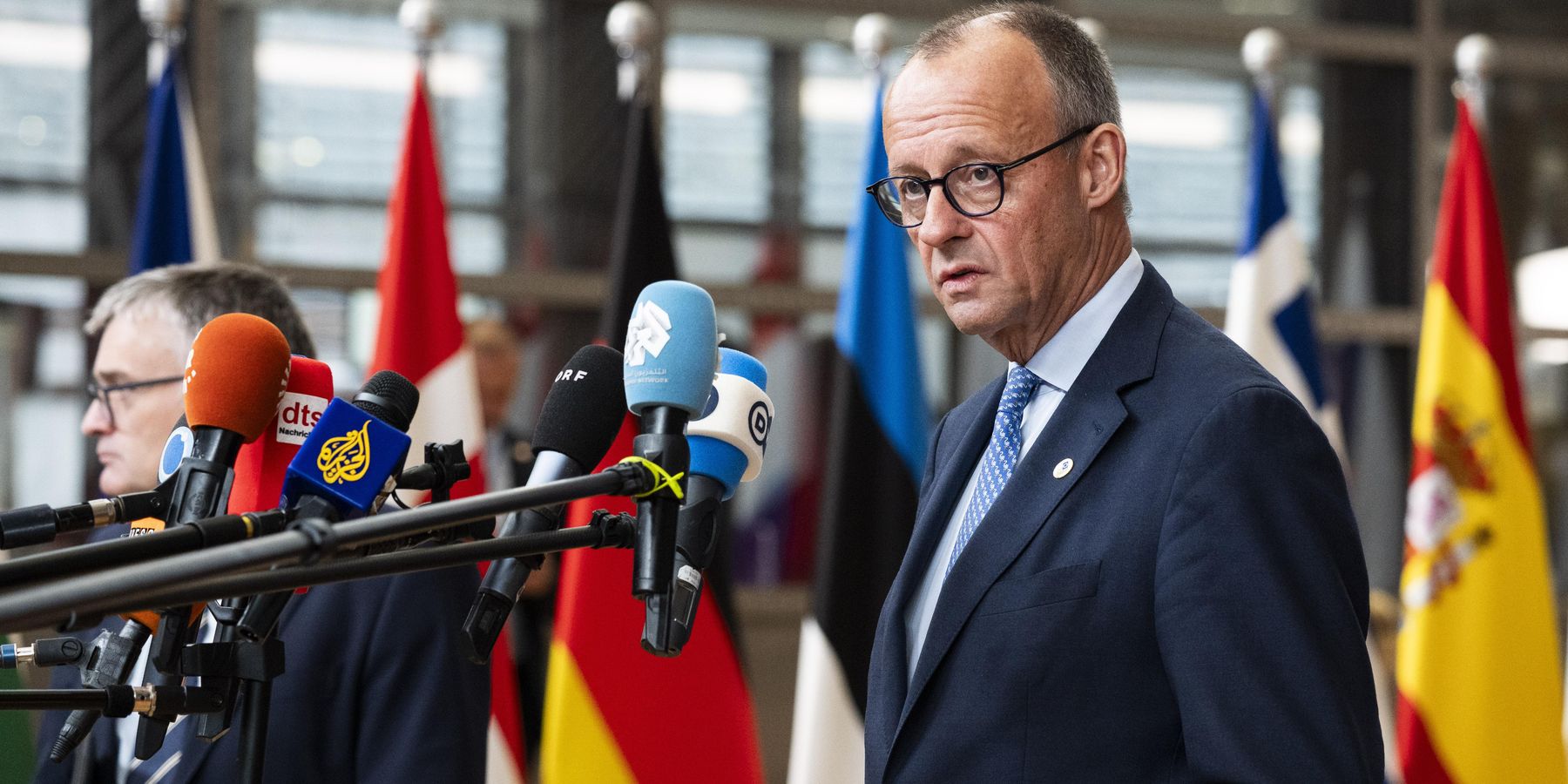
In May, Chancellor Friedrich Merz took office and committed Germany to stepping up, in partnership with France, as the backbone of a new European security architecture. The country abolished its constitutional debt brake for military spending, promising to triple Germany’s defense budget within the next five years. The removal of the debt brake (which limited government borrowing to 0.35% of GDP) was a source of controversy, since Merz had promised not to touch the mechanism while campaigning, only to reverse course after the election.
But the collapse of the conscription bill illustrates the shaky foundations of this about-face. Germany wants to increase its armed forces from 182,000 to 260,000, relying on volunteers but with compulsory registration and a lottery for all male 18-year-olds, should the number of recruits fall short. The bill faltered because the Social Democrats objected to the mandatory registration and lottery. Just 10 European countries currently have mandatory military service, with the proportion of young men actually drafted ranges from 8% to 80% depending on the country. Germany itself ended mandatory military service in 2011.
Merz’s cabinet is positioning defense investment as a path to reviving Germany’s ailing economy. Germany experienced two years of negative growth in 2023 and 2024, largely due to the escalating cost of energy in the wake of the Ukraine war. As Economy Minister Katharina Reiche put it, rearmament is an “economic and technological opportunity for Germany.” About 50% of new procurement contracts have gone to German companies.
Resistance to joint EU funding and weapons imports perpetuates the remarkable inefficiency of Germany’s defense industry. As a recent study by the Brussels think-tank Bruegel notes, fragmentation is the central problem in European weapons production, and Berlin is a major offender. European defense firms produce nine different types of jet fighters, four types of tanks, 16 frigates, and 17 models of armored personal carriers (APCs).
In contrast, the U.S. produces just four fighters and has one basic model of tank, frigate and APC. That enables the U.S. to benefit from economies of scale. Thus, for example, a German Panzerhaubitze 2000 howitzer, at €17 million per unit, costs 10 times as much as its American M109 counterpart. The German Leopard 2A8 tank is almost twice as expensive as the American M1A2 Abrams.
Cleavages over ties to the U.S. and Russia, as well as Germany’s pacifist orientation, run deep in German political culture. The disputes between the SPD and CDU/CSU, and within the ranks of the SPD, over the conscription question make clear that these rifts will continue to plague Germany’s changing defense politics. Boosting defense spending as a way to stimulate economic growth is unlikely to succeed in papering over these political divisions.
- German leaders miscalculated popular will for war spending ›
- What’s holding back German rearmament? It turns out, a lot ›