

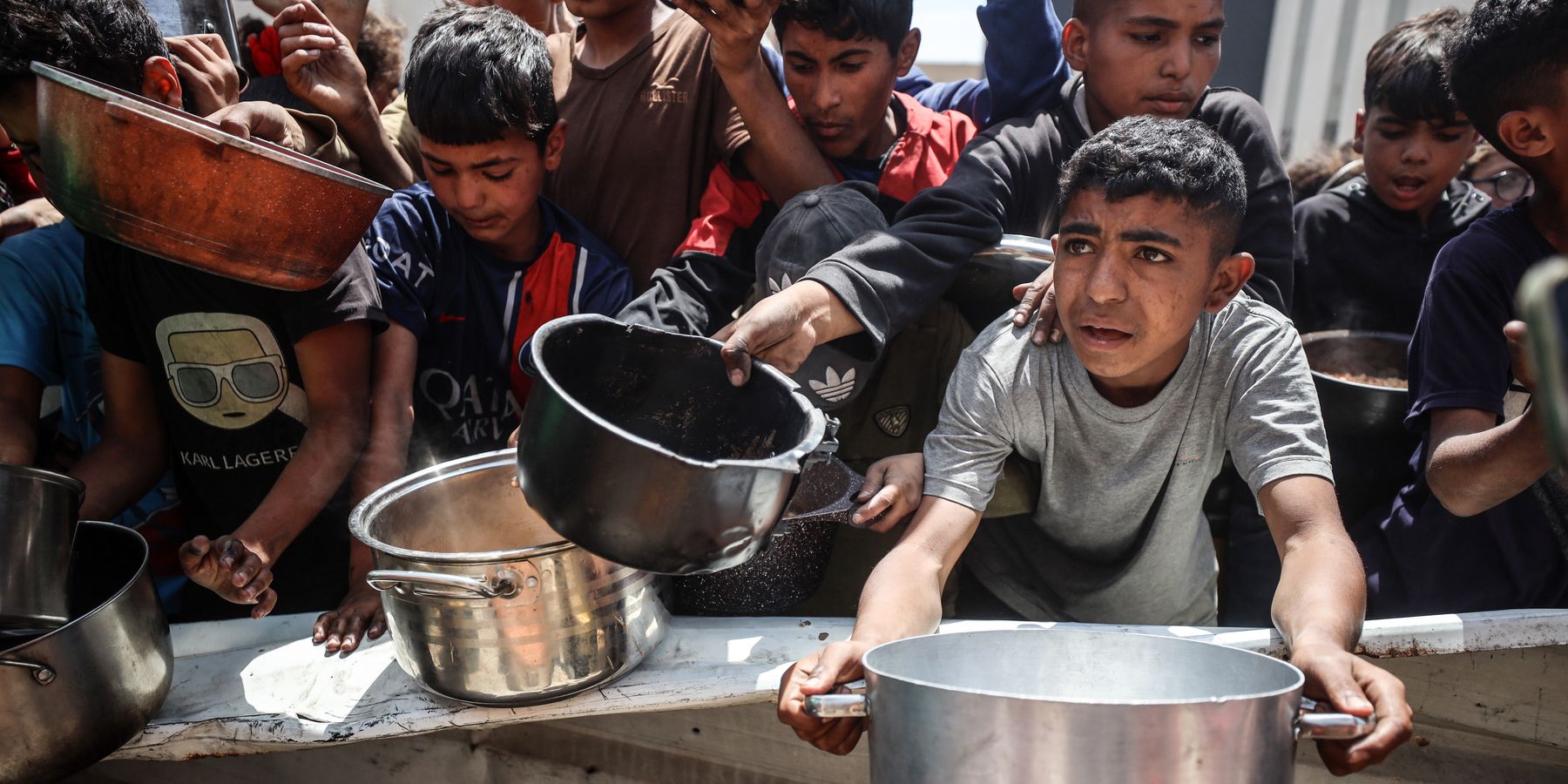
As the risk of famine spreads across Gaza — and as shocking images of overcrowded soup lines stream from Gaza daily — an influential network of Israeli government defenders has emerged to tell you that none of this is happening at all.
The Free Press — a pro-Israel media outlet often sympathetic to the neoconservative worldview — published a highly circulated article last week from journalist Michael Ames titled, “The Gaza Famine Myth,” which purports to demonstrate that food security in Gaza has been far above the famine and crisis levels that international humanitarian organizations have observed since at least early 2024.
The Israeli blockade, which the Israeli government openly admits has restricted all aid from entering the strip since March 2, 2025, has once again pushed Gaza to the edge of famine, with U.N. reports warning of starvation levels far surpassing 2024’s severity.
But Israel and its supporters are downplaying the unanimous chorus of famine warnings from international monitors, alleging that accusations of an Israeli starvation campaign have been overstated, accusing journalists of systematically exaggerating the hunger crisis in Gaza.
“The Gaza Famine Myth” focuses on a single statement from President Biden’s USAID Administrator Samantha Power, who said in May 2024 that there was a famine in northern Gaza, based on data from the Integrated Food Security Phase Classification (IPC).
“There were serious problems with Power’s sensational testimony,” Ames writes. “Foremost among them: The IPC never declared a famine in Gaza.”
Ames argues that Power and USAID did not have authority to declare a famine in Gaza because only the IPC can only issue that declaration based on its data. But the IPC itself says that it “does not ‘declare Famine’ or issue ‘Famine declarations,” but rather facilitates the analysis that allows governments, international/regional organizations and humanitarian agencies to issue more prominent statements or declarations.”
But it wasn’t just USAID declaring famine. Cindy McCain, director of the World Food Program, which distributes aid and monitors food security in Gaza, said in May, 2024 that there was a “full-blown famine” in northern Gaza and that it was “moving its way south.”
And in July, 2024, as Israel began to allow slightly more aid into the strip — though nowhere near the pre-war levels which were already to put the Palestinians “on a diet” — a group of U.N. experts declared that famine had spread throughout Gaza.
Each of these separate opinions reaffirmed USAID’s rationale for declaring a famine in northern Gaza and yet Ames never mentions them.
Despite these other famine declarations by reputable sources, Ames instead focuses only on the USAID statements and claims the IPC’s governing authority, the Famine Review Committee (FRC), had actually “rebuked” its analysis.
But the FRC did not “rebuke” the USAID analysis. It merely said it could not endorse USAID’s conclusions because the FRC lacked the access necessary to gather “essential up to date data on human well-being in Gaza.”
As U.N. Humanitarian Coordinator Jamie McGoldrick said on April 11, 2024, only three roads into Gaza were technically open — none consistently — and all in “very poor condition.” Visiting Kamal Adwan Hospital, he said “every single patient” in the children’s ward faced “life-threatening hunger.”
Ames does not address what the FRC said about its access limitations and instead claims the FRC report definitively debunks USAID’s famine statement — he points to a passage within the FRC report that criticizes USAID for discounting U.N. donations to bakeries and some private sector donations in its calculations of food insecurity to allege that, “north Gaza actually had 10 times more food last April than USAID had claimed,” and that “a famine had been averted.”
Ames derives his “10 times more food” claim by taking the highest end of the FRC’s estimate for bakery donations and private sector contributions during the month of April, 2024, a guess which the FRC discloses from the outset of the report it makes with limited evidence. But the idea that, through the exclusion of bakery donations and private sector contributions from its analysis, USAID had overestimated food insecurity in Gaza by such a wide margin is both intuitively implausible and directly contradicted by the reports of humanitarian organizations.
The World Food Program reported on April 19, 2024 that it had opened 3 bakeries in northern Gaza, “the only bakeries working in the north,” and “the first bakeries producing bread after more than 170 days.”
Oxfam reported in April based on IPC data that Palestinians in northern Gaza were “forced to survive on 245 calories a day.” WFP had documented how the Israeli blockade inflicted starvation conditions that approached famine levels in northern Gaza as early as January and February of that year.
Ames does not address any of this data. Instead, he suggests, mostly based on social media posts from an Israeli-British citizen who told Ames she is “not a journalist,” that Gaza is stocked with food.
There has been no evidence that any of these international humanitarian organizations exaggerated their food security data. Rather, there has been substantial evidence demonstrating that the number of Palestinians who have already died from starvation have been vastly undercounted.
Testimonies from healthcare professionals in Gaza support that conclusion. In October, a group of 99 American physicians, surgeons, nurses, and midwives who volunteered in the Gaza strip wrote an open letter to President Biden presenting even more evidence, using IPC data, that the human toll in Gaza was far higher than we understood.
“The scale of this starvation is not widely appreciated,” they wrote. “In total it is likely that 62,413 people have died of starvation and its complications in Gaza from October 7, 2023 to September 30, 2024. Most of these will have been young children.”
Ames’ apparent goal — to suggest that famine in Gaza has been oversold to the public — is directly at odds with the reports and opinions of independent humanitarian groups, their aid workers on the ground, healthcare providers, and starving Palestinians in Gaza.
Additionally, Ames’ article comes as international aid groups — and Israelis themselves — warn of impending catastrophe unless Israel’s more than two month-long total siege is lifted. On Tuesday, the New York Times reported that some Israeli military officials “have privately concluded that Palestinians in Gaza face widespread starvation unless aid deliveries are restored within weeks.”
Meanwhile, The U.N. declared that food stocks have already run out and that water access has become impossible. Last Thursday, Abdul Nasser Al-Ajrami, head of the Bakery Owners Association of Gaza, reported that “all bakeries have shut down due to a total lack of flour and fuel. Bread has run out completely, and half of Gaza’s homes have no flour left.”
The Free Press is determined to draw attention away from the human tragedy on the ground in Gaza by debating what is and what isn’t an officially declared famine. That is their right of course, but the rest of the world shouldn’t waste another minute on this nonsense when the real focus should be on saving civilian lives now.
- Samantha Power: Israel is chief impediment to Gaza aid ›
- Samantha Power: Aid workers say crisis in Gaza 'unprecedented' ›
- Could the maritime corridor become Gaza’s lifeline? ›
- Congress lets Israel off the hook as more starving Gazans die | Responsible Statecraft ›
- How much is shoddy, pro-Israel journalism worth? Ask Bari Weiss. | Responsible Statecraft ›
- Mainstream media largely sidelined starvation story, until it couldn't | Responsible Statecraft ›