

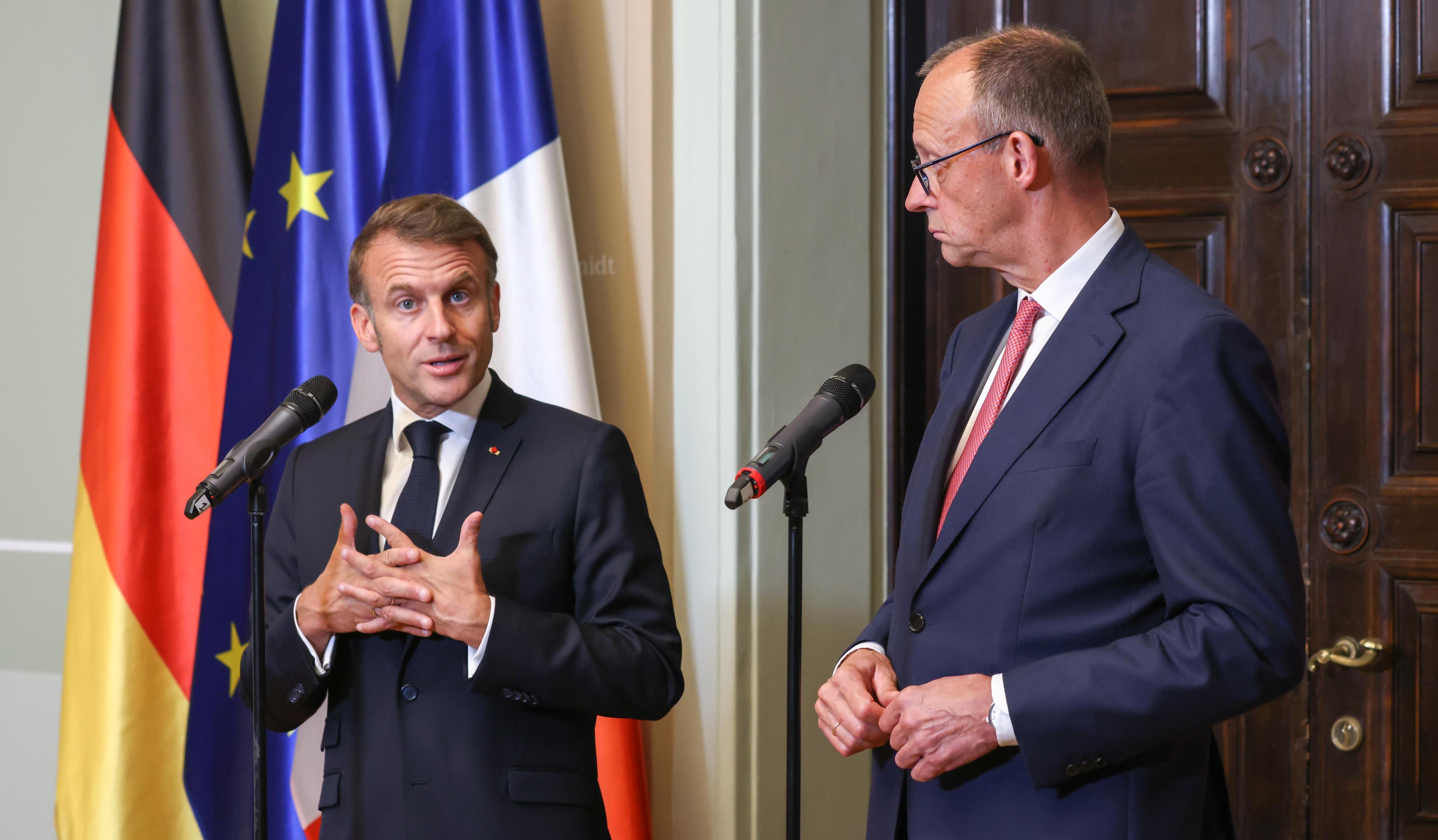
Since early last year, France has been exploring with Germany and other partners the question of expanding or extending France’s nuclear deterrent to protect NATO partners in Europe.
This idea, in more modest versions advanced by France since the 1990s, always met resistance from traditionally Atlanticist Germany, concerned never to appear to doubt U.S. defense commitments to Europe. France itself has until now also been ambivalent about seeming to internationalize its force de frappe, conceived as the ultimate guarantor of France’s national territorial defense.
Germany and France have recently found common ground on extending French nuclear deterrence, so long as it complements rather than replaces the U.S. nuclear deterrent and applies equally to all European NATO members. France has also attracted interest in its proposal from Poland, Sweden, the Netherlands, Belgium, Denmark and Greece.
Speaking at France’s Longue Ile base for nuclear-capable submarines on March 2, Macron announced a new policy of “advance deterrence” extending deep into Europe, while retaining France’s sole responsibility for any decision to use a French nuclear weapon. Despite this reservation, the announcement represents a major shift in French nuclear doctrine. Macron argued that Europe could not “afford to stay out” of a “new age of nuclear weapons.”
He said that Paris would be willing to deploy nuclear-capable Rafale fighters to partner countries in Europe and introduce new cooperation on nuclear planning. After Macron’s speech, France and Germany said they had formed a new steering group to realize these ideas and to “add to, not substitute for” NATO’s nuclear deterrence.
In July, France and the UK signed the Northwood Declaration pledging unprecedented coordination on their nuclear deterrence policy.
The European Nuclear Study Group of experts produced a report for the recent Munich Security Conference on filling perceived gaps in Europe’s nuclear deterrence. The group has explored policy options ranging from continuing to rely exclusively on U.S. nuclear deterrence, to extending nuclear cooperation with France and the UK, seeking a nuclear weapon for Europe as a whole, or even to allowing new, independent national nuclear weapons.
The latter two of these options would breach the Nuclear Non-Proliferation Treaty, of which Europe has been a principal adherent. The fact that either European or national nuclear weapons have even been put on a discussion agenda reflects a momentous shift in European thinking. Germany committed not to seek nuclear weapons under the 2+4 agreement that brought about German reunification. The approach being offered by France seems the least disruptive option available if reassurance is in fact needed.
Why has this issue arisen now?
The receptivity to France’s overtures certainly reflects some loss of confidence in the reliability of American security commitments to NATO partners. Europe’s worries arise in large part because of the willingness of the Trump administration to reach an accommodation with Russia over Ukraine.
Macron and France’s partners on this initiative are in a hurry because a victory of the right populist Rassemblement National (RN) in presidential elections next April could radically change France’s stance regarding European security arrangements. The RN leadership and potential Macron successors Marine Le Pen and Jordan Bardella oppose the idea of “sharing” France’s nuclear deterrence. Macron apparently aims to put arrangements into place that would be difficult for a new president to reverse.
Why has Germany’s attitude changed?
Germany has tended in the past to resist suggestions from France to Europeanize security arrangements in pursuit of strategic autonomy. In particular, Germany feared signaling any lack of full confidence in the protections of the U.S. nuclear umbrella. Germany is one of several NATO countries involved in “nuclear sharing” with the U.S. and will not want to undermine this arrangement.
Over the last two years, Chancellor Friedrich Merz has undertaken a major conventional rearmament program, which risks overshadowing the conventional military capabilities of other European countries, including France. By far the largest economy in the European Union, Germany can pursue this program because of its comparatively sound public finances and low indebtedness. German rearmament has, however, already caused a certain wariness among Germany’s partners, leading Merz to reiterate constantly Germany’s commitment not to pursue unilateral security goals but instead always to act within a framework of collective European security. Merz emphasized this in his speech to the Munich Security Conference last month.
Participation by Germany in a French-led initiative to reinforce nuclear deterrence is a practical demonstration of Berlin’s European orientation and may offer a measure of reassurance to countries like Poland, where German conventional rearmament might otherwise be viewed with concern.
How might the US react?
The European NATO member countries have differing views on the likelihood of a permanent disaffection by the U.S. from Europe and NATO, but the tide seems to be shifting gradually toward a loss of confidence and a degree of adaptation. The U.S. threat to take Greenland by force and the commitment in the Trump administration’s National Security Strategy to support national populist parties contending for power in Europe provoked a loss of faith in U.S. security commitments.
The Europeans nevertheless hope to persuade Trump to reconsider his stance on Ukraine and his pursuit of rapprochement with Russia. At the same time, they would like to be prepared for a durable shift in U.S. foreign policy priorities away from Europe, requiring Europe to develop greater strategic autonomy, an aim long pressed by Macron.
The U.S. has not commented on the French proposal and has reportedly given private assurances that the American nuclear deterrence still applies fully to the European members of NATO. It remains an open question how fully the U.S. would wish to accommodate the extension of French nuclear deterrence to European NATO members. Russia will of course firmly oppose the French initiative, which could further set back prospects for an agreement to end the war.
There is a delicate balance to be sought between seeking insurance against U.S. withdrawal of its nuclear umbrella and demonstrating to the U.S. and others needing convincing that Europe can emerge as an independent geopolitical actor in a world dominated by great powers.