

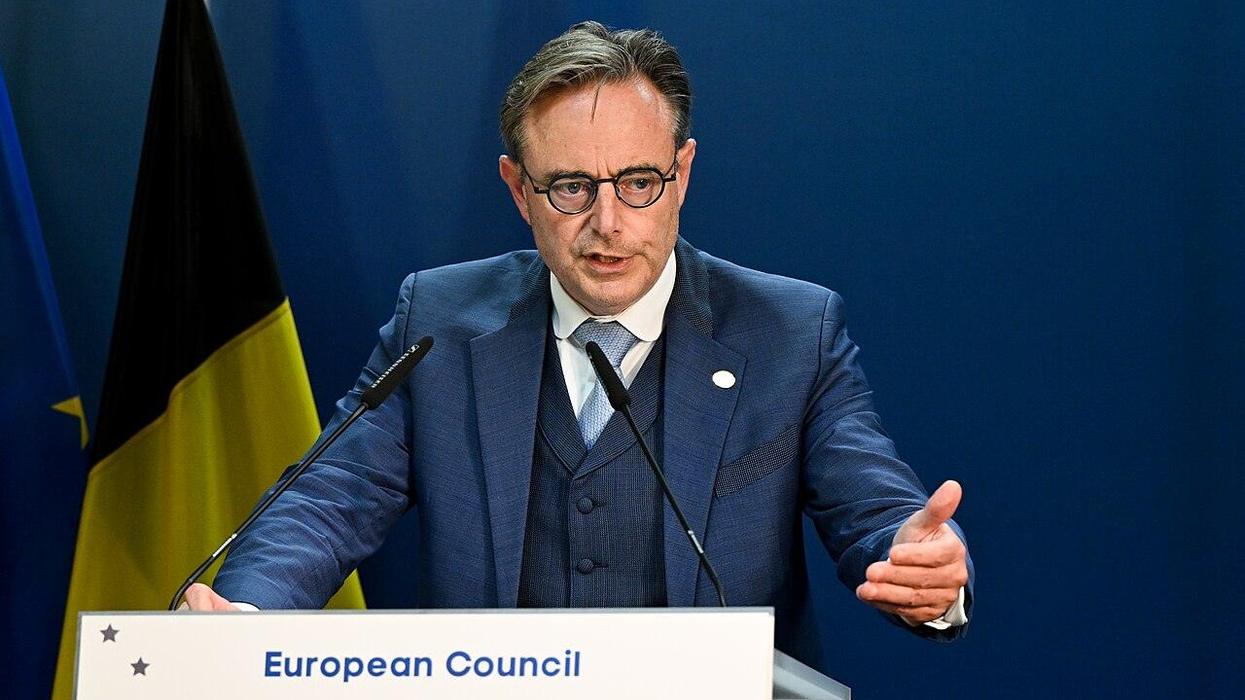
At long last, a European leader has said what should have been apparent from the very first: that the Israeli-U.S. war against Iran and Iran’s retaliation against energy exports from the Persian Gulf, make it urgently necessary for European Union countries to normalize relations with Russia and resume buying Russian energy.
Belgian Prime Minister Bart de Wever said over the weekend that Europe needs to rearm, but:
“We are losing on all fronts, we must end the [Ukraine] conflict in Europe’s interest…we must normalize relations with Russia and regain access to cheap energy. It is common sense. In private European leaders tell me I am right, but no one dares say it out loud. Given that we are unable to pressure Putin by sending weapons to Ukraine, and cannot suffocate his economy without U.S. support, only one method remains: making a deal.”
De Wever’s statement must be set against the background of a steep rise in oil and gas prices as a result of the U.S.-Israeli war against Iran. If the war continues and prices remain at the existing level or rise further, then the Russian government will have no difficulty both paying for the war and stabilizing the Russian economy. Europe by contrast risks stumbling into a disastrous combination of high energy costs, economic crisis, high refugee flows from Ukraine and Iran, and declining capacity to help Ukraine. The result could be a disaster for Ukraine, and a dire threat to the EU itself.
Recognizing the threats to the world and U.S. economies posed by the blocking of Gulf energy — and the consequent threat to Republican chances in the midterm elections — the Trump administration has already suspended sanctions against Russian oil exports. Trump has also resumed his harsh criticism of Ukrainian President Volodymyr Zelensky for his refusal to make a deal. British and European (entirely correct) refusal to join in the war against Iran is also unlikely to make Trump more sympathetic to European positions on Ukraine.
As long as the war on Iran lasts, the chances of “100%” U.S. support for increased pressure on Russia therefore appear to be close to zero. Russia’s leverage over the U.S. will grow still more if Trump is forced to call on Putin to mediate with Iran in order to get the U.S. out of the hole Trump has dug for his country in the Middle East.
Moreover, Iranian drone and missile attacks have led both the U.S. and European countries to divert to the Middle East air-defense systems that are vital to Ukraine’s ability to defend itself. British Prime Minister Keir Starmer has said that, “We cannot allow the war in the Gulf to turn into a windfall for Putin” — but it is obviously not in his power, or that of the EU, to prevent this.
Normalization of relations with Russia should not be seen as the abandonment of Ukraine. On the contrary, the EU should offer the resumption of energy purchases and the suspension of all sanctions in return for Russia giving up its demand for the small part of the Donbas still held by Ukraine — the issue that, more than any other, has been preventing a settlement.
Of course, we cannot be sure that Russia would accept such a deal — though it would be very much in Russia’s long-term interests; but at the very least, such a proposal would give the Europeans a positive role in negotiations. If — as they constantly complain — the U.S. and Russia have so far cut them out of negotiations, that is because so far they have refused to put forward anything useful or sensible.
It seems however that anyone waiting for common sense from European governments has a long wait in store. Official reactions to de Wever’s statement have been overwhelmingly negative. EU Energy Commissioner Dan Jorgensen replied that not just during the Ukraine war but “in the future, we will not import even one molecule of energy from Russia.” De Wever’s own foreign minister, Maxime Prevot, declared that:
“Should we engage in dialogue with Russia? Yes. That is what diplomacy is: Talking with those with whom you disagree. But dialogue is not the same as normalization. And that is a crucial distinction…Today, Russia refuses a European seat at the table. It maintains maximalist demands. As long as that is the case, talking about normalization sends a signal of weakness and undermines the European unity we need more than ever.”
This contains a fundamental error that has plagued European and U.S. diplomacy for a generation and more: that talking with opponents is a concession in itself and a goal in itself. It’s true: “Dialogue is not the same as normalization.” But normalization has to be offered to Russia as part of dialogue leading to a compromise of peace, or, in present circumstances, there is little point in talking at all.
Emphasizing the need for “European unity” has become a wonderful way for European politicians to avoid having to take unpopular and courageous stances themselves. The problem is that it effectively throws European policy into the hands of an EU Commission, which is not democratically accountable to any electorate, and of the most Russophobe states of Eastern Europe, which can be expected to veto any EU move towards compromise with Russia. That is why individual West European governments will have to take the lead.
Prevot’s attack on Wever contained one statement that at present is entirely false – that Russia maintains “maximalist” demands on Ukraine. This was echoed by Lithuanian Foreign Minister Kestutis Budrys, who said that: “We know their demands coming back from ‘21. And that will be not only related to Ukraine, that will be related also to us and to the deployment of the forces and many other things. So we have to collect our strength.”
In fact, as a result of its failed attempt at a quick victory and the agonizing slowness of its advances on the ground, Russia has long since abandoned its “maximalist” demands. Even the demand for the whole of the Donbas is far less than the territorial demands it was making in 2024. It is hard to know whether European officials’ constant repetition of this obvious falsehood is the result of paranoid delusion or a deliberate effort to frustrate a peace settlement.
Mr. Budrys also said that he expects positive results from talks with Russia only when “Europe has the sticks in its hands.” As long as the Iran war continues however, the “sticks” are simply not going to be there. And if the wars in Iran and Ukraine both continue, then it is likely that any future settlement is going to be much more unfavorable to Ukraine than the one on the table now.
European governments and commentators like to congratulate themselves on their new “realism” with regard to Russia. They seem not to understand that realism is not just about building up your military forces. It is also about accurately and honestly assessing relative strengths and likely (as opposed to desirable) outcomes, and negotiating compromises on that basis.
It would be an immense help in this regard if European governments could drop some of the self-righteous hypocritical moralizing and hysterical demonization of Russia in which they have engaged, and which has been used to oppose any compromise with Moscow. Thus in her response to de Wever’s statement, Swedish Energy Minister Ebba Busch said that if Europeans resume purchases of Russian energy “then we’ve completely lost our moral compass.”
But as indicated by the grotesquely different European response to Russian aggression and crimes and those of Israel and the U.S., Europe’s moral compass appears to be a highly inaccurate guide of European behavior. German officials who continue to mouth the mantra of Germany’s commitment to a “rules-based order” remind one vividly of their East German predecessors, who continued to mouth Marxist-Leninist mantras as their system disintegrated beneath their feet.
Betonkoepfe (“concrete heads”) was the popular name for them, and they were supposed to have disappeared along with Communism. But it seems that democratic bureaucrats can be just as good at pouring concrete into their ears as communist ones. All it takes is a sufficient dose of hypocrisy, conformism and moral cowardice.