

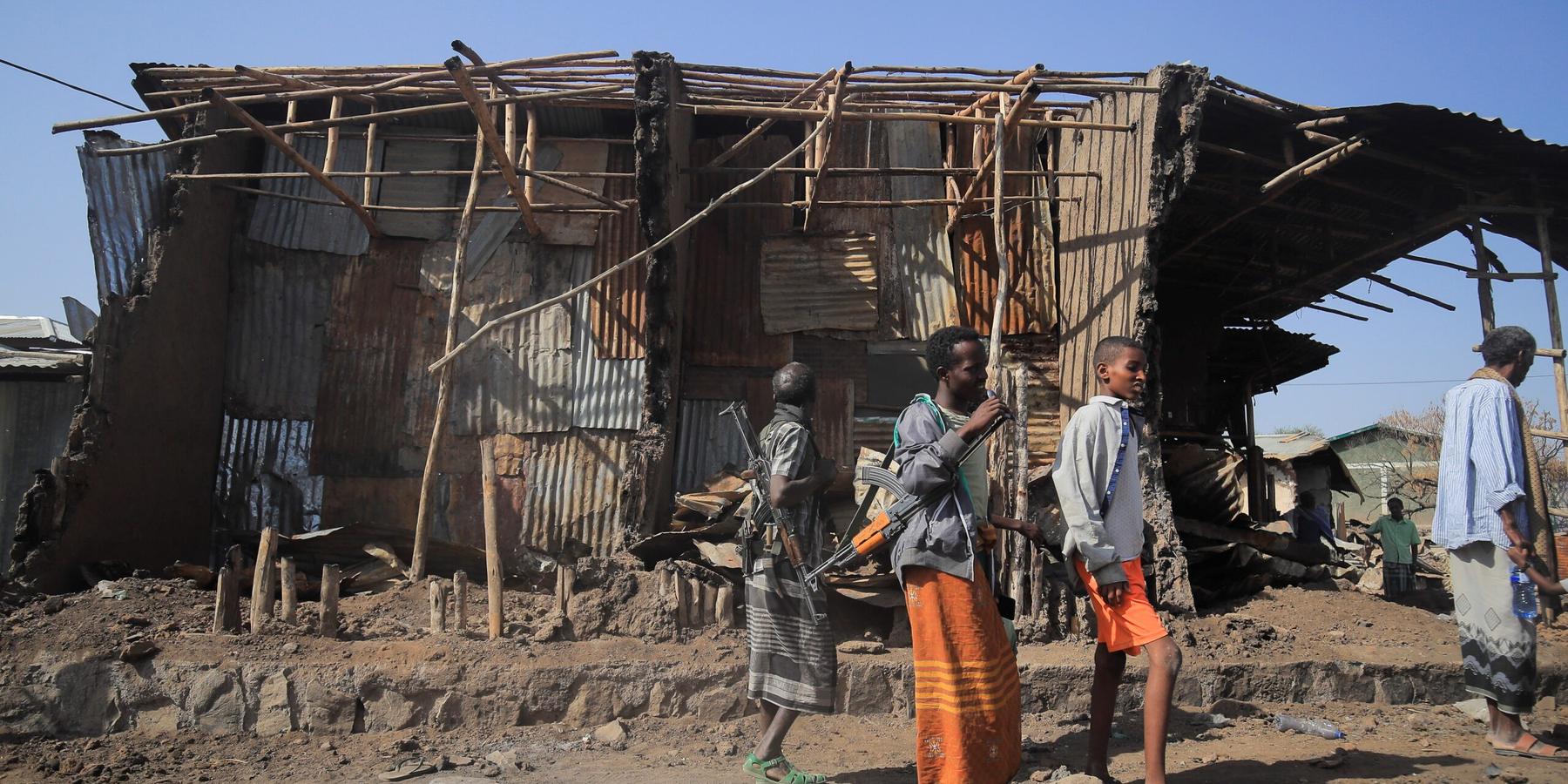
Ethiopia is on the brink of another civil war.
Last week, fighting between rebels and federal forces in the northern Tigray, Amhara, and Afar states left hundreds dead. These clashes may signal the start of a potentially devastating conflict in a country still recovering from a bloody civil war that killed approximately 600,000 people between 2020 and 2022.
Fighting began as seven rebel groups from across various parts of the country announced the formation of a military coalition called the Ethiopian Peoples’ Forces Alliance for Survival. The alliance’s expressed aim is to remove the federal government headed by Prime Minister Abiy Ahmed Ali from power.
Major fighting has thus far remained confined to the northern Tigray state, where the previous civil war took place. The leading rebel group, the Tigray People’s Liberation Front (TPLF), made significant territorial gains across the state last week, seizing control of Alula Aba Nega International Airport in the Tigrayan capital of Mekelle, as well as airports in the nearby cities of Axum and Shire. In response, Ethiopian Airlines shut down all service to those airports, cutting off much of Tigray to commercial air transit.
Following advances by rebel forces in Tigray, the Ethiopian military seems to have regained some territory in recent days. On Monday, the Ethiopian government and allied militias announced they had recaptured the strategic town of Alamata, about 75 miles south of Tigray’s capital.
Among those joining forces with the TPLF in this expansive rebellion is the Fano National Movement, a separatist coalition based in the country’s northern Amhara state that sided with the federal government against the TPLF in the last war. Once rivals, the TPLF and the Fano have now made common cause against the Ethiopian government.
In recent years, the Fano has been actively pursuing its own effort to end the “oppression” of the Amhara region from the country’s federal government and has clashed in armed conflict with federal forces in pursuit of that end. This new alliance thus accords with the Fano’s aim of securing greater independence from what it views as an overbearing federal government.
The recent uptick in violence follows months of growing tensions in Ethiopia. In May, the TPLF reclaimed control over the political administration of Tigray, arguing that the Ethiopian government had failed to follow through on its end of the Pretoria Agreement, which ended the previous civil war.
In the months since, sporadic fighting between federal forces and the TPLF has sprung up throughout Tigray. And the Ethiopian government’s drone warfare — which has killed civilians — has focused the attention of human rights activists, who argue such attacks should be investigated for possible war crimes.
Washington’s response to the renewed conflict has thus far mostly followed a wait-and-see approach, though growing violence in the country is beginning to attract attention on Capitol Hill. On Monday, Semafor reported that Senate Democrats, led by Sen. Jeanne Shaheen (D-N.H.), are pushing Secretary of State Marco Rubio to intervene in the conflict, though it remains unclear what such an intervention could look like.
The White House placed visa restrictions on unnamed TPLF officials in June following reports of clashes between the rebel group and federal forces. But just a couple weeks ago, Washington lifted sanctions on officials and the military of neighboring Eritrea — sanctions that the Biden administration had put in place during the previous war in an effort to curb Asmara’s role in that conflict. With these sanctions removed, Eritrea may find it easier to intervene in a renewed Ethiopian civil war.
In another case of twisting alliances, Eritrea was aligned with Ethiopia during the previous civil war, having viewed the TPLF and its aspirations as a threat to its own interests. But growing animosity between Ethiopia and Eritrea in the years since the Pretoria Agreement was signed has pushed the small coastal country to shift its support away from the federal government in Addis Ababa and toward the TPLF.
The root of the Eritrea-Ethiopia discord comes down to Ethiopia’s renewed determination to gain access to the Red Sea. Over the past couple years, Ethiopian officials have increasingly demanded free access to Eritrea’s Red Sea Port of Assab, which was under Ethiopian control until Eritrea’s independence from the country in 1993, at which time Ethiopia lost its coastline. Ethiopia has since signed an expensive agreement requiring it to pay between $1.5 and $2 billion annually in fees to neighboring Djibouti to use its Red Sea port, on which Addis Ababa relies for the vast majority of its maritime trade.
Another important player in the region’s complicated geopolitical chess match is Egypt, which has a long-running dispute with Ethiopia over the Grand Ethiopian Renaissance Dam (GERD). The GERD, which was inaugurated on September 9, 2025 after about fourteen years of construction, is a massive dam upriver on the Nile that is the continent’s largest hydropower generator. Egyptian officials claim that the dam puts Egypt’s water security at risk, arguing that Ethiopia’s control of the dam will limit the amount of water that flows downstream, severely threatening Egypt’s vast irrigation system that sustains its agricultural economy.
As a result, Cairo has sought to gain leverage with Addis Ababa, in part by providing diplomatic support and, at times, military assistance to those of its neighbors with which it has strained relations or even overlapping territorial claims. They includeEritrea (via diplomatic support), Sudan (via diplomatic support and possible arms sales), and Somalia (via diplomatic support and troop deployments).
Sudan and Somalia themselves are in the throes of intense domestic conflicts. The Sudanese army is struggling in a brutal civil war against the Rapid Support Forces for control over the country. Meanwhile, Somalia continues its decades-long fight against armed groups while having to contend with the growing relations forming between foreign governments and multiple Somalian regions that claim independence from the central government.
This tangled web of alliances, mixed with intense domestic conflicts in surrounding countries, will make it difficult to contain a Tigrayan war. A multi-layered regional war has thus become a distinct possibility.
For now, the United States has little choice but to wait and see what happens, though targeted sanctions focused on entities that could fan the flames of war (such as Eritrean officials) should be considered on a case-by-case basis.
But any military intervention should be entirely off the table, particularly as the United States remains preoccupied with the mess caused by its ill-planned war against Iran.
- US military marching into Puntland as Red Sea tensions escalate ›
- How the Egypt-Ethiopia feud could upend Trump's plans in Africa ›
- Sniffing out Red Sea access, US in line to be Eritrea's latest suitor ›