

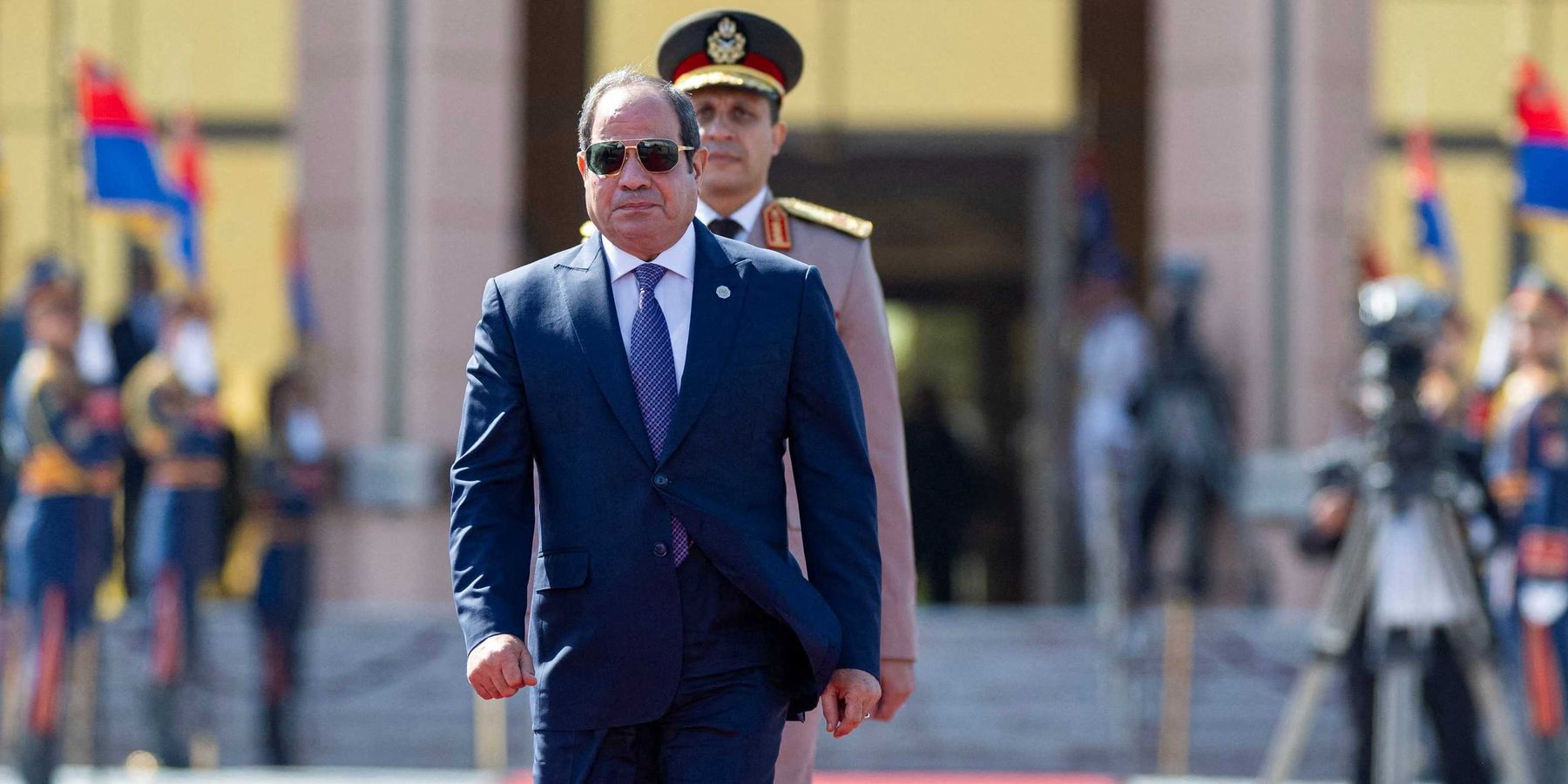
Various forces, from tariffs to wars to the emerging multipolar world order, are potentially reshaping the Middle East and its alliances, and Egypt is playing a leading role. However, Egypt’s vision is bumping up against the reality that its dependence on Washington limits those shifting alliances and Egypt’s ability to play a leading role in them.
Time will tell how far Egypt can go.
Egypt appears to be asserting itself, or trying to, when it comes to Israel and its war in Gaza. There have been some recent developments on this score.
On September 15, Egypt’s President Sisi gave a landmark speech at the Emergency Arab-Islamic Summit in Qatar. The speech contained three shocking moments. The first was Sisi identifying Israel as “the enemy.” That was not only the first time Sisi has called Israel an enemy since coming to power in 2014, but the first time an Egyptian official has called Israel an enemy in the almost half century since Anwar Sadat went to Israel in 1977.
The second was Sisi’s warning “to the people of Israel,” with reference to the Abraham Accords, that “what is currently unfolding… erodes opportunities for any new peace agreements.” But that was just the introduction. More significant was the warning that followed, that it “may even abort existing peace accords with the nations of the region” referring obliquely to the 1979 Egypt-Israel Peace Treaty.
And the third was his call for an Arab-Islamic security alliance. Sisi said that “it has become imperative for us to establish an Arab-Islamic mechanism for coordination and cooperation to enable us all to confront the major security, political, and economic challenges surrounding us.” In a stunning line, Sisi said that it must be clearly seen that “the geography of any Arab country extends from the Ocean to the Gulf and its umbrella is wide enough for all Islamic and peace-loving countries.”
The Jerusalem Post reports that the NATO-like arrangement would be a defensive umbrella capable of reacting rapidly to protect any Arab state under attack. Egypt is reportedly prepared to contribute a force of 20,000 and to place an Egyptian general in command of the force.
Another key movement is the buildup of Egyptian forces in the Sinai Peninsula that seems to contravene that 1979 treaty with Israel. Israeli Prime Minister Benjamin Netanyahu has presented U.S. Secretary of State Marco Rubio with a list of violations and has asked the United States, as guarantor of that treaty, to pressure Egypt to scale down.
Fearing a push of Palestinians across its border with Gaza, Egypt has deployed additional forces to the region, bringing its total force to about 40,000 soldiers. That is nearly twice as many as allowed by its treaty with Israel. Accompanying the troops are armored vehicles, advanced Chinese-made air defense systems, and M60 battle tanks. Egypt has reportedly warned that within 72 hours of any mass wave of Palestinians moving from Gaza into Egypt, they would double their troops and deploy heavy weaponry and helicopters.
Israel says that Egypt has established military infrastructure, built underground facilities that could store missiles, and extended runways for fighter jets. And there are reports that Egypt “has decided to reduce coordination with Israel until further notice” and that Egypt is “planning to restructure its security communications with Israel.”
The military build-up is the physical expression of Egypt’s fear of a mass movement of Palestinians out of Gaza and into Egypt. Egypt doesn’t want to be a party to any movement of Palestinians out of their land. They fear, after Netanyahu’s warning that Israel could strike Hamas leaders “wherever they are,” that Egypt could be a target, too, since Cairo hosts some Hamas leaders as part of the mediating process. They fear that Hamas fighters who move into Egypt could attack Israel from Egyptian soil, inviting Israeli retaliation.
Also, domestically, Egypt has its own problems with local Islamist insurgencies and does not relish any influx of Hamas fighters.
No doubt this is why Egypt is urging Hamas to give a positive response to Trump’s peace proposal for Gaza.
Reaching out to Neighbors in the Muslim World
Meanwhile, Egypt’s tense relations with Iran have been growing more friendly.
Iran broke relations with Egypt in 1979. Iran has seen Egypt as a betrayer, and Egypt has seen Iran as a regional threat. After the 2024 BRICS expansion, though, Egypt and Iran found themselves as members of the same international organization whose purpose is to balance U.S. hegemony in the new multipolar world.
That, it turned out, was just the beginning. In June of 2025, Iranian foreign minister Abbas Araghchi met with Egyptian Foreign Minister Badr Abdelatty and President el-Sisi in Cairo. “After many years,” Araghchi posted, “diplomacy between Iran and Egypt has entered a new phase. The level of political interaction and cooperation, and more importantly, the level of trust and confidence in relations between the two countries, is unprecedented.” And Egypt agreed. Abdelatty said, “There is a mutual desire to develop our relations, taking into account the concerns and perspectives of each side.”
The meetings produced an agreement “to launch periodic consultations at the sub-ministerial level to address aspects of bilateral cooperation.”
Iran is not the only Muslim country that Egypt is warming up to. Relations with Turkey fell apart a dozen years ago when Mohammed Morsi was ousted as president of Egypt. In July 2023, Egypt and Turkey took steps to normalizing relations and restored ambassadors to each other’s countries. Last year, Sisi and Turkish President Recep Tayyip Erdogan visited each other’s countries for the first time in 12 years. Last week, the two countries held joint naval drills for the first time in 13 years.
Turkish Foreign Minister Hakan Fidan said that relations between Turkey and Egypt are at their “best levels in modern history.”
But how far can it go?
All of this signals a shift away from Israel, but Egypt may not really take “any concrete measures” beyond rhetoric and these geopolitical exercises, as Annelle Sheline, Research Fellow for the Middle East program at the Quincy Institute, told me, because “the unpopular government of Egypt depends on handouts from the U.S. and is unlikely to do anything that would threaten the $1.3 billion it receives from the U.S. each year.”
Stephen Zunes, professor of politics and Program Director for Middle Eastern Studies at the University of San Francisco, agrees. Zunes told Responsible Statecraft that public opinion may be making Sisi “feel emboldened to pursue a more independent foreign policy.” However, in addition to Egypt’s economic and military dependence on the United States, “Sisi is not that popular, Egypt is struggling economically, they don't have the clout of the smaller but much richer oil monarchies, and regional politics is far more complicated than it used to be.”
Further frustrating Egypt’s position is that it is increasingly dependent on Israel for its energy needs. In August, a $35 billion deal was signed that further increases Egypt’s natural gas dependence on Israel. Once a net exporter of LNG, Egypt has been struggling to meet its own energy needs. Israel has reportedly threatened to suspend the agreement in response to Egypt’s military buildup in violation of the peace agreement. “Cairo’s moves are driven by a non-negotiable domestic imperative: keeping the lights on,” wrote Elfadil Ibrihim this summer.
Just as importantly, even as Sisi made his comments about Israel being “the enemy,” it has been harder for the Egyptian people to do the same. There has been a crackdown on Gaza war protests since Oct. 7, 2023. More recently, attempts by Egyptian activists to join the Gaza flotilla have been met with “threats by security agencies,” and three activists suddenly disappeared this week, according to reports. There seems to be a real limit on this new independent spirit.
This is a sound warning against reading too much into recent moves by the government, say experts. Time will tell if any of it leads to a real reshaping of the region.
- Israel testing Egypt's 'weak hand' in Gaza conflict ›
- Why Arab leaders aren't helping the Palestinians in Gaza ›
- Can Egypt really stop Israel from attacking Iran again? | Responsible Statecraft ›