

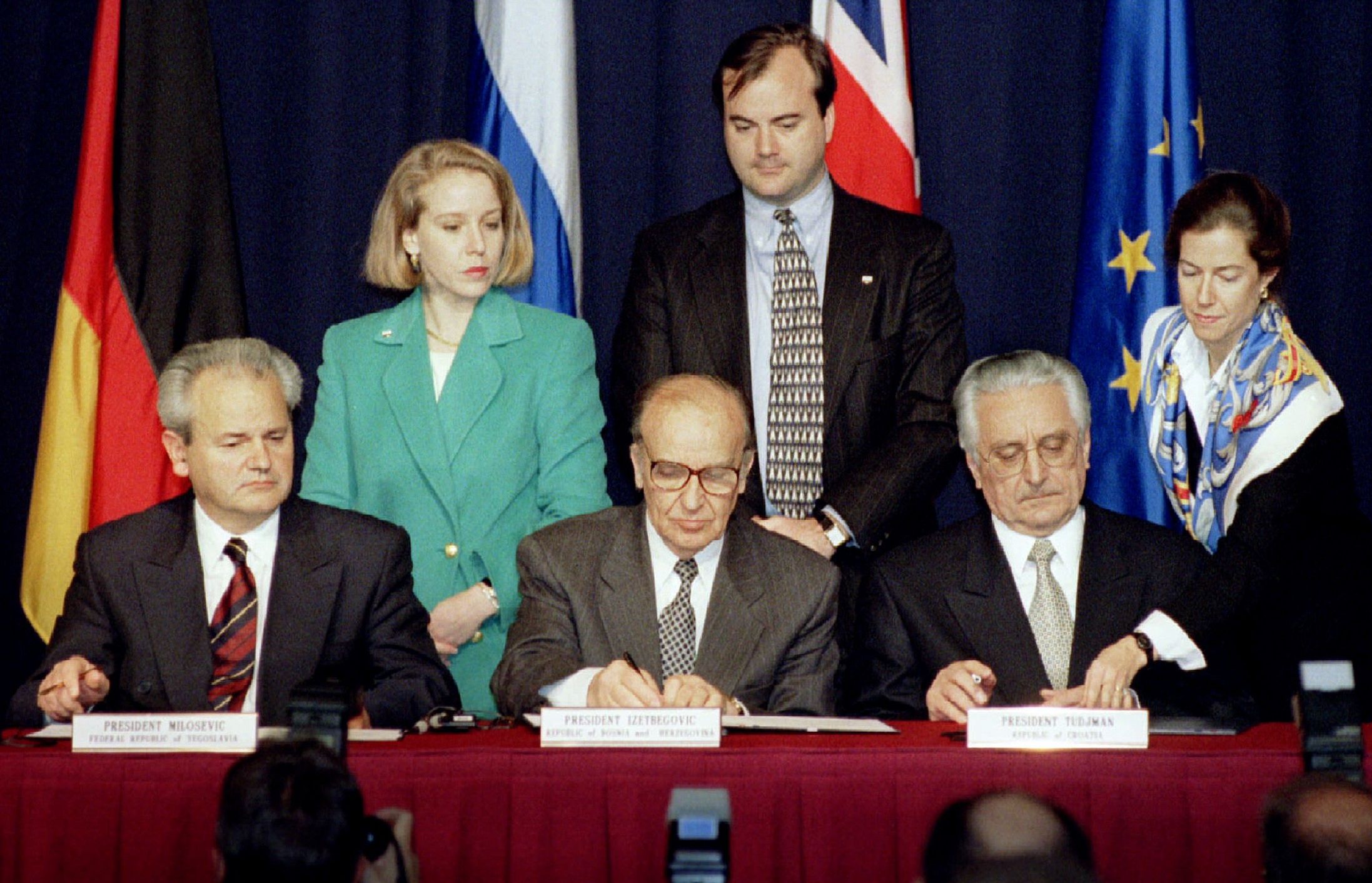
In December 1995, the Dayton Accords brought the horrible, nearly four-year long Bosnian War to an end. Thirty years on, 2025 will likely bring numerous reflections on the “Road to Dayton.” Many of these reflections will celebrate the unleashing of NATO airpower on the Bosnian Serbs in 1995, which supposedly forced them to “sue for peace.”
The truth, however — which has only become clearer as more documentation has become available — is that the United States forced the Muslim-dominated Bosnian government to the negotiating table at Dayton and granted large concessions to the Serbs that were unthinkable in Washington when the Clinton administration entered office in 1993. The Dayton Agreement was, in essence, a belated admission of American failure.
‘A tough and resourceful foe’
The clearest and most rigorous expression of the foreign policy establishment’s narrative about Dayton is probably Derek Chollet’s 2005 book, “The Road to the Dayton Accords”. Chollet, who worked as an adviser to key Clinton administration diplomats Richard Holbrooke and Strobe Talbott, argues that “the United States had initially encouraged the Europeans to take the lead in Bosnia,” but “as time went on, Europe’s response proved feckless, and the introduction of European troops under a United Nations mandate did little to stop the horrendous bloodshed.”
Finally, “in the course of six months between June and November 1995, President Clinton and his team dramatically reversed months of indecision by setting a bold course, defying expectations both in the risks they undertook and the success they achieved.” Ultimately, Chollet concludes, “the Bosnia experience has taught many lessons, but the most important one is this: when it comes to solving global problems, American leadership remains indispensable.”
Scholars such as Susan Woodward, Paul Shoup, and Steven Burg have long contested this narrative. Today, their critiques of American triumphalism are increasingly supported by the U.S. government’s own documentary record.
The first catastrophic U.S. error was widely predicted at the time: the decision to recognize the new state of Bosnia-Hercegovina in April 1992. This decision, which was, in many ways, prompted by German recognition of Croatia in December 1991, was disastrous because Bosnia’s secession from Yugoslavia was spearheaded by a short-lived alliance between Bosnian Muslim (later called “Bosniak”) and Croat political leaders against the Bosnian Serbs. The CIA predicted, in a December 1991 report ominously titled “Bosnia-Hercegovina: On the Edge of the Abyss,” that recognition would “prompt the Serb and Croat areas [of Bosnia] to attach their respective areas to Serbia and Croatia,” which would then “set a chain reaction of violence in motion as local groups seek to promote or prevent annexation.”
When the “abyss” arrived, Bosnian Serb forces, with assistance from the Yugoslav National Army, took control of Bosnian territory with large Serb populations and “ethnically cleansed” this territory of Muslims. In a December 1992 memo summarizing the views of the intelligence community for the Clinton Transition Team, two intelligence officials wrote that “attempting to reclaim all of the territory the Bosnian Serbs now occupy would require massive Western military intervention.” The Bosnian Serbs — who were not foreign conquerors but had been living in Bosnia for centuries — could be beaten back by such an intervention, but “once recovered from the initial shock,” they “would prove a tough and resourceful foe.”
“A more manageable objective,” the memo concluded, “would be the survival of a fragmented Muslim-majority state following a partition of Bosnia-Hercegovina.”
‘Legitimizing ethnic cleansing’
“De facto partition” is essentially what the Dayton Accords ended up achieving. While Dayton formally upheld the territorial integrity of Bosnia-Hercegovina and allotted 51% of Bosnian territory to a Muslim-Croat Federation, it allotted the remaining 49% to a contiguous Bosnian Serb state-within-a-state and gave this “entity” almost total autonomy over its internal affairs, as well as the right to “special parallel relationships” with Serbia. These were significant concessions to Serb interests that the Clinton administration had, until 1995, been unwilling to make.
Why not? First, as Clinton’s ambassador to the U.N., Madeline Albright, put it during a February 1993 National Security Principals meeting, concessions to the Serbs would have been “contrary to what Governor Clinton said” during the 1992 election campaign, when he identified them as the sole aggressors in the conflict (a view that was contested by the intelligence community) and criticized the weakness of the Bush administration in confronting them. Albright also argued, as other U.S. diplomats did, that concessions to the Serbs would “legitimize ethnic cleansing.”
Gradually, however, the administration became more willing to compromise as the war dragged on into the next election cycle.
“I fear Bosnia will overshadow our entire first term,” Albright wrote to deputy national security adviser Sandy Berger in August 1995. “Our continued reluctance to lead an effort to resolve a military crisis in the heart of Europe has placed at risk our leadership of the post-Cold War world.”
While Albright’s memo has often been celebrated (including by Chollet and by Albright) for its call to unleash NATO on the Bosnian Serbs, the memo also suggested that the U.S., in a settlement of the conflict, “could be more forward-leaning on the Serbs’ right to secede peacefully from Bosnia and join a potential ‘Greater Serbia.’”
Albright added that “it may be necessary to consider proposals to trade Federation territory for Serb-held territory, especially if the Federation agrees and if the exchange makes the Federation more durable. This means population transfers that we have previously been unwilling to countenance.”
Albright, who was probably the biggest hawk in the Clinton administration, went from refusing any “legitimization” of ethnic cleansing through even minor concessions to the Bosnian Serbs in 1993 to not only “legitimization” of ethnic cleansing, but support for further “population transfers” and even a Serb right to secede.
In this context, while the administration publicly condemned the Serb takeover of Srebrenica and Žepa in July 1995, a July 17 National Security Council discussion paper optimistically suggested that this development “may open the way to more realistic territorial solutions,” facilitating “a heart-to-heart discussion with the Bosnians aimed at eliciting greater flexibility on the map, constitutional arrangements, and possibly the Bosnian Serbs’ right to secede from the Union after an initial period.”
Although a right to secession was not, ultimately, included in the Dayton Accords, and the Serbs fulfilled their earlier promises to make territorial concessions, the new U.S. push for compromises on all sides infuriated the Bosnian government. “The Bosnians still wish us to believe that they are getting a lousy deal,” Holbrooke, Clinton’s chief negotiator at Dayton, wrote in a memo to Secretary of State Warren Christopher on November 17, 1995. “But they know it is not only a good deal but the very best they will ever get.”
Holbrooke, who had privately advocated for bombing the Serbs as a means to “strengthen our image” with the government in Sarajevo, then accused Bosnian President Alija Izetbegović of showing “remarkably little concern for the suffering his people have endured.”
Holbrooke, for his part, showed “remarkably little concern” for the fact that Izetbegović and his government had been led to believe that America would help them defeat, rather than “appease,” the Bosnian Serbs. Clinton’s team said as much during the 1992 presidential campaign and in office, while their actions — such as air strikes, brutal sanctions against the civilian population of Serbia, and deliberate failure to enforce a U.N. arms embargo against anyone other than the Serbs — reinforced the impression that the “cavalry is coming.” The U.S. Congress’s repeated efforts to lift the arms embargo only piled on more false hope.
The “Road to Dayton,” in the final analysis, is a cautionary tale about false hope. The Bosnian government was strung along by an administration that struggled to admit that it had promised more than it could deliver. Dayton, at least, recognized this reality. A similar reality may soon be recognized in Ukraine — or even again in Bosnia if the current façade of a unitary Bosnian state, which is only sustained by Western money and threats of force, collapses. The lesson, here, is not about the virtues of American firepower, but the need for American leaders to learn, from time to time, how to swallow their pride.