

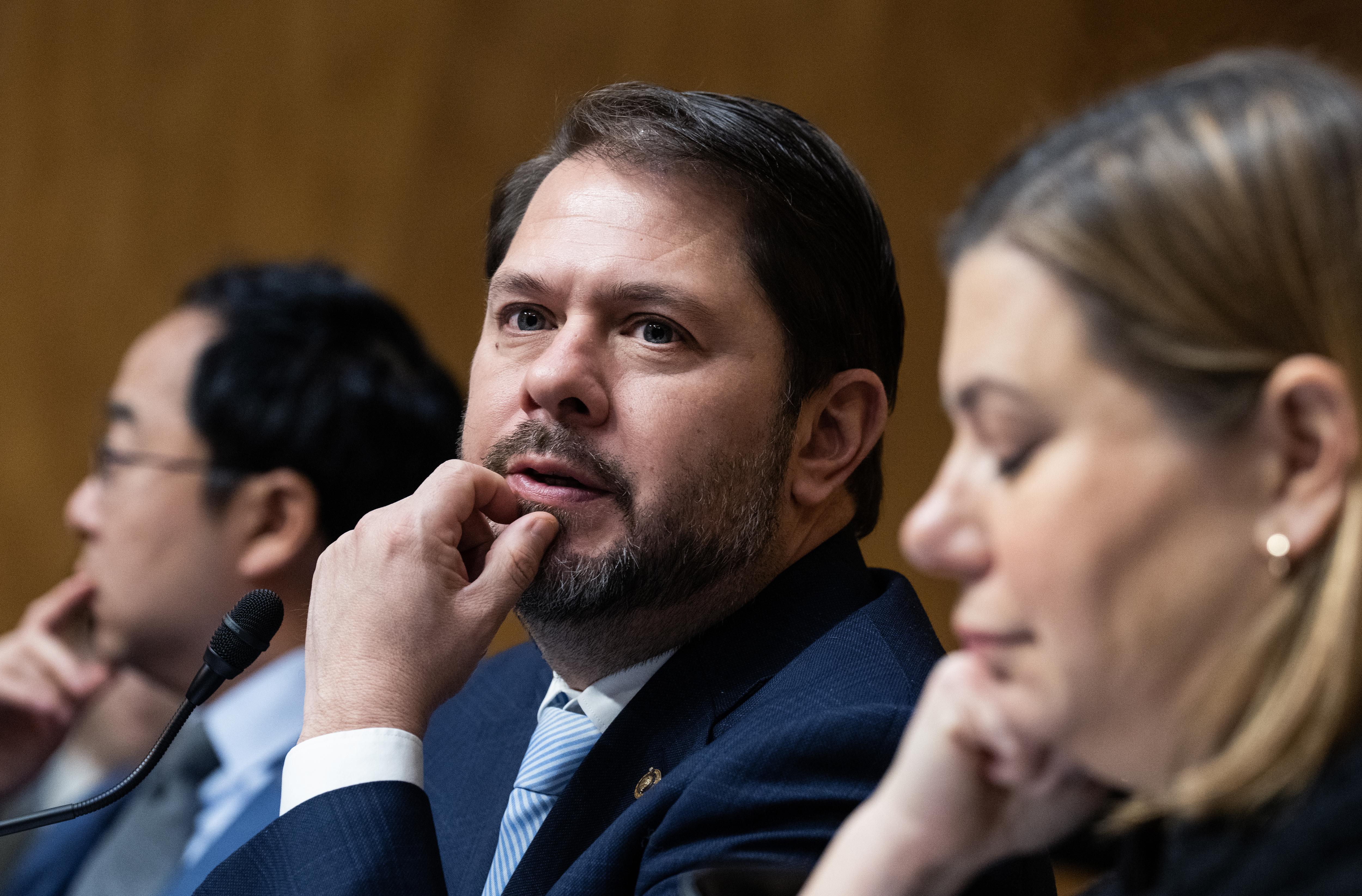
On Wednesday, Sen. Ruben Gallego (D-Ariz.) told CNN that he would support new funding for the U.S. war with Iran — but only if Israel and Arab Gulf states help pay for it.
“We’re using our taxpayer money to protect those countries,” Gallego said. “We’re using our men to protect these countries. They need to throw in and have skin in the game too.”
But Gallego’s Goldilocks stance didn’t last long. Following a wave of online backlash, the senator changed course Thursday morning and declared his opposition to any “supplemental funding for the illegal Iran war.”
The sudden about-face demonstrates how the Democratic base is pushing its lawmakers to accept the “obvious political logic” of voting against new funding for the war in Iran, according to an advocate lobbying against the war, who requested anonymity to speak freely about congressional dynamics. The message, as the advocate put it, is simple: “a vote to fund this war is a vote for the war.”
Just days after launching a surprise campaign to topple the regime in Iran, the Trump administration has already floated the idea of seeking a $50 billion supplemental funding bill to help sustain its war effort, which is costing at least $1 billion per day. For now, it appears that such a request would sail through the Republican-controlled House. But any funding for the war will face a far more difficult test in the Senate, according to advocates and lobbyists who spoke with RS.
The math is straightforward. In order to advance a funding bill through the normal process, Senate Republicans will need to get at least seven of their Democratic colleagues on board. Sen. John Fetterman (D-Pa.) is the only Democrat who has made clear that he would support a supplemental, but his vote could well be cancelled out by Sen. Rand Paul (R-Ky.), who has been among the war’s sharpest Republican critics.
These seven votes could be hard to come by. Some Democrats have expressed openness to a funding bill, like Sen. Gary Peters (D-Mich.), who told RS in a statement that Trump must “provide a clear strategy” for the war before asking for more funds. Other national security Democrats, like Sens. Elissa Slotkin (D-Mich.) and Jack Reed (D-R.I.), have also left the door open to a “yes” vote.
But a large swathe of Democratic senators have united behind a strong anti-war message. And many of those who have floated the idea of funding the war, like Gallego, have been forced to walk back their stances. Take Slotkin, who said Wednesday that she doesn’t “rule anything out” since “we’re in it.” Following a wave of backlash, she softened her stance on Thursday, saying, “I will always look at anything that is brought to me, but I have a pretty skeptical eye.”
Progressive operatives see opposition to the war as a political winner. Democratic lawmakers can use a battle over a supplemental bill to attack Trump for spending money overseas while pinching pennies at home, argued Dylan Williams, the vice president for government affairs at the progressive Center for International Policy.
“Frankly, it's mind-boggling that any Democratic lawmaker would consider funding this war,” Williams said. “Trump and Republicans are running at full speed into a buzzsaw on kitchen table affordability issues, and this war makes that worse.”
Of course, the GOP does have some tools for twisting Democrats’ arms. One option under consideration is to tie Iran funding to a Democratic priority, like additional Ukraine aid or disaster funding. Another is to frame Democrats as insufficiently supportive of the troops, or insufficiently opposed to the “Ayatollah,” as Sen. Markwayne Mullin (R-Okla.) put it Tuesday.
But Williams expects that Democrats will hold out against these attacks. When it comes to questions of supporting soldiers, for example, the response is straightforward. “The best way to protect our troops is to end the war that has put them in harm's way,” Williams said.
Further bolstering Democratic arguments is the fact that the Pentagon is already flush with cash. The Defense Department has “barely obligated” any of the $150 billion in supplemental funding that it received from Congress last year, according to a senior congressional staffer who spoke on condition of anonymity. “It's essentially a slush fund,” the staffer told RS. “They can program that money to pay for whatever urgent needs are coming out of Iran.”
The problem for the Trump administration is that this money will only go so far in replenishing munitions stockpiles on short notice. If Trump wanted enough weapons to sustain a long war, the Pentagon would have had to invest some of that $150 billion when it received the funding last year. “There's no way that our munitions manufacturers can speed up production in the short term to meet urgent demand,” said the staffer. “It's the height of irresponsibility to launch a war of choice against a massive adversary like Iran when you know for certain that your stockpiles are in a dire situation.”
Given the limited near-term impact, a vote on a supplemental will serve primarily as a political litmus test. “Trump wants to signal to the world that he's serious about Iran by securing congressional support for a $50 billion supplemental,” the staffer said.
Democrats can thwart that message if they seize the opportunity to block additional funding, Williams argued. “The most immediate impact will be the political signal it sends to Trump that his war is deeply unpopular and cannot go on for the months the Pentagon is now planning for,” he said. “That limiting of political space around the president is critical.”
- House and Senate votes fail, giving Trump free rein on Iran war ›
- The cost of Trump's Iran war: $5 billion and counting ›
- Dems: We will not approve one more cent for this war | Responsible Statecraft ›