

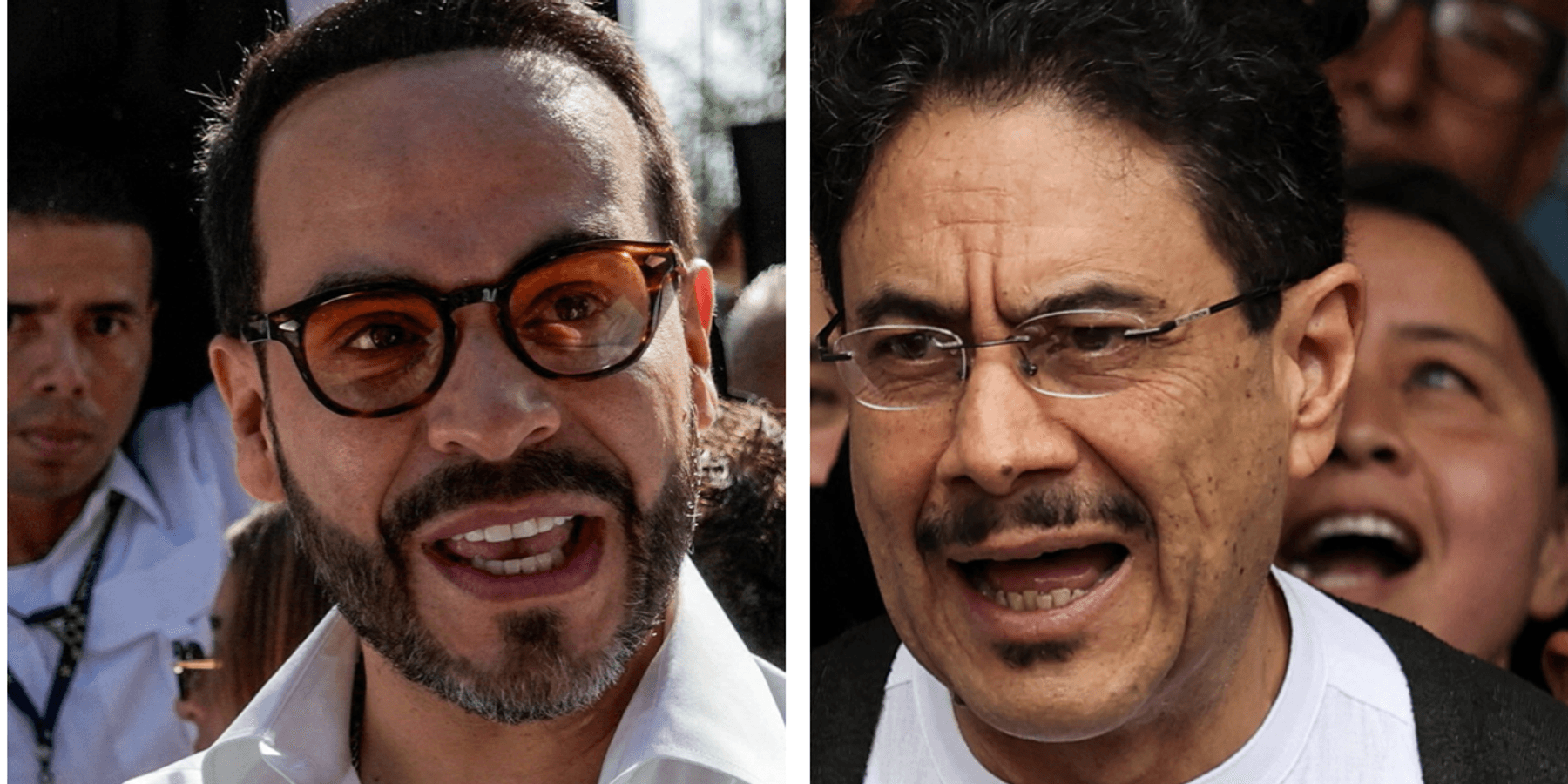
Right-wing outsider Abelardo de la Espriella and left-wing senator Ivan Cepeda have emerged victorious in Colombia’s high-stakes, first-round presidential election Sunday, setting the stage for a tight runoff on June 21 that could reshape the country’s relationship with the Trump administration and political dynamics across Latin America.
De la Espriella, 47, a criminal lawyer and businessman with the Defenders of the Homeland movement, won 10.3 million votes, or 43.7% of the total—shy of the 50% required to clinch victory in the first round—while Cepeda, 63, a human rights activist and former peace negotiator with President Gustavo Petro’s Historic Pact party, won 9.65 million votes, or 41% of the total.
Trailing far behind were center-right senator Paloma Valencia of former president Álvaro Uribe’s Democratic Center party, with 1.6 million votes, or 7% of the total, and Sergio Fajardo, of the centrist Dignity and Commitment party, with 1 million votes, or 4% of the total. The preliminary vote tallies came in within less than two hours of polls closing at 4 p.m. local time.
De la Espriella easily took the country’s central highlands and eastern plains, where Colombia’s largely conservative, majority-white urban centers are located, while Cepeda won the regions on the country’s Pacific and Atlantic coasts and Amazon rainforest, where Colombia’s Indigenous and Afro-descendant populations are the majority.
According to Colombia’s National Electoral Council (CNE), nearly 24 million Colombians voted at 118,346 polling tables across 13,489 voting stations nationwide, as well as 2,181 polling tables across 253 voting stations in 67 other countries, for a participation rate of around 57.5%.
This was somewhat higher than in the 2022 first-round elections, which Petro, who is limited to a single term, won with 40% of the vote.
Sunday’s elections unfolded across the South American country of 54 million people (41 million of whom are eligible to vote) without major incidents or violent episodes, although the country’s non-governmental Electoral Observation Mission (MOE) registered hundreds of presumed anomalies and electoral violations, including armed actors restricting voter mobility, political campaigning at polling stations, attempts at vote-buying and imitation of electoral authorities, and widespread online disinformation campaigns, among others.
Petro and Cepeda have urged electoral authorities to scrutinize potential irregularities and ratify the count before accepting the final tally.
Election monitors said that nearly a quarter of Colombia’s 1,110 municipalities faced risk of violence from Colombia’s myriad irregular armed groups on election day, while Colombia’s defense ministry deployed over 400,000 soldiers and police to safeguard the vote.
The pro-Trump De la Espriella, who calls himself “The Tiger” and promises to convert the violence-afflicted nation into a “Miracle Country,” jumped ahead in most major polls — which for months had him trailing behind both Cepeda and Valencia — in recent weeks, bolstered by his aggressive use of social media, support from charismatic Evangelical pastors, and backing from key conservative figures across Latin America.
His efforts to win in the first round, however, fell short despite last minute attempts to shift voter intention even after campaigning had formally closed the weekend before.
On Friday night before the election, President Daniel Noboa of neighboring Ecuador joined a live stream with De la Espriella where he announced that 75% tariffs he had enacted on Colombian imports would be lifted the day after Sunday’s vote, a move denounced by Colombia’s foreign ministry as a form of electoral interference.
In a similar vein, U.S. senator Bernie Moreno (R-Ohio) — who joined an 86-member State Department electoral observation mission on Sunday after visiting President Noboa in Ecuador last week — along with Reps. Maria Elvira Salazar (R-Fla.) and Carlos Gimenez (R-Fla.), have made several statements in the days leading up to the vote implicitly encouraging voters to vote for De la Espriella and reject Cepeda.
The June 21 runoff pits diametrically opposed visions for Latin America’s third largest country and economy against one another. De la Espriella has promised to end Petro’s “Total Peace” negotiations with the country’s guerilla, paramilitary, and criminal groups; unleash lethal military force to fight drug trafficking, and construct ten maximum-security prisons for low-level criminals just has President Nayib Bukele has in El Salvador.
He also wants to cut taxes for the private sector, resume aerial fumigation of coca crops, join the Trump administration’s “Shield of the Americas” consortium, and issue new concessions for fracking and oil exploration.
Cepeda, on the other hand, intends to double-down on the demobilization of armed actors through peace negotiations and intensify the country’s clean energy transition. He promises to center human rights and combat illicit finance as the cornerstone of his counternarcotics strategy, and seeks to deepen Colombia’s leadership role in Latin America, invest in public education, and prioritize anti-militarism and international law in the country’s foreign affairs.
The second round runoff will likely come down to whether the roughly 12% who voted for Valencia and Fajardo will opt for De la Espriella or Cepeda. It’s likely that Fajardo’s 4% will mostly swing in favor of Cepeda and Valencia’s 7% will go for De La Espriella — putting him above the 50% needed — though many of Valencia’s more centrist voters attracted to her openly-gay, liberal running mate, Juan Daniel Oviedo, may be put off by De La Espriella’s conservative family values and outwardly misogynistic behavior, and instead vote for Cepeda.
It’s also expected that voter turnout will be considerably higher in the second round — as it typically has been in past votes — with many Cepeda supporters opting to stay at home in the first round given most polling had put him squarely in the lead, yet not hitting the 50% mark required to win outright. This dynamic could work to Cepeda’s favor, as it did in Colombia’s 2022 presidential elections, when the two right-wing and center-right candidates won a combined 52% to Petro’s 40% in the first round, but a surge in last-minute support and voter turnout for Petro’s movement catapulted him to over 50% for a victory in the runoff.
Even if De la Espriella wins the June 21 vote, he will likely face an uphill battle getting some of his more radical proposals passed into law. Petro’s Historic Pact party won a plurality of Colombia’s Senate and House of Representatives seats in the country’s March 8 legislative elections, while De la Espriella’s party has just one congressman and four senators in the legislature, making it likely he would have to form coalitions with centrist parties and moderate some of his proposals for them to have a chance at becoming law.
If Cepeda wins the June runoff, he is likely to face similar governance challenges as well as an uphill battle with the Trump administration — as Petro has — though his cooler demeanor and more pragmatic work-style may facilitate the country’s long-standing institutional and operational relationships with its U.S. counterparts despite possible tensions between the executives.
Meanwhile, with a De la Espriella victory, the Trump administration would gain a major new ally in Latin America’s epicenter — and a partner more than willing to accelerate the spread of the “Donroe Doctrine” at a key inflection point in the regional balance of power.
- Noboa's Ecuador: Is this what 'partnering' with the US looks like? ›
- Sunday's election could put Colombia back on team Trump ›