

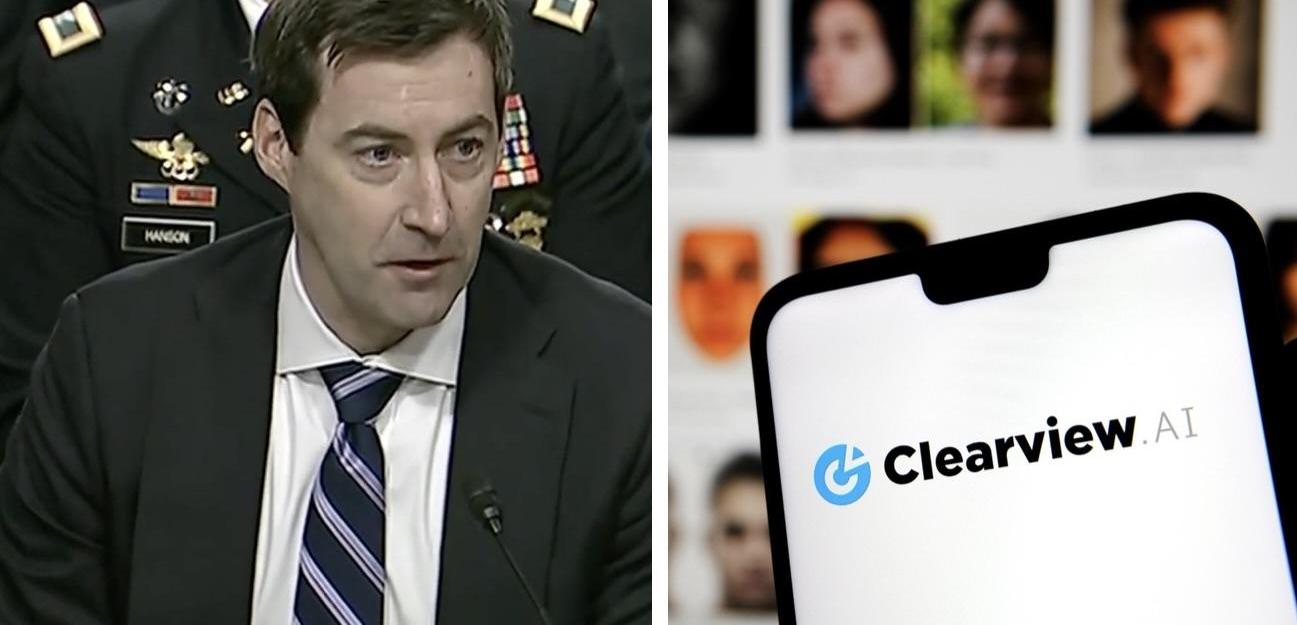
Owen West, the incoming head of the Defense Innovation Unit (DIU), previously advised Clearview AI, an invasive facial recognition technology company that has heavily involved itself in the Ukraine war to try to shed its pariah status in the commercial sector.
Created in 2015 to boost collaboration between the Pentagon and Silicon Valley, the Defense Innovation Unit (DIU) was given more than $1.3 billion in taxpayer funds to in 2025 to bring commercial technologies into the defense space through contract acquisition and award programs, public-private partnerships, and other opportunities.
Now at the helm of that organization, West is well-positioned to offer the company he advised a helping hand as well as boost the prospects for facial recognition and adjacent surveillance technology in the massive Pentagon budget. He has been the lead DOGE staffer at the Pentagon since last summer, and was more recently put in charge of its effort to acquire small drones for the military.
In September 2025, ICE awarded Clearview AI a $9.2 million contract for facial recognition investigations.
Founded in 2017 with funding from controversial venture capitalist and Pentagon contractor Peter Thiel, Clearview AI has over 60 billion images of faces in its database — scraped online, without consent — that it says can be used to identify almost anyone on earth. Barred from most U.S. private sector use in 2022 after the ACLU sued it for violating biometric privacy laws, the company has received hundreds of millions of dollars in fines for similar misconduct in Europe. It has dodged most of these fines.
Despite widespread condemnation of its facial recognition services as “dystopian,” some local and state law enforcement and ICE still use Clearview AI, as do the FBI, the Army, and Department of Justice.
Owen West joined Clearview AI’s Advisory Board in August 2021, as did other former government and law enforcement officials. (West served in the first Trump Administration as Assistant Secretary of Defense for Special Operations). According to archived versions of the company’s website, he served on the Clearview AI board until at least June 2024. The timing of his entrance into the second Trump administration roughly coincided with a leadership shakeup at Clearview AI, where its former CEO Hoan Ton-That was forced out in February 2025 amid financial struggles relating to the company’s reported difficulties in securing government contracts and funding.
Involvement in Ukraine war
Amid chronic bad press, Clearview AI has moved to showcase its usefulness in the Ukraine war. It offered its services to the Ukraine government, for free, at the beginning of the conflict to help its military identify Russian spies and soldiers — even dead Russian soldiers — and use the data it collected to help prosecute Russian war crimes.
As Clearview AI told TIME Magazine, since the beginning of the war, the Ukrainian government had run facial recognition searches in its database more than 350,000 times in the first 20 months to identify more than 230,000 Russian soldiers, and also to locate 190 Ukrainian children it said had been abducted by Russia.
“The volume is insane,” Clearview AI’s then-CEO, Hoan Ton-That, told TIME. “Using facial recognition in war zones is something that's going to save lives.”
Supporting facial recognition technology, Owen West wrote back in 2022 that an online “Wall of Shame” publicizing “the names, pictures, locations and lifestyles of Putin's extended network,” could help hold Russians accountable for their role in the Ukraine war.
“To help loosen Putin's hold on Russia, combining crowdsourced photographs with facial recognition is a modern tactic too powerful to be ignored,” he wrote.
What West and Ton-That did not acknowledge is that these efforts, which they justify as wartime measures, risk further normalizing the surveillance of civilian populations, foreign, and domestic, writ-large.
The revolving door strikes again?
Outside Clearview AI, West has ping-ponged between government and industry. Before his appointment in the first Trump administration, he served in the Iraq War as an officer in the Marine Corps and worked as a banker for Goldman Sachs.
West’s role at the DIU, which brings commercial technologies into the defense sector — while fostering a “dual-use” technology ecosystem that encourages the commercial sector to adopt weapons systems technologies in kind — could be a real boost to Clearview AI.
To this end, Clearview AI’s current CEO Hal Lambert, a prominent Trump fundraiser, has been positioning the company for “opportunities” sprouting from the current administration’s defense and border security priorities.
“We're talking to the [Pentagon], we're talking to Homeland Security…There are a number of different agencies we're in active dialogue with,” Lambert said early last year.
- Why Russians haven't risen up to stop the Ukraine war ›
- Trump's '28-point plan' for Ukraine War provokes political earthquake ›