

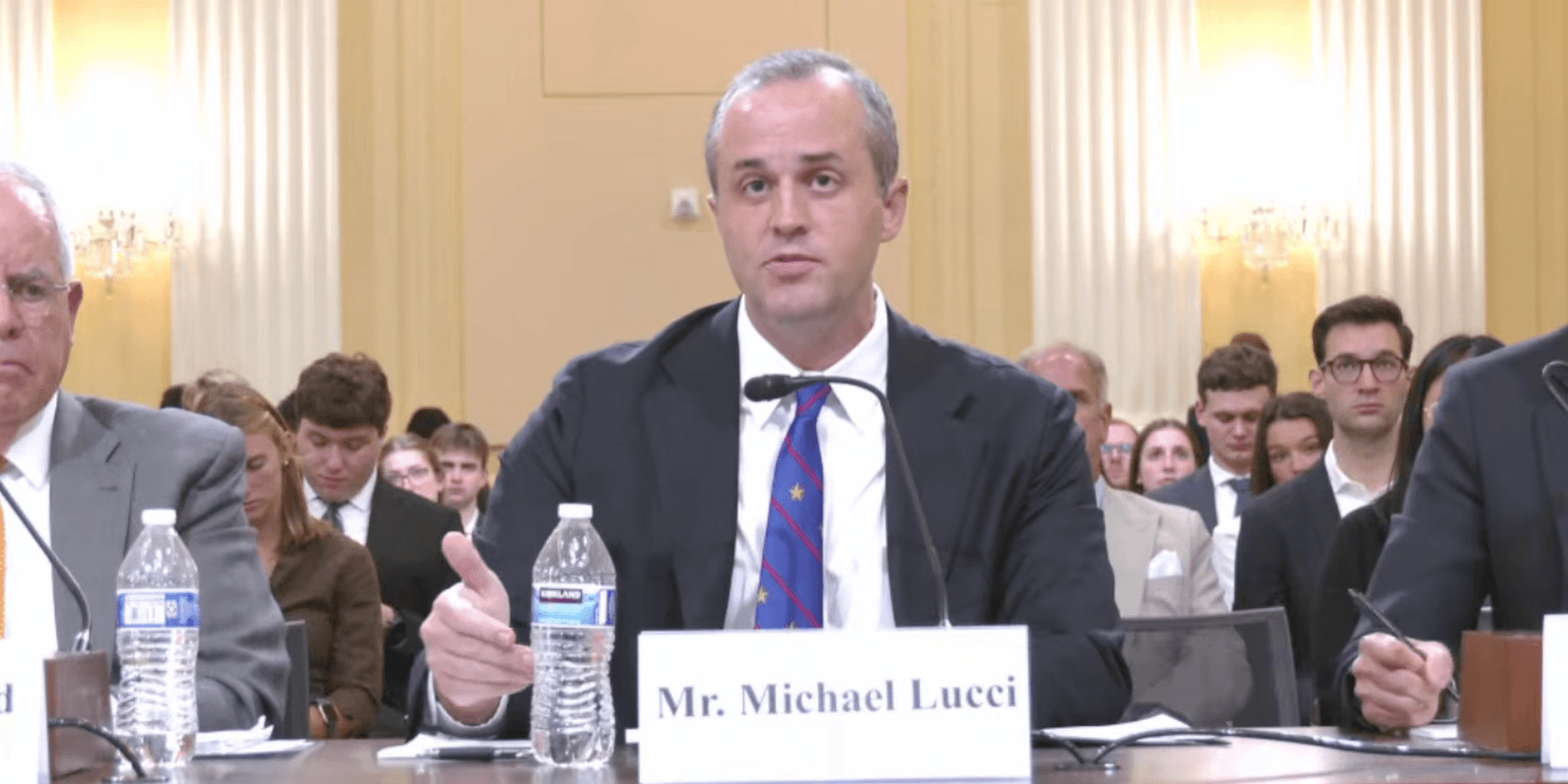
At a recent hearing of the House Select Committee on China, State Armor CEO Michael Lucci urged lawmakers to treat Chinese influence in the United States as a national security priority.
“The American homeland is contested. States are on the front lines of this contest, and the Chinese Communist Party is exploiting vulnerabilities at the state and local level that can go overlooked here in Washington,” Lucci said.
As evidence, Lucci pointed to Chinese ownership of American farmland, the presence of Huawei equipment near a nuclear missile silo in Nebraska, and a former Chinese officer’s purchase of land near a Texas military base.
The hearing raised questions about how far the U.S. should go in the name of national security, especially when it targets specific nationalities and ethnic groups. During a heated exchange with Rep. Ro Khanna (D-Calif.), Lucci questioned the allegiances of 1.5 million Chinese Americans who obtained U.S. citizenship through birthright. “You think they should be denaturalized even if they are born here?” asked Khanna.
“I actually think this is a very clear security threat,” Lucci said, before acknowledging he thinks denaturalization should be considered.
Lucci has criss-crossed the country lobbying state legislatures since founding State Armor in 2023. In his testimony, he touted his successes in getting anti-China foreign influence legislation passed in Nebraska and Texas. But these laws have little organic support, are backed by dark-money groups, and in some cases have not increased transparency at all around state-level foreign influence operations.
Last year, Nebraska passed a bill that required Chinese companies to register as foreign agents and cut off tax incentives for those companies. Lucci, who fought for the bill in Nebraska and was seen next to Governor Jim Pillen at the bill signing ceremony, celebrated the legislation during his testimony to Congress.
The main argument in favor of the law was transparency. “We have some existing transparency requirements for those who would seek to influence policy in the state of Nebraska, but not enough,” said Nebraska State Senator Elliot Bostar, the bill’s author, at the signing ceremony.
But the bill, which went into effect in October, does not appear to have led to any increase in transparency. In fact, not a single business, individual, or entity appears to have registered as a “foreign adversarial company.” The Nebraska Attorney General’s Office is supposed to publish a monthly update on registrations, but has not done so. (The Attorney General’s Office did not point RS to a single report over a phone call, and did not respond to an email request for comment.)
Instead, it has led to economic complications. The new law threatens to cut off tax incentives for dozens of companies with Chinese subsidiaries, including Walmart, Costco, 3M, and Monsanto. These concerns led Bostar to support an amendment that allows companies with Chinese subsidiaries to keep their tax incentives. The amendment passed in April.
The loss of tax incentives still could apply to companies such as Smithfield, the Chinese-owned pork producer and food processing company that operates several plants in Nebraska. Pillen’s family business — Pillen Family Farms — is a direct competitor to Smithfield, raising concerns that the governor has a vested interest in the anti-China bill.
Smithfield warned Bostar that the measure would cause economic disruptions to the state. Lucci characterized Smithfield’s lobbying as a “veiled threat” in his testimony to Congress.
Nebraska State Senator John Frederickson told the Flatwater Free Press, a Nebraska nonprofit newsroom, that this is the problem of a state taking on national security issues; “I think it’s a perfect example of what happens on the state level when we try to overstep our role,” he said.
Nick Robinson, Senior Legal Advisor at the International Center for Not-for-Profit Law, previously told RS that states should not be in the business of regulating foreign influence. “It would be a nightmare to have 50 different regulations for foreign influence across the country,” said Robinson.
Despite these on-the-ground complications, Lucci touted Nebraska as a “leading state” confronting the threats of the CCP in his testimony to Congress.
State Armor does not disclose a list of its funders, but IRS filings reveal that State Armor has largely been funded by the Concord Fund, an organization associated with conservative activist Leonard Leo. The Concord Fund gave $3.3 million to State Armor before dissolving in January. Leon Rachel Corp., a shell company that funds a number of hawkish organizations such as the Foundation for Defense of Democracies and the American Israel Public Affairs Committee (AIPAC), gave another $100,000 to State Armor in 2024.
Lucci used to be a Senior Fellow at the Cicero Institute, a think tank founded by Palantir co-founder Joe Lonsdale. A Wall Street Journal profile of Lucci last year noted that several wealthy China critics close to him could stand to gain from hawkish state policies, though Lucci maintains his donors do not have a financial interest in his advocacy.
Lucci did not respond to a request for comment.
In addition to passing state-level foreign influence bills, one of State Armor’s other top legislative priorities is preventing Chinese citizens from owning land near critical infrastructure.
Lucci is trying to pass a bill in Ohio, for instance, that would prevent citizens of China and other adversaries from owning land within 10 miles of critical infrastructure. “Critical infrastructure,” in the bill’s definition, includes railroads, telephone poles, fiber optic cables, power plants, dams, and water treatment facilities. Critics have warned this would effectively ban Chinese citizens from owning land in the entire state of Ohio.
At a state hearing for the bill in March, over 100 people — including concerned Chinese citizens, businesses, and civil liberties organizations such as the American Civil Liberties Union — voiced their opposition to the legislation. Meanwhile, almost all of the proponents of the bill flew in from out of state, representing dark-money think tanks like State Armor, the America First Policy Institute, and the Jamestown Foundation.
At another hearing in May for the Ohio Senate’s version of the bill, over 200 people voiced their opposition, compared to two in favor.
“This bill unfairly presumes malicious intent of immigrants based solely on national origin, targeting individuals who have lawfully entered the U.S. and abided by its laws,” testified Xuefeng Wang, Associate Professor at the University of Cincinnati.
Melody Miao, a 14-year-old high school student, told the committee “I grew up here, went to school here, learned the Pledge of Allegiance by heart, memorized the Bill of Rights, and watched fireworks every July 4,” Miao said. “Still, I’ve lived my entire life, fearing that no matter how much I loved my country, I wasn’t American enough.”
In Lucci’s telling, these appeals to equality are tell-tale signs of being a CCP-tied foreign agent. “These CCP-intelligence tied actors obscure their party-state affiliations and hide their true intentions by laundering their propaganda into American terminology such as ‘property rights’ and ‘American Dream,'” Lucci told the Daily Caller.
A number of other states have introduced legislation to limit or even ban Chinese citizens from owning land, including Alabama, Florida, and Missouri.
This is not to say that the Chinese government does not oversee extensive influence operations in the U.S. In 2024, former New York State official Linda Sun was indicted for allegedly working for China in exchange for gifts, including a Hawaii apartment and a 2024 Ferrari. Sun was charged with visa fraud, money laundering, and acting as an unregistered foreign agent. A Brooklyn judge declared a mistrial in December, after jurors could not reach a verdict. In June, Thomas Weir Pauken, a U.S. journalist who lived in China, pleaded guilty to working as an agent for China. The FBI said Pauken “gathered intelligence” on American targets and “reported it back to his Chinese handlers.” Pauken is now facing up to 10 years in prison.
The challenge, according to John Yang, President and Executive Director of Asian Americans Advancing Justice, is avoiding conflation of the actions of China with its citizens. Yang testified to the the House Select Committee on China that the U.S. needs to be able to address foreign influence “without repeating past mistakes, in which broad, ethnicity-based suspicion of Chinese and other Asian Americans has too often substituted for evidence-based enforcement.”