

The ongoing melodrama of President Donald Trump’s outbursts against Britain and other allies unwilling to join his misbegotten war against Iran is getting tedious.
Brits still value the special relationship with America even if the President is not making us feel special. But, we have no ships. Sending a commercial vessel to the Strait of Hormuz to help unblock would represent a suicide mission.
The phrase “turning a blind eye” is often associated with Britain’s most accomplished Naval commander, Admiral Horatio Nelson, who in the 1801 Battle of Copenhagen deliberately ignored a signal demanding that he retreat. Holding a telescope to his blind eye, he declared “I really do not see the signal” before leading his ships in a decisive defeat of the Danes and Norwegians.
After the U.S. and Israel chose to launch a war against Iran, midway through diplomatic negotiations hosted by the Omanis in Switzerland, Prime Minister Keir Starmer has been trying his best to turn a blind eye to President Trump’s oscillating requests for military assistance.
With a majority of the British public opposed to Israel’s actions in Gaza, supporting a U.S.-Israel war on another Muslim population won’t be a vote winner for a UK government that is already flagging in the polls.
From the start, most British people have remained unclear on the U.S. reasons for going to war and broadly opposed to the use of British air bases by the U.S.A to conduct strikes against Iran. That helps to explain Starmer’s early decision to deny the U.S. the right to use British airbases in Fairford and on the Chagos Islands. And the shouts of “U-turn” when he relented under the pretext of only permitting strikes on “missile sites.”
Whatever the views of ordinary Britons, some politicians and journalists on the right have nevertheless criticised Starmer for not backing America in its fight and thereby risking the so-called special relationship. To his credit, Starmer has invested heavily in building these ties with Trump but but he doesn’t have the political space to offer complete and unconditional support for his war and nor, in my view, should he.
In any case, the U.S.-UK relationship doesn’t feel that special right now, and it is in the maritime domain where tensions are the most apparent. In remarks to his Cabinet on March 26, President Trump referred to the UK’s two aircraft carriers as little better than “toys.” On March 17, he said “we don’t need anybody.” Just days before onMarch 14, he was urging nations to send warships to protect commercial vessels in the Strait of Hormuz. Days before that on March 8, President Trump declared the war already won, and in referring to the UK’s placing its sole serviceable aircraft carrier on high readiness, he said, “That’s okay, Prime Minister Starmer, we don’t need (sic!) them any longer.”
Following the back and forth between the U.S. President and British Prime Minister is as tedious as watching the courtship rituals of teenage sweethearts, and evocative of Taylor Swift’s lyric, “I say, “I hate you”, we break up, you call me, “I love you.””
The only irony here is that the UK hadn’t wanted to send the carrier HMS Prince of Wales to the Gulf anyway. A rushed press announcement was made on the heels of embarrassment at the UK Ministry of Defence over the bungled and delayed deployment of our only available Type 45 air defense destroyer, HMS Dragon.
That vessel took a whole week before it set sail on March 10 because of the need to perform “software upgrades.” A further 13 days would pass before Dragon arrived in Cyprus, despite normal sailing time of around five days because further repairs were undertaken in the English channel and in Gibraltar.
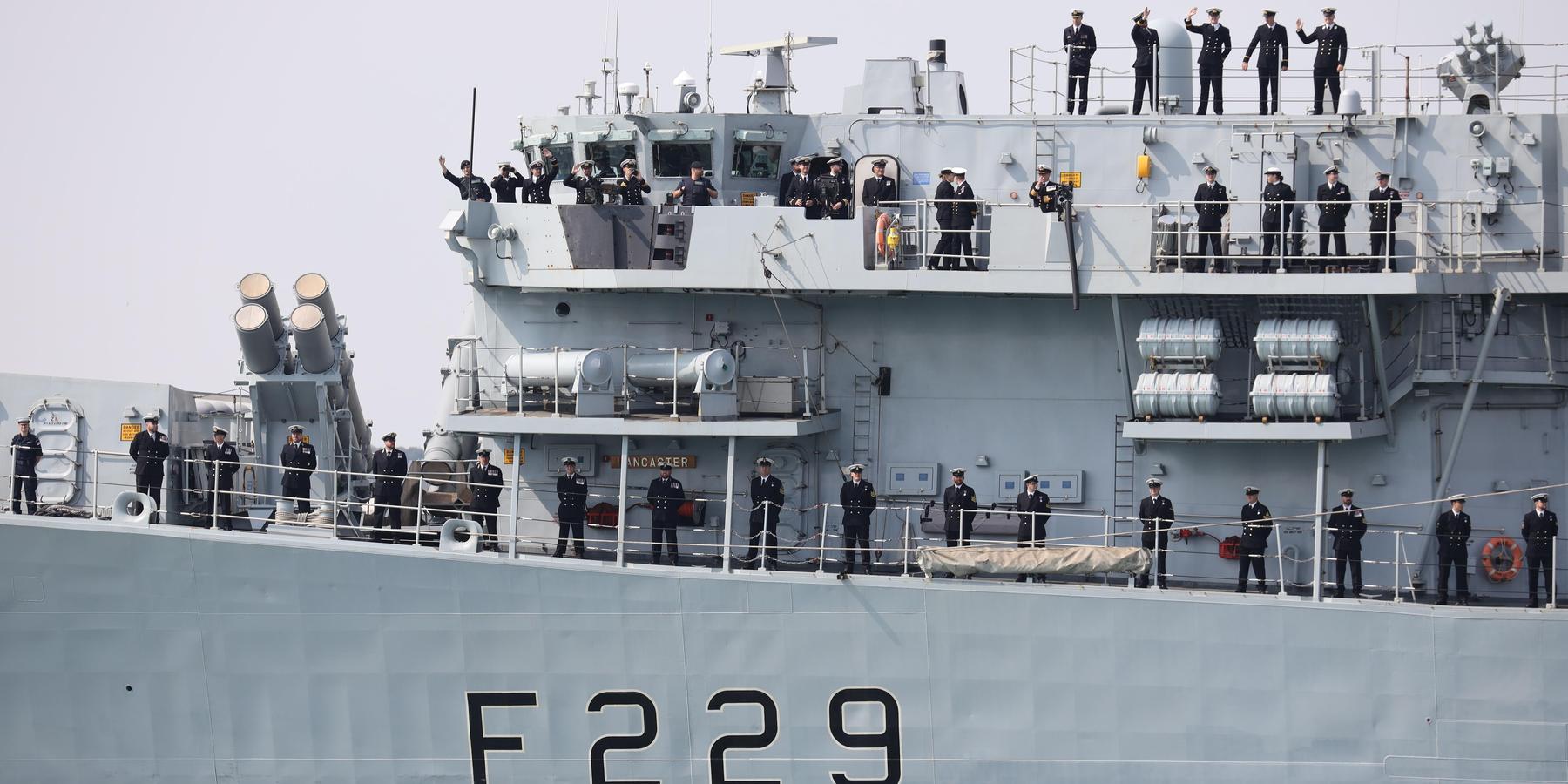
As I pointed out in Responsible Statecraft almost 11 months ago, Britain has hardly any serviceable warships, as the debacle over HMS Dragon has proved. Indeed, and as it relates to the Gulf, HMS Middleton, the last of the Royal Navy’s minehunters based in Bahrain, was brought back to the UK in January of this year on the back of a heavy lift vessel “because she is no longer certified to sail”.
The Royal Navy will not be able to meet its NATO commitments next week because of a shortage of ships and, in a huge embarrassment, has asked Germany to cover the gap.
Of course, that is how NATO cooperation should work. However, the U.S.--Israeli war in Iran is absolutely not a matter pertinent to NATO for the blindingly obvious reason that the U.S. is the aggressor and not the victim.
But in Britain, the dawning recognition of the innate weakness of the Royal Navy, once the Queen of the seas and now labelled a national embarrassment, has shocked many ordinary people to their core.
The UK Ministry of Defence has been working hard to spin their way out of trouble with positive news stories, the latest focusing on the UK’s readiness to lead a coalition to reopen the strait of Hormuz which has been blocked since the start of the war. Yet, commercial vessels from so-called “friendly” nations such as China and Russia have already been allowed to pass through the Strait of Hormuz.
So, what would this smashing British proposal involve? Look more closely, and you’ll see that the offer isn’t for warships which Britain does not possess, but potentially a “leased commercial vessel” that can act as a mother ship for “autonomous, uncrewed systems designed to detect and neutralize naval mines in the strategic waterway.”
The Royal Navy, it seems, has become dependent on the Maritime equivalent of Avis Rent-a-Car.
Clearly, this is a reckless proposition, with war ongoing. The might of the United States Navy has been powerless to unblock the Strait through military means. Sending in an unarmed British commercial vessel, without the permission of the heavily armed Iranian military, appears little short of a suicide mission.
If I were the captain of the British commercial vessel ordered to Hormuz by Keir Starmer, I suspect that I’d follow Nelson’s lead and turn a blind eye.
- On Iran, Spain's Sanchez rises above the bowed heads of Europe ›
- The EU's pathetic response to Trump's Iran attack ›