

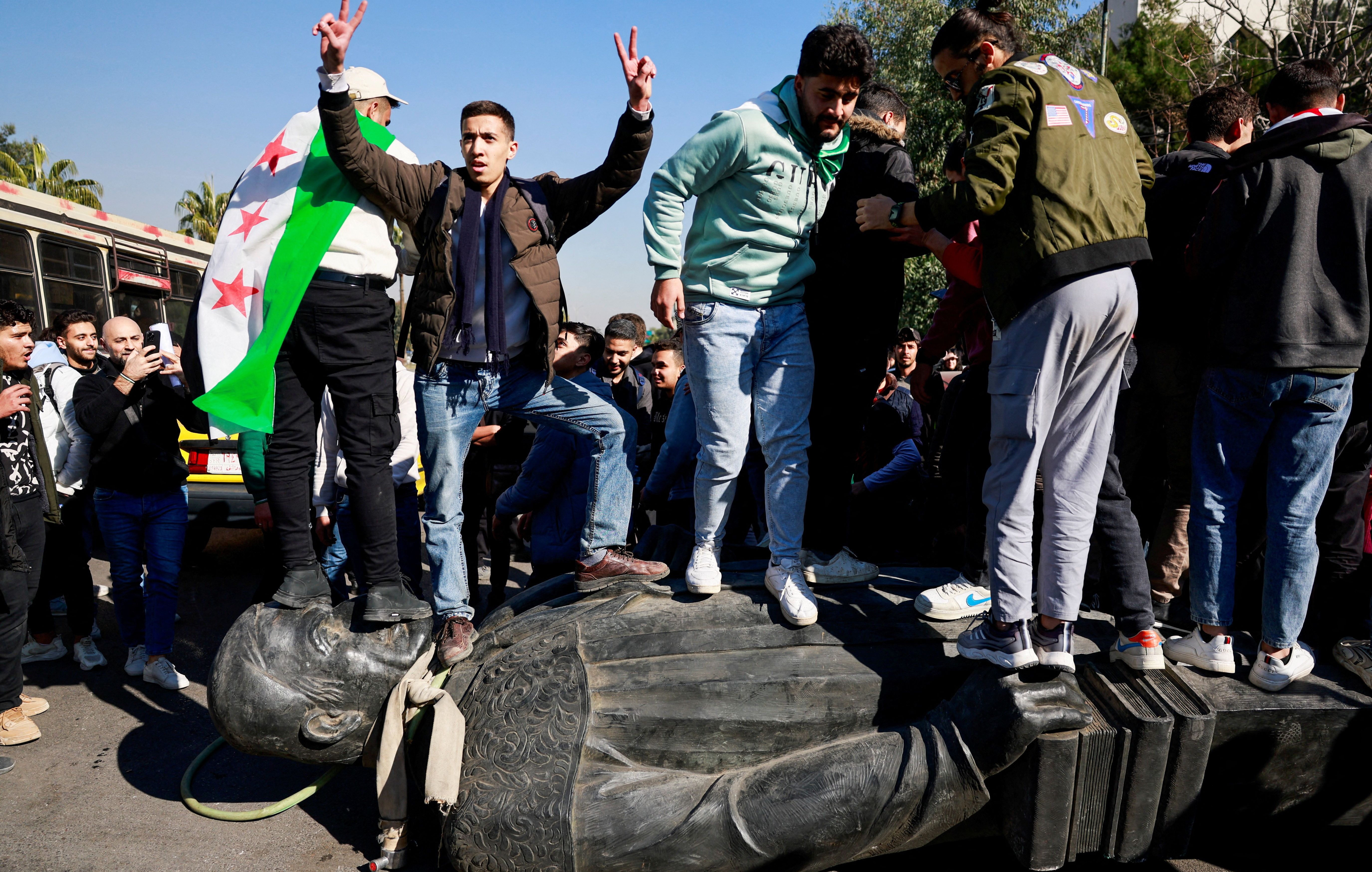
Officials in the Biden administration are taking credit for creating conditions in Syria that enabled opposition forces to overthrow the Syrian government.
Now that opposition forces have ousted Syrian President Bashar al-Assad, administration officials are insisting that longstanding U.S. policies, including actions taken by the Biden administration against Assad’s supporters, made the overthrow of the Syrian government possible. Administration officials deny that they aided Hayat Tahrir al-Sham (HTS), the U.S.-designated terrorist organization that led the drive to overthrow Assad, but they insist that they facilitated the opposition’s victory, citing years of U.S. efforts to empower the opposition and weaken the Syrian government.
U.S. policy “has led to the situation we’re in today,” State Department Spokesperson Matthew Miller said in a December 9 press briefing, the day after Assad fled the country. It “was developed during the latter stages of the Obama administration” and “has largely carried through to this day.”
White House Spokesperson John Kirby agreed, giving credit to the president. “We believe that developments in Syria very much prove the case of President Biden’s assertive foreign policy,” Kirby said in remarks to the press on December 10.
US policy
For over a decade, the United States has sought regime change in Syria. Officials in Washington have openly called for an end to the rule of Syrian President Bashar al-Assad, the repressive and authoritarian leader who first began ruling Syria in 2000, following decades of rule by his father, Hafez al-Assad.
U.S. efforts to oust Assad date back to 2011, when Syria descended into a civil war. As Assad responded to popular uprisings with violent crackdowns, the United States began supporting multiple armed groups, several of which were seeking the overthrow of the Syrian government.
The Obama administration designed the initial U.S. strategy to oust Assad. Hoping to avoid “catastrophic success,” or a situation in which extremists ousted Assad and seized power, the administration decided on a stalemate strategy. The United States provided opposition forces with enough support to keep pressure on Assad but not enough to overthrow him.
The administration’s goal was “a political settlement, a scenario that relies on an eventual stalemate among the warring factions rather than a clear victor,” U.S. officials explained at the time, as reported by The Washington Post.
The Obama administration came close to achieving its objectives in 2015, when opposition forces began moving into areas around Damascus. With Assad under growing pressure, it appeared that he might lose his grip on power and be forced to negotiate or surrender.
As opposition forces gained momentum, however, Assad received a lifeline from Russia, which intervened to save him. By coming to Assad’s assistance with airstrikes and military support, Russia enabled Assad to turn the tide against the rebels and remain in power.
Following Russia’s intervention, the civil war largely settled into stalemate, which left Syria divided into different areas of control. Assad consolidated his control of Damascus and the surrounding areas with support from Russia, Iran, and Hezbollah. Many opposition forces regrouped in northwestern Syria, where they received support from Turkey. Kurdish-led forces, which were separate from the opposition, carved out an autonomous region in northeastern Syria, keeping another part of the country outside of Assad’s control.
Keeping pressure on Assad
As the civil war cooled, U.S. officials maintained its strategy of stalemate. Although they believed that Assad had secured his position in Damascus, they remained convinced that they could still pressure him into resigning, primarily by keeping him weakened and denying him a victory.
U.S. policies to keep Assad weakened spanned the administrations of Barack Obama, Donald Trump, and Joe Biden. These policies included the diplomatic isolation of Assad, severe economic sanctions on Syria, ongoing military strikes inside Syria, and additional support to opposition groups.
With Syria becoming a “cadaver state,” as an official in the Trump administration described it, U.S. policies also kept the country dismembered. By preventing Assad from regaining control of areas that he had lost in the war, U.S. officials hoped to pressure him into accepting a political transition.
U.S. officials focused much of their efforts on the Kurdish-led forces in the northeast, an area that includes strategically important wheat fields and oil reserves. Although the Kurds did not seek to overthrow Assad, wanting instead official recognition for their autonomous region inside Syria, U.S. officials knew they could undermine Assad by keeping northeastern Syria outside his control.
At the same time, U.S. officials worked to ensure that opposition forces remained in control of northwestern Syria. Even with the region controlled by HTS, a U.S.-designated terrorist organization, U.S. officials abetted the group’s operations, viewing HTS as “an asset” and believing it was critical to keeping Syria dismembered.
“I just did everything I could to be able to monitor what they were doing and ensuring that those people who spoke to them knew what our policy was, which was to leave HTS alone,” former U.S. diplomat James Jeffrey acknowledged in a 2021 interview with the PBS program Frontline.
Questions about the Biden administration's approach
Since the Biden administration entered office in 2021, however, it has been largely quiet about its intentions for Syria. Although the administration appeared to continue the strategy of stalemate, mainly by keeping Assad weakened and Syria dismembered, administration officials rarely expressed a great deal of interest in the country.
As administration officials grew quiet, some lawmakers grew suspicious, wondering whether the Biden administration was abandoning the project of ousting Assad. During a 2022 congressional hearing, congressional leaders criticized the administration for creating an impression that it had accepted Assad’s rule.
“I remain concerned this administration has accepted Assad’s rule as a foregone conclusion,” U.S. Senator James Risch (R-ID) remarked.
From 2022 to 2023, a number of U.S. allies in the Middle East began moving to restore relations with Assad. In May 2023, Arab leaders welcomed Syria back into the Arab League, ending its suspension from the organization. Officials in the Biden administration criticized the moves, but they did not express any interest in returning to the more volatile dynamics of the civil war.
In fact, recent news reports indicate that the Biden administration was working to forge a deal in which Assad cut ties to Iran in exchange for reductions in pressure on his government. This major diplomatic push, which involved the United States and its Gulf allies, preceded the recent armed uprising that ousted Assad, leading to speculation that the Biden administration had been anticipating a future in which the Syrian leader remained in power.
Revivals and surprises
After HTS began its offensive in late November 2024, the Biden administration revived a familiar playbook. Resorting to the ideas and tactics of its predecessors, the administration presented HTS’s maneuvers in a manner that fit with a policy of stalemate.
In a December 1 interview with CNN, National Security Advisor Jake Sullivan pointed to the stalemate framework by making two basic points. The first was that the Biden administration had concerns about HTS, which Sullivan placed “at the vanguard” of the uprising. “We have real concerns about the designs and objectives of that organization,” he said, acknowledging it is a U.S.-designated terrorist organization.
His second point was that the Biden administration did not see the actions taken by HTS as particularly worrisome, as they could potentially weaken the Syrian government. “We don’t cry over the fact that the Assad government, backed by Russia, Iran and Hezbollah, [is] facing certain kinds of pressure,” Sullivan said.
Even as administration officials saw advantages to be gained from the stalemate strategy, however, it remained unclear just how much pressure the Biden administration wanted HTS to put on Assad. Once HTS began making rapid gains, officials appeared to grow concerned.
“These are not good folks,” White House Spokesperson John Kirby said on December 2, referring to HTS.
Still, some observers indicated that there was a strategic logic to HTS’s moves. Former U.S. official Andrew Tabler, who worked on U.S. policy toward Syria in the Trump administration, suggested at a policy forum hosted by The Washington Institute that the uprising could test Assad’s capabilities.
“They just decided to sort of poke the front lines, so to speak, in a very dramatic way,” Tabler said.
Tabler acknowledged that HTS’s uprising revealed significant weaknesses in Assad’s capabilities, but he anticipated that it would take several years to pressure Assad into leaving office. Like many officials in Washington, he saw the offensive as a way to increase pressure on the Syrian government rather than the beginning of the end to Assad’s rule.
“This is a challenge to the regime, but it’s not going to lead to its immediate collapse,” Tabler said.
In fact, many U.S. officials did not anticipate that the offensive would lead to a sudden collapse of the Syrian government. Given that Assad had previously survived a comparable challenge in 2015, there were strong beliefs both inside and outside of Washington that Assad and his supporters would continue to repel opposition forces.
“I think the entire international community was surprised to see that the opposition forces moved as quickly as they did,” Secretary of Defense Lloyd Austin later noted. “Everybody expected to see a much more stiff resistance from Assad’s forces.”
It was only once opposition forces began to take control of Aleppo in early December, about a week before Assad fled the country, that the Biden administration began planning for the possibility of Assad’s downfall, according to U.S. officials.
When “we saw the fall of Aleppo, we started to prepare for all possible contingencies,” a senior official in the Biden administration explained.
Indeed, the speed of the opposition’s movement caught many of the highest-level officials in the Biden administration by surprise, as they had been working on the assumption that Assad would remain in power for the immediate future.
“We didn’t directly see the fall of Assad,” State Department Spokesperson Matthew Miller acknowledged.
Shifting balance of power
Regardless of the ebb and flow of the Biden administration’s Syria policy, years of U.S. actions have clearly taken a toll on Syria. Just as U.S. officials have claimed, the United States played a central role in creating the conditions that led to Assad’s ouster.
Since the Obama administration first devised the strategy of stalemate, which helped transform Syria into a dismembered cadaver state, Assad ruled over a devastated country, one that may never recover.
The Biden administration’s resurgent American empire has also had major consequences for Syria. By spending the past two years supporting Ukraine against Russia and the past year backing Israel’s military offensives across the Middle East, the Biden administration has implemented policies that have imposed major costs on Assad’s supporters, especially Russia, Iran, and Hezbollah. Without external support, the longtime Syrian leader could no longer withstand violent challenges to his rule.
Shortly after the fall of Assad, President Biden recognized the implications of his administration’s actions, claiming in a major address that U.S. policies set the stage for Assad’s downfall. Even while acknowledging that “some of the rebel groups that took down Assad have their own grim record of terrorism and human right abuses,” he proudly insisted that his administration’s actions had made regime change possible.
Indeed, President Biden has been quick to take credit for the overthrow of another government in the Middle East. Rather than being open about the implications of “catastrophic success,” Biden has taken pride in how he and his predecessors have implemented policies that enabled a U.S.-designated terrorist organization to force Assad from the country.
“Our approach has shifted the balance of power in the Middle East,” Biden said. Through a “combination of support for our partners, sanctions, and diplomacy and targeted military force when necessary, we now see new opportunities opening up for the people of Syria and for the entire region.”
This article was originally published at Foreign Policy in Focus.
- Turkey and Israel are reaping rewards from the chaos in Syria ›
- Ending the Syria war, getting US troops out, and lifting sanctions ›