

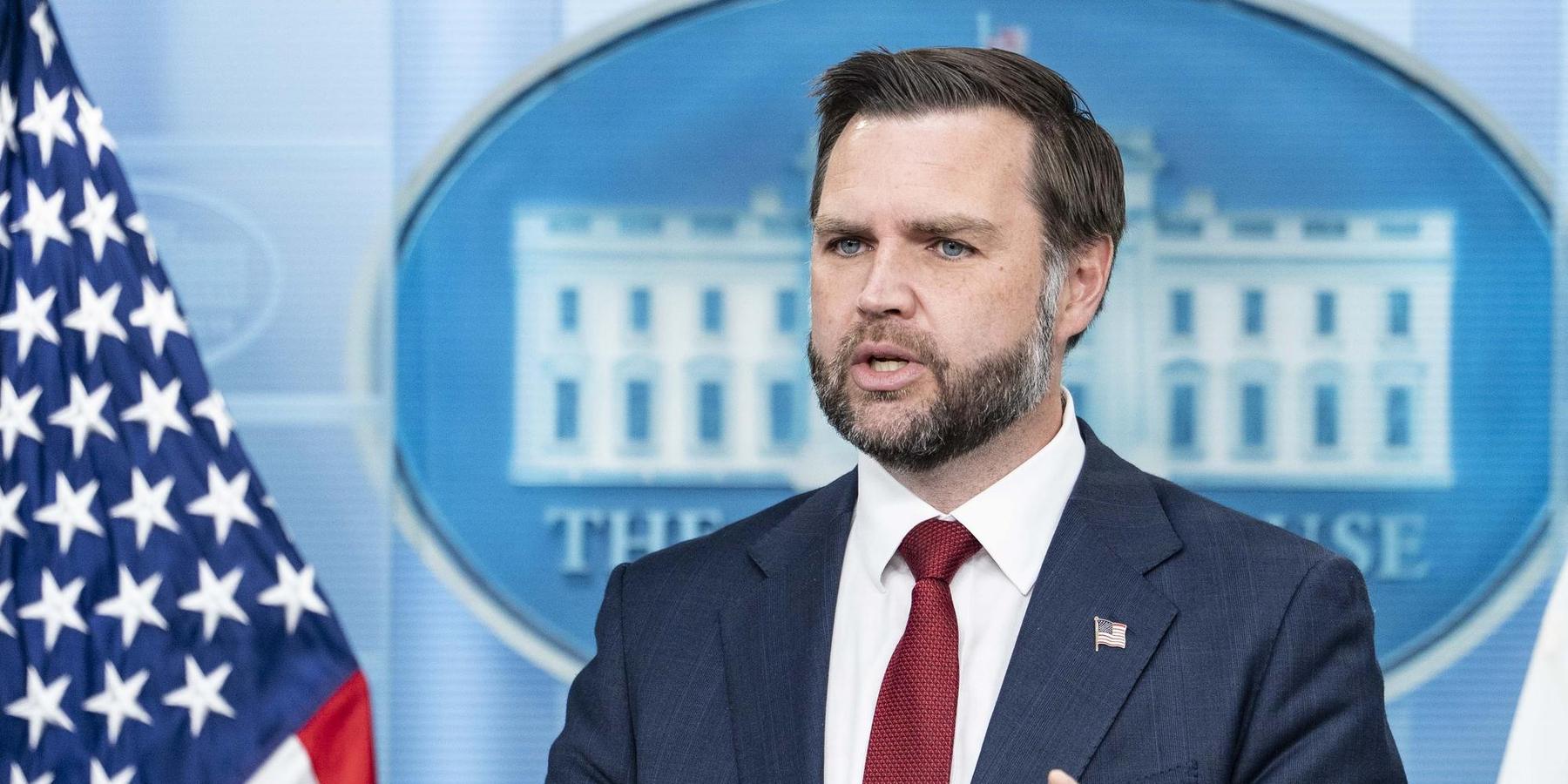
In a Thursday address at the GOP midterm convention that exalted President Donald Trump and demeaned his opponents as “extremists who openly hate our nation,” Vice President JD Vance hardly spoke about foreign policy.
He did not mention the war in Iran directly, and he only brought up foreign policy as an example of an issue that divides the party’s base. He urged voters not to “throw the baby out with the bathwater” because “you happen to disagree with us on a policy issue here or there.”
The acknowledgement of foreign policy as a divisive issue in the MAGA coalition is a stark retreat for Vance, who staked his 2023 endorsement of Trump on the fact that “he started no wars despite enormous pressure from his own party and even members of his own administration,” framing the president’s America First record as a much-needed deviation from decades of bipartisan hawkishness.
A few wars later, Vance appears to have backed down from the anti-war aspects of the America First movement. Meanwhile, in response to the Iran war and the administration’s supposed betrayal of its campaign promises, the Institute for Peace & Diplomacy has launched “Reclaiming America First,” an initiative meant to take back that mantle from what it describes as Trump's hawkish drift, and to articulate an alternative vision for American foreign policy.
Arta Moeini, director of research at the Institute for Peace & Diplomacy and one of the project leads, laid out the parameters he believes should guide an “America First” approach during a Thursday panel marking the launch of the event: it should be neither ideological nor partisan, nor tied to any one individual; it should be grounded in realism; and it should prioritize core U.S. security interests and domestic renewal while rejecting unilateralism and nativism.
“Trump has shown himself to be at least disingenuous about using the term ‘America First,’” Moeini said during the panel, adding that part of the inspiration for the discussion was to combat “the taint of that association of ‘America First’ with this version of Trump.”
That question of who actually carries the tradition forward inevitably turned to Vance, long seen as its standard-bearer within the administration, but whose own words offer a measure of how far the movement’s foreign policy rhetoric has shifted since Trump’s return to office.
While panelists mostly agreed that an “America First” foreign policy was likely only to come from a conservative U.S. president, the group's read on Vance as the steward of that vision was more measured. Moeini said Vance would have been “smart enough not to go to war" with Iran, even if he might not be the right person to fix U.S. foreign policy in the Middle East.
Michael Brendan Dougherty, a senior writer for the National Review, offered a grimly ironic assessment of how a more realist foreign policy could take hold in a hypothetical Vance administration.
“If Vance is elected president after Donald Trump, he’s going to be looking at a munitions stockpile that is very depleted, and will be discouraging of him taking on unpredictable gambles. That’s not the way you want restraint to [be achieved], but it is the way it’s going now,” he said. “The Iran war is bringing about a humiliation of America, and that will bring along at least some restraint.”
Dougherty also pointed to the constraining effect of public opinion, saying that American opposition to war may have prevented Trump from taking even more dramatic steps in Iran, such as an invasion of Kharg Island.
There is evidence that elements of Trump’s base have turned against him as a result of this war. A recent survey from Navigator Research found that roughly 20% of Trump 2024 voters regret their decision. Among that group, almost half cited the war with Iran as the primary reason for their regret.
There were real policy disagreements over what "America First" meant. Daniel McCarthy, editor of Modern Age, warned that talk of a "multinodal" world echoes liberal internationalism and misreads an American public that is still proud of the country, while the panel also split over whether to encourage or deter a Polish or Japanese nuclear program. But all the panelists agreed that America First is a foreign policy movement that both predates and will outlive Trump.
“America First as an ordering principle of American statecraft will long outlive MAGA and the current coalitional dynamics at play surrounding the president,” Reid Smith, Vice President for Foreign Policy at Stand Together, said.
- Party elites so blind they can't see their base turning against the war ›
- Why are so many Vance allies leaving the administration? ›
- The death of 'America First' ›
- Thanks to Trump's war, Dems successfully co-opt 'America First' | Responsible Statecraft ›