

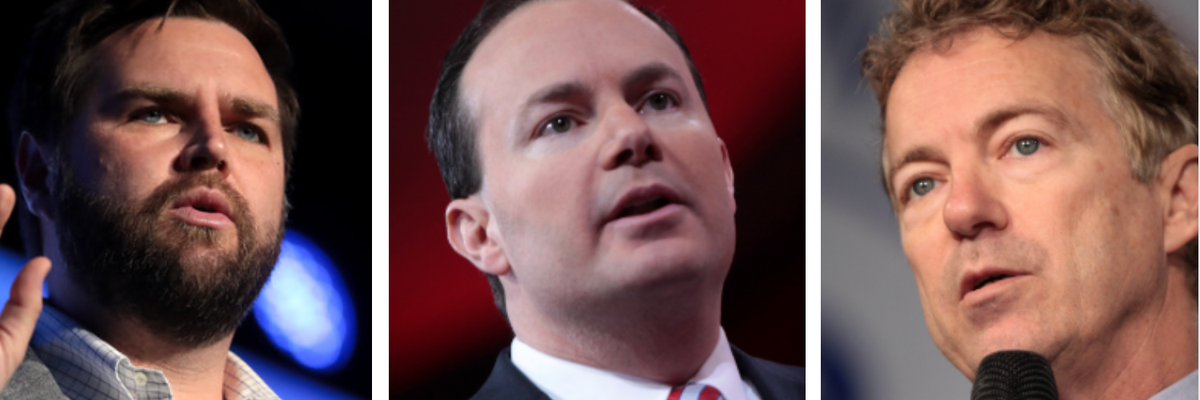
A number of Republican lawmakers, including three senators, sent President Joe Biden a letter Thursday proclaiming that they will no longer support “unrestrained” American aid to Ukraine and “will adamantly oppose all future aid packages unless they are linked to a clear diplomatic strategy designed to bring this war to a rapid conclusion.”
Calling the conflict a “proxy war with Russia” that is “not in the strategic interest of the United States and risks an escalation that could spiral out of control,” the members charge that the current administration policy of “sanctions and drawn-out aid” will only prolong the conflict.
“There are appropriate ways in which the U.S. can support the Ukrainian people, but unlimited arms supplies in support of an endless war is not one of them,” the letter reads. “Our national interests, and those of the Ukrainian people, are best served by incentivizing the negotiations that are urgently needed to bring this conflict to a resolution.”
The names affixed to the document are no real surprise. The three senators — Rand Paul (R-Ky.), Mike Lee (R-Utah), and J.D. Vance (R-Ohio) — have voiced concern about the aid in terms of oversight and the sheer amount drawn from U.S. coffers over the last year (over $113 billion, more than $60 billion of which is direct military assistance or resources for U.S. and NATO defense specifically earmarked for the war).
The senators join a growing chorus of conservative voices questioning whether more unconditional military aid might disincentivize the diplomatic track and help further destroy the country as the conflict grinds on in a war of attrition.
"Since we’re paying the piper, we have a responsibility to call the tune: to figure out what’s possible and make sure our investment is getting us there," Daniel McCarthy, syndicated columnist and editor of Modern Age journal, tells RS. "The only realistic path to stability demands diplomacy of the highest caliber. The alternative is endless spending for endless war."
On the House side, 16 Republican members signed the letter, following the lead of freshman Rep. Eli Crane of Arizona. They include Reps. Mary Miller of Illinois, Paul Gosar and Andy Biggs of Arizona, Matt Gaetz and Anna Paulina Luna of Florida, Dan Bishop of North Carolina, Barry Moore of Alabama, Lauren Boebert of Colorado, Tim Burchett and Andy Ogles of Tennessee, Ralph Norman of South Carolina, Matt Rosendale of Montana, Marjorie Taylor Greene, and Mike Collins of Georgia and Josh Brecheen of Texas.
The group includes familiar faces in the growing conservative-populist movement like Greene who have been been adamant about not sending more aid to Ukraine. Rep. Greene told Lesley Stahl of 60 Minutes recently that Ukraine was “not the 51st state,” and that she has to focus on fixing the problems her constituents and the American people are facing.
“We have mud all over our face, Lesley. We're $31 trillion in debt. We're not defending our own border. We're ignoring our own people's problems," she added. “The United States needs to be pushing for peace in Ukraine, not funding a proxy war with Russia."
She joins another controversial lawmaker, Rep. Gaetz, who has been issuing a flurry of bills and resolutions to end U.S. deployments overseas. He also introduced what is being called the “Ukraine Fatigue Resolution” urging the cut off of aid and calling on both sides to move toward a peace agreement.
For his part, Vance led a letter early this year to the Biden Administration calling for a full accounting of the Ukraine aid, with the supposition that the American people deserve to know where its taxpayer dollars are going and that they are not being wasted, corrupted, or diverted.
Oversight has been a justification for the growing aid criticism, which drew headlines when Speaker Kevin McCarthy was fighting for his gavel back in January and Gaetz and other detractors declared that they intended to make Ukraine aid an issue in future federal budget debates. So far that hasn't been the case, but as current allocations are quickly depleted, the Biden administration will no doubt have to consider another aid package.
Expect these members and outside conservative groups like the Heritage Foundation to elevate today's letter and put up resistance to any new funding. As Heritage president Kevin Roberts told RS in February: “It would be excellent if Speaker [Kevin] McCarthy (R-Calif.), who has remained consistent on this issue, is able to turn the spigot off until and unless there is an articulation that is an answer to the question: 'We want the Ukrainians to win, we want Putin to lose, and we want to make sure that we’re not wrecking our budget and paying attention to the much more present threat, which is Chinese aggression all around the world.'"
The China question is definitely highlighted in the letter today. Members warn that:
“Should our actions entangle us in a confrontation with Russia now or should conflict erupt in the Indo Pacific in the coming years, we fear that our military will be woefully unprepared to meet these challenges as a direct result of what has been shipped to Ukraine. The top responsibility of the President and the only mission of the Department of Defense is to ensure U.S. national security. To push the limits of our readiness is to disregard this mission."
Critics have balked at such an assessment. Aside from the retort that the U.S. should be giving Ukraine everything it needs to counter Russia’s illegal invasion before pushing Kyiv into talks, some are saying the war in Ukraine is actually helping the U.S. prepare for confrontation with China. From Gabriel Scheinmann of the Alexander Hamilton Society:
"The Russian invasion has allowed the United States to conduct a dry run of exactly the sort of policies that deterring or defeating a Chinese attack on Taiwan would require: active defense industrial production lines, an efficient logistics network to get those arms into the field, a coalition of allies providing significant firepower and aid, an increase in energy exports to sustain our allies, and economic pressure to punish and degrade the aggressor."
But the Republican argument against “blank checks” for Ukraine seems to be gaining some salience among regular Americans. The support for unconditional military aid has tapered rather notably, from 60 percent in May 2022 to 42 percent this February. The biggest drop in support, however, has come from Republicans.
The same goes for a March YouGov poll that found support across the board — including financial assistance and sending weapons all the way through fighter jets — all above 50 percent for Democrats, below 50 percent for Republicans.
Given the limited number of Republicans in either chamber who decided to sign the letter today, it would seem there's still a lot of work to do to shift the thinking on this matter among party elites to reflect sentiment outside the beltway.
"Republicans with a Beltway mindset crave the praise of the media and professional political class in Washington— their peers, in other words. The voters who elect them are faraway and socially invisible to them," said McCarthy, who warns that Washington Republicans will have to face their constituents eventually, at the ballot box. "This makes establishment Republicans vulnerable to populist challengers, but only if those challengers can get heard over the media’s pro-establishment noise machine."